Home Blog Page 17

1,000% Tax on AR-15 Rifles and Magazines Makes a Comeback

0

Last year we reported that House Democrats were proposing a bill to place a 1,000% tax on AR-15 rifles (below). Although the bill didn’t make any headway, that hasn’t stopped Democrats from proposing the legislation for a second time. And it looks as though they are targeting supposed “high capacity” magazines as well.

House Democrats Propose 1,000% Tax on Ar-15 Rifles and Magazines

Earlier this month 25 House Democrats put forth legislation to resurrect an idea from last year that stalled in the House. The initial legislation, as well as the newly proposed legislation, would place an excise tax of 1,000% on AR-15 rifles. Or, to the gaslighters, “assault weapons.”

It is worth noting that the recent legislation was brought forth by the originator from last year, Rep. Don Beyer, D-Va. However, last year Beyer received the support of 37 other Democrats. Whereas this year, he has the support of 24.

According to Fox News, “The text of Beyer’s new bill was not out as of the weekend, and it was unclear if any changes were made from his 2022 version. His bill from last year imposed the tax on any magazine or related device that can accept more than 10 rounds of ammunition.”

As reported below, the tax would price regular, law-abiding Americans out of the market. Specifically, a $500 AR-15 would immediately increase to $5,000, and a $2,000 rifle would become $20,000.

But it gets more devious than just placing a tax on AR-15 rifles. It appears they have also labeled any semi-automatic firearm as an “assault weapon.”

Fox News goes on to state, “The same 1,000% tax would be imposed on any “semiautomatic assault weapon,” which last year’s bill defined as a semiautomatic rifle or pistol with a fixed magazine of 10 rounds or more or that have other various features.”

The bill was proposed after 100 Democrats expressed “disappointment” in House Speaker McCarthy for not moving on anti-gun legislation. Additionally, the letter requested that voting on “firearm-related” measures be brought to the floor “as soon as possible.” The letter came after the House recessed early.

Please continue to follow Personal Defense World for updates on this developing story.

On June 7, 2022, Personal Defense World reported:

For all their cries about “threats to democracy,” Democrats sure love to skirt the democratic process to get their way. They know how unpopular gun control is with the American public. In fact, every time they talk about gun control, gun sales go up. However, it appears they have figured out a scheme to get around us pesky citizens—place an unreasonable tax increase on AR-15 rifles.

Democrat Representative Proposes a Bill Placing a 1,000% Tax on AR-15s

Yes, you are reading this right. Democrats know that gun control would fall flat on its face if they were to use the true democratic process. Not only is gun control a failed ideology, but it inspires more and more people to purchase firearms.

Even people who have never owned firearms before are purchasing their first guns in record numbers. The American people see the fallacy of disarming the public, defunding the police, and going soft on criminals and have had enough.

So, how do gun grabbers get around us pesky little law-abiding American citizens? Tax us out of our rights.

According to Breitbart News, “Rep. Don Beyer (D-VA) is pushing a 1,000 percent tax on AR-15s and other semiautomatic rifles that Democrats label as ‘assault weapons.’”

When I see this, I can’t help but think of the movie Braveheart, when the king reinstated Prima Nocta. If they can’t get us out, they’ll tax us out.

Although for now the language they are using only indicates this going into effect for modern sporting rifles, this is just a foot in the door. The real plan is to do this for all semi-automatic firearms.

CBS News recently said the quiet part out loud, “The proposed bill places a 1,000% excise tax on any type of semi-automatic firearm, pushing up the price of the military-style weapon beyond the means of many potential buyers” (Emphasis mine).

Granted, it could be that they just don’t understand that AR-15s are not the only firearms with a semi-automatic action. Maybe they don’t know that most pistols are semi-automatic as well. But I think they do know and are just counting on no one noticing.

The fact that President Biden recently indicated plans to come after 9mm pistols illustrates this.

So Much for Democracy

Have you ever noticed that every time something happens that Democrats don’t like it is a threat to democracy? But then, any time democracy gets in their way, they throw it out the window? If you have, then it should come as no surprise that they have toiled to find a work around to pass this bill, with little interference from the democratic process.

According to the CBS News report, “Additionally, because the bill would be a revenue measure, it could be introduced through the reconciliation process, which would only require approval from 50 senators, instead of the 60 votes needed to pass most legislation. Only ‘a simple majority’ would be required to get the bill passed, Fritschner added.”

Of course, corporate media is attempting to garner support by pushing the false narrative that most American’s support gun control. However, reality shows this to be untrue. If this were truly the case, there would not be record numbers of first-time buyers over recent years. The facts just don’t jibe with the narrative.

Breitbart News points out that, “On November 17, 2020, Breitbart News reported National Shooting Sports Foundation (NSSF) numbers showing that Americans own an estimated 434 million firearms. Nearly 20 million of those firearms are Modern Sporting Rifles, firearms that the Democrats categorize as ‘assault weapons.’”

Even CBS News had to admit that, “About half of all rifles made in the U.S. or imported in 2018, were AR-style weapons, according to the firearms trade group NSSF.  In 2020, there were about 20 million AR-style firearms in the U.S., the group said.”

These numbers are not indicative of a society that is for gun control of any kind.

The Destruction of an Entire Industry

Unfortunately, there is a hidden cost to legislation like this and it cannot be understated. This legislation could very well cause the complete annihilation of the firearm industry.

According to the Washington Times, “A new AR-15-style rife can cost consumers anywhere between $400 to $2,000, depending on modifications. Mr. Beyer’s 1,000% tax could drive up the price from anywhere between $4,000 to $20,000.”

There are very few people who would be able to afford to purchase a firearm at that cost. And I would posit that there are almost assuredly not enough of those people to keep the industry afloat. No industry can survive when the market can no longer afford its goods and services.

Make no mistake, this is downright dirty pool, and they know it.

My prediction is that we are about to see another explosion of AR-15 sales before this is enacted. Proving once again that the American people overwhelmingly support the Second Amendment over gun control.

Didn’t find what you were looking for?

Watch: Men Rescue Mule Deer Trapped in Electric Fence

0

Two men saved a mule deer from a potentially life-threatening predicament recently, and the daring rescue effort was captured on camera. The incident occurred on November 25 along U.S. Highway 26, between the towns of DuBois and Riverton, Wyoming. Watch the footage for yourself below.

According to Cowboy State Daily, a Wyoming-based news outlet that shared the story and the footage, the men (identified only as “Clay and Mike”) used wire cutters to free the deer after spotting its struggle from the highway. The video shows the duo approaching as the muley bucks violently in an effort to break free from the fence. Then one of the men grabs hold of the struggling deer’s rack while the other tosses a coat over the its head and pushes down on its back with his hand.

After a few tense seconds, they managed to free the deer from its entanglement. The video ends as it bounds away through the snow, seemingly uninjured.

“Usually with a buck or bull, they can be aggressive. But he submitted right away when they threw a jacket over his head. I think that deer had been there a while,” eyewitness Annie Boedigheimer-Beaumont told Cowboy State Daily. Boedigheimer-Beaumont filmed the rescue and posted it to Instagram and Facebook the following day.

Read Next: Watch Two Men Free a Deer Swinging from a Rope Swing

According to Boedigheimer-Beaumont, the landowner granted the group permission to enter the field and rescue the deer after shutting off power to the electric fence. An avid hunter who visits Wyoming regularly from her home state of Oregon, Boedigheimer-Beaumont said she’s friends with the two men in the video and just happened to be driving down Highway 26 when they stopped to free the buck.

“Our guys did … such an amazing good deed in saving this Mule Buck,” she wrote in her original Instagram caption. “It [will] live to see hopefully many more days. What an awesome experience.”

Garmin Introduces the New Foretrex 801 & 901 Wristop Solutions

0

Garmin is no stranger to wrist-based computer solutions for the outdoors and shooting industries. The company has offered its robust watches for years—providing important data like navigation, weather, ballistics, etc. Now Garmin introduces its latest wrist-mounted platform with the Foretrex series in two options. The new watches boast a long battery life and everything you need for navigation with tactical and ballistic applications.

The Garmin Foretrex 801 and 901

Constructed to a military standard (MIL-STD-810) for thermal, shock, and an IPX7 water-resistant rating, the Foretrex platform can handle hard use in hard environments. Featuring an easy-to-read 2.2-inch monochromatic screen, onscreen data can be seen in a variety of lighting conditions. Correspondingly, the screen is also visible when using night vision goggles.

Both the 801 and 901 utilize advanced sensors to navigate any terrain. These sensors include a 3-axis accelerometer, 3-axis compass, and barometric altimeter. Likewise, the Foretrex platform features integrated multi-band signal reception technology, using multiple frequencies for better positional accuracy. Similarly, the units are multi-GNSS and receive signals from more than one satellite constellation for improved performance in challenging environments.

Pairing the Foretrex with a compatible smartphone lets you utilize the features in the Garmin Explore app to plan, navigate, and review. Even off-grid, the app can pair with the watch to load routes and waypoints. Likewise, while connected, the Foretrex will display emails, texts, and alerts on the device.

However, for those that may travel in sensitive locations, the Foretrex provides Stealth Mode and a Kill Switch. While in Stealth Mode, the unit will still collect distances traveled without recording location data. The Foretrex can also upload logged data without revealing location information. Likewise, activating the Kill Switch hotkey quickly resets the unit to factory settings, discarding any stored data.

Each unit supports external ANT+ sensors and is compatible with Garmin devices, like inReach. As a result, users can receive inReach messages directly on the unit when paired with an inReach device. Likewise, you can use the unit to trigger an interactive SOS to the 24/7 Garmin-staffed Garmin Response Center.

The Foretrex uses two field-replaceable AAA batteries for up to 100 hours in one-second tracking and up to 1,000 hours in expedition mode.

Ballistic Capabilities in the 901

In addition to navigation capabilities, the 901 is also a trusted tool for competitive shooters within Precision Rifle Series (PRS) and Extreme Long Range (ELR) events. This is due to the Applied Ballistics Elite solver integration. Likewise, compatibility with the AB Synapse – Garmin app allows shooters to enjoy more streamlined shooting solutions.

When downloaded to a smartphone, the app allows users to manage ballistic profiles on their Foretrex 901. Additionally, the Applied Ballistics Elite solver provides state-of-the-art solutions for calculating long-range trajectories. Correspondingly, the Foretrex 901 pairs with compatible rangefinders to receive data. The connection also allows users to provide a ballistic solution back to the rangefinder.

The Garmin Foretrex 801 and 901.

“Foretrex is an essential piece of kit for adventurers, tactical personnel and competitive rifle enthusiasts who need robust, dedicated features that can be quickly accessed while keeping their hands free. Now with enhanced positional accuracy and dedicated features for special applications, the Foretrex 801 and 901 will be indispensable tools whether on assignment or at your next competition.” – Dan Bartel, Garmin Vice President of Global Consumer Sales.

Editor’s Note:

I have been wearing a Garmin Tactix since the first model came out. In fact, I wore that first model in the Amazon jungle back in 2014 and put it through some very hard use in very harsh terrain.

Not only did it hold up, but I gave that unit to a friend in the Air Force after I upgraded to a newer Tactix model, and he is still wearing it today. He has had it in Afghanistan a couple of times since I gave it to him, and it is still going strong.

Availability

The Garmin Foretrex 801 and 901 are available now with MSRPs of $249.99 (801) and $599.99 (901). For more info, please visit Garmin.com.

Garmin Foretrex Specs

The Garmin Foretrex 801 and 901.
Photo by Garmin (Photo by Mossberg)

Quickfit™ Watch Band Compatible: Yes (26 mm)
Dimension: 2.9″ x 1.9″ x 0.9″
Display Size: 2.2″ diagonal
Display Resolution: 320 x 240 pixels
Display Type: monochrome MIP
Weight: 3.8 oz with batteries
Waterproof: IPX7
Battery Type: 2 AAA batteries (not included)
Battery Life: Up to 100 hours in default GPS Mode, UP to 1000 hours in Expedition Mode
MIL-STD-810: yes (thermal, shock, water); bare unit only
Interface: USB-C
Courses: 500
Tracks: 100
Navigation Track Log: 10,000
Navigation Routes: 50
MSRP: $249.99 (801), $599.99 (901)

Features

  • Foretrex 801 and 901 keep users on track thanks to multi-band signal reception technology for improved positional accuracy. In addition, multi-GNSS functionality allows the units to receive signals from more than one satellite constellation, improving performance in challenging environments.
  • The new units provide Stealth Mode and Kill Switch features to support users located in sensitive areas.
  • Foretrex 901 is now compatible with the AB Synapse – Garmin app to provide users with more streamlined shooting solutions.
  • Units have a battery life of up to 100 hours in one-second tracking and up to 1000 hours in expedition mode
  • The new, easy-to-read 2.2” monochromatic display allows on-screen data to be seen in a variety of lighting conditions – even when using night vision goggles.

Didn’t find what you were looking for?

Thinking with a Gun in Your Hand: Interview with John Hearne

0

In this conversation with John Hearne, we talk about what it takes to win a gunfight. Why do some people excel under extreme stress while others fail to perform? How can we train and practice to be better mentally prepared to face violence?

Details in the video below, or scroll down to read the full transcript.


Hey everybody, Chris Baker here from LuckyGunner.com.

Most defensive shooting instructors and content creators will at some point at least pay lip-service to concepts like awareness or mindset. But it’s very rare to find reliable, detailed, and actionable instruction on the mental side of preparing for a deadly force encounter. There are a handful of instructors doing some really good work in this area, and at the top of the list is John Hearne.

I first met John about seven years ago when I took his 8-hour seminar called “Who Wins, Who Loses, and Why.” I thought it was enough of a game-changer that I took it again the following year. John has since added a range class called Cognitive Pistol and Tactical Anatomy as a follow-up that builds on the principles he teaches in the lecture class. I had the opportunity to take that class a couple of weeks ago at Royal Range in Nashville. I highly recommend both classes. He teaches them a few times a year at different locations around the country.

While we were in Nashville, John was kind enough to let us ask him some questions on camera. We’ll start with a little of John’s background.

JOHN HEARNE: I have an interesting dual career track. I’ve been a currently-serving peace officer serving for about 30 years now, starting back in 1992.

On the other side of that, I have a strong academic background. I thought I was going to go on and get a PhD, ended up staying in law enforcement. So I’ve had this dual career of being able to work in law enforcement, see the good and bad side of humanity, and at the same time, use that to fuel my curiosity and research topics and use that to ground my research and presentations.

Who Wins, Who Loses, and Why?

Q: The big lecture you’ve been presenting for the last several years covers a ton of different topics, but they’re all inter-related. I think it’s all relevant for anyone who’s interested in human performance under stress. Can you talk about what all you cover in that presentation?

JH: The whole purpose of the lecture is to understand who wins, who loses and why in interpersonal conflict. And a big part of that is just being able to perform well under stress. So the talk isn’t necessarily applicable just to people in gunfights. It’s applicable to anybody in a high-stress environment, whether it’s a firefighter or a pilot dealing with an in-flight emergency.

We get into the weeds of human performance, human evolution, where people come from, how the mind functions under stress, how it transitions from an emotional state to a rational state. And ultimately, because the stakes are so high, how do we keep you in the rational state for as long as possible so you can perform all the skills, apply the knowledge you’ve been developing (hopefully) over the years, and actually be able to deliver that at a reasonable level when the need is present.
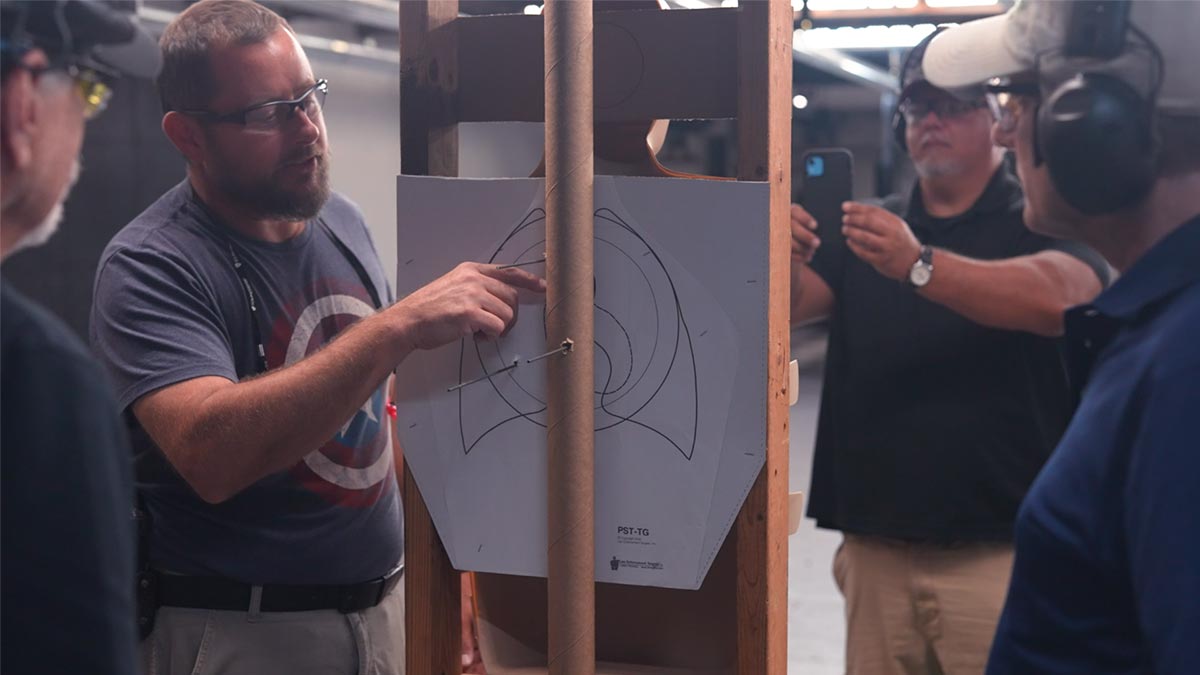
Thinking with a Gun in Your Hand

Q: Why is it important to be able to think with a gun in your hand?

JH: A lot of times when we go to shooting classes, I’m just performing a contrived drill. I know before whatever the start signal is — and it’s almost always an audible start signal when the real world only gives us visual start signals — I know before the drill even starts exactly what I can do. I can prepare in my head exactly what I need to deliver and it’s much easier to access that motor program and just deliver.

In the real world, I don’t know what motor program I’m going to need to deliver until the last possible moment. So, thinking with a gun in your hand is very useful from just the standpoint of, it’s just a useful skill to develop, but it’s also more reflective of the problems we’re going to solve in the real world.

One of my mentors called it ‘problem solving at the speed of fight’. I think that’s a good way to say that. What we’re trying to do is give you a chance to think with a gun in your hand, practice solving problems with the pistol as a tool. We need to think of the pistol as just another tool — a piece of emergency life-saving equipment. And we have to learn how to apply that as reality unfolds around us. We have to adapt to reality as it presents itself, not as some contrived drill tells us to do.

Q: Can you think of any specific examples where somebody had the technical skill to handle the problem in front of them, but wasn’t prepared for the mental load or the decision-making that was required?

JH: I’d say that we see that every day. If you watch badge cam, you’ll occasionally see some stellar rock stars on badge cams. But what we see most of the time is people that are barely surviving the confrontation primarily because they suck less than their opponents.

A really good example — a tragic example — is the murder of Deputy Kyle Dinkheller that took place down in Georgia. If you go back and look at the training on Dinkheller, his co-workers thought he was the best shot in the police department. If they had to pick one person to win a gunfight, they would have picked Kyle. but when you watch that video, you see that he did not handle that fight the way that he would have wanted to — or anybody would have wanted. We want the good guy to have won. So that would be a classic example that everybody is very familiar with of somebody not being able to perform well the moment the flag flies.

[Editor’s note: The Dinkheller murder is commonly presented as an example in officer survival training, but it’s not as well-known among the general public. Dashcam video of the incident is publicly available. The footage itself is not especially graphic visually, but the audio is disturbing. For defense-minded individuals, it is worth watching at least once.]

Technical Skill and Mental Capacity

Q: So having a high level of technical skill isn’t always enough by itself. But at the same time, I know you also advocate for pursuing a high level of skill because it can help with the mental side of things. Can you explain that?

JH: We have very finite mental resources. We’re not nearly as smart, don’t have nearly as much attention as we think we do. And when you get under stress, you’re gonig to have even less of those resources. So the better technical shooter you are, that’s going to free up mental resources to be able to solve the problem at hand.

If you have to think about how to run the gun, you can’t think about where your nearest point of cover is, whether I need to perform a failure drill. So by having very high levels of technical competency, it frees your mind up to solve that problem.

There’s a video that just came out — a body cam video — where an officer is getting in a gunfight and literally every time he tries to get a mag in the gun, it’s backwards and he’s struggling just to get the gun [into the fight]. If you’re struggling to get the gun reloaded, you can’t be thinking about where your next point of cover is, where other officers are moving to. So again, high levels of technical shooting are vital because it frees our mental resources to focus on other aspects of the fight that we need to be more worried about.

Q: Can you talk about the importance of gun-handling skills: the stuff we do with a gun other than actually shoot it?

JH: It comes back to core competence. If I want to know whether somebody is a competent shot, I want to see how they handle the gun. How they load, unload, press-check, perform reloads and stuff like that.

The way you handle the gun is indicative of the amount of training you’ve put in overall and how much the gun is an extension of your self. There’s a great quote from Bill Lewinsky that the expert has automatic use of the tool. How you handle the gun is directly reflective how expert you really really are.

So, maybe you can shoot 100 points on a bullseye at 25 yards. But if it looks like a train wreck getting the gun up, if it takes you forever to do that… Being able to press the trigger straight back is great, but how you handle the gun is more indicative than just about anything else I can look at if I want to size you up as a shooter real quick.

A Frank Denial of Reality

Q: Tom Givens has talked about the phenomenon where victims of violent crime often report afterward that the only thing going through their head at the time of the attack was “why is this happening to me?” What can we do to prepare mentally to avoid that kind of mental block and go right to problem solving mode?

JH: “Why is this happening to me,” is just a frank denial of reality. Criminal violence happens every day. I mean, just look at the murder rate that’s gone up in the last couple of years. Murders spiking off the screen.

It should not be a shock to your conscious that somebody’s trying to rape, cripple, rob you, murder you, something like that. That happens over three million times every year. Just as a matter of odds, it was probably going to be your chance sooner or later.

So, the biggest problem we have is to accept the unfolding reality in front of us. You have to be in the position where you can say, “I knew that some person might try to hurt me, harm me, or something like that. I didn’t know it was going to be today, but I recognized it as a possibility, so I’ve prepared for it. I’ve got a mental parking space in my head for what I have to do. And I have the technical skills to back that up.”
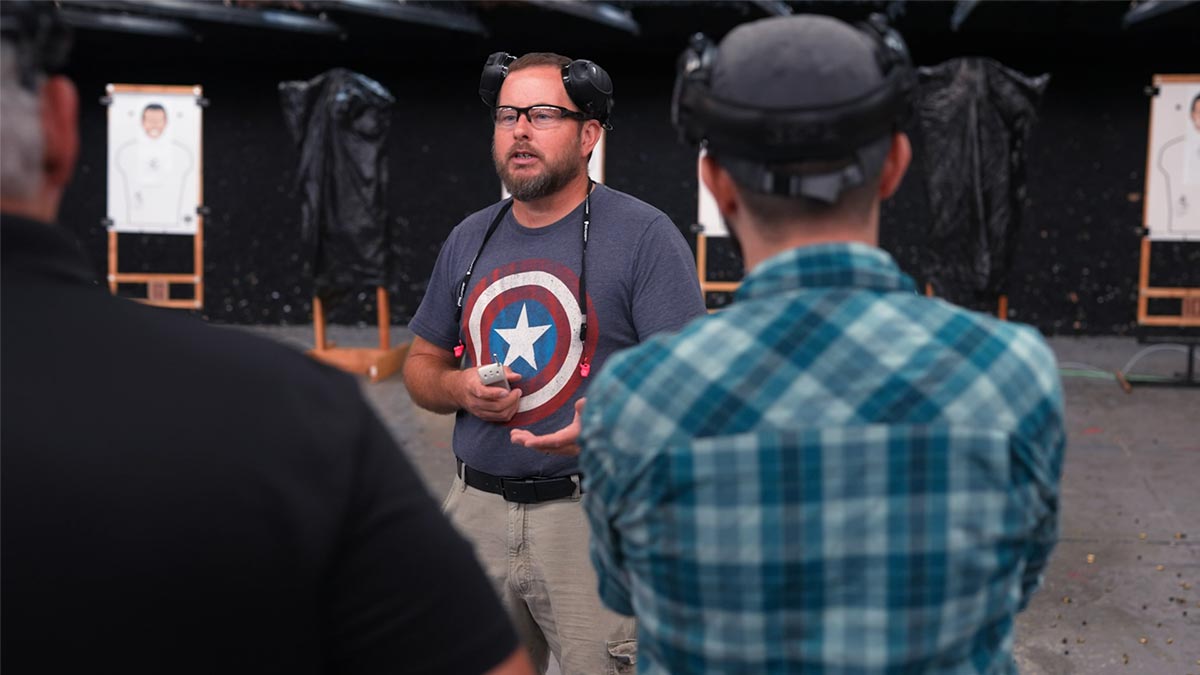
Q: Anybody can take steps to prepare themselves to handle highly stressful events, but is there an element of personality involved as well? Are some people just naturally better at remaining calm under pressure?

JH: There’s definitely some personality aspects to that. We have this thing called the Big Five personalities. We know people that tend to be higher on the neuroticism scale tend to be more likely to freeze under stress.

So there is, in fact, a personality attribute to that. But a lot of these have to do with subjective trainable impressions. A lot of how your situation is is just a result of how bad you think it is. So if we can change your situation — your assessment of how bad something is — we can make the problem easier for you to solve.

If you do have high levels of technical skill and you have a very easy shooting problem, there’s no stress associated with that. You can deliver that all day, every day, twice on Sunday, and it’s not a big deal.

Developing Emotional Control

Q: Are there any hobbies or careers or other pursuits outside of defense-specific training that can help us learn to better adapt to high-pressure situations?

JH: Something we have to understand is what we’re struggling to do first and foremost is develop emotional control. We’re trying to let the sub-conscious trust the rational mind and let it stay in control of the problem.

There’s research that comes to us out of the military, out of the selection for high-end military units. There are certain recreational activities like skydiving, rock climbing, and motorcycle racing. People that excel in those three arenas tend to do very, very well in high-end military units because all those skills basically require that you be able to maintain self-control, you be able to perform fine motor skills while under, literally, life and death stress.

I also think it goes to — that’s your idea of fun. We’re always assessing the problem in terms of “how bad is this?” Well, people that go out and engage in those kind of activities, their “how bad” meter is kind of broken, for lack of a better word. They’re certainly not like normal folks. So when they get into difficult situations, their idea of how bad it is — it doesn’t even blip the radar, so they’re able to perform much better.

Reality-Based Training

Q: Where should a shooter be in terms of skill level before they co consider incorporating things like force-on-force training or increasing their cognitive load – training that goes beyond just putting holes in paper?

JH: I think that, obviously, you have to be able to hit. Because ultimately — this is what’s different from real world problems and a lot of other stuff. The gun is just a tool. And it’s no different than any other tool that I might use in work.

So, let’s just use a tool that we’re all familiar with: the car. At what point do you have to be good enough with a car to be able to take a racing course? Well, you have to be able to get the car into gear, make it go forward and backward and understand steering inputs and stuff like that.

But a lot of times, if you’ll get into something at the advanced level, you’ll learn the skills quicker because you’re being pushed. Obviously, you have to be able to be safe with the gun, be aware of your trigger finger, muzzle discipline.

I would say there’s three gradations of skill when we talk about this stuff. The first skill is you have to have enough trigger control to be able to press the trigger without disturbing the sights. The next level of trigger control for me is being able to change the amount of trigger control you need to solve a problem based on available targets. And finally, you need to be able to track your sights. That would be the ultimate goal.

Realistically, if you can just press the trigger straight back without disturbing the sights, if you can do that consistently, you have enough basic level of skill to start to learn how to do this stuff. I would say that learning to do it in the more proper context where you’re actually going to be doing it is probably more important than being really really great.

You don’t have to be able to shoot a two-second Bill Drill to take advantage of a force-on-force class. The great advantage of force on force class is letting you build the mental maps you need to solve the problems. If you have to have a one-second draw to solve your shooting problem, you’ve probably screwed up a lot of stuff to get in that much of a hole where a one second draw is going to make the difference. If you’re surviving by a tenth or a quarter of a second, you’ve screwed up a lot of stuff way in advance before you get there. The importance of a good force-on-force class is to teach you all that other stuff that you have to have in order to do well.

Variation in Training

JH: A lot people out there in the community are like, “well I’m not going to do this or that because…” their reasons — “it’s not tactical, I’ll get training scars, that’s not realistic,” and stuff like that. The problem is there is no single training thing that we can do that teaches us everything we need to know. So what we need to do is go out and work all these different training modes and take something from each one of them.

A lot of people say “just plinking with a gun doesn’t help.” No, I think it does. First off, shooting well is not a natural act. So even if you’re just popping tin cans with your .22, you’re exposing yourself to gunfire, you’re showing your mind that if I follow the shot process, I get the hits I want. And we can make it match up with their reality. So if I’m a red dot guy with my pistol, my 10/22, my 15-22 probably needs to have a red dot on it so I get that training crossover. If I’m still shooting an iron sighted pistol, maybe I plink with iron sights. But even something as simple as plinking tin cans has training value.

And we can go up from there, whether I’m doing structured practice, structured dry practice, I’m shooting matches, I’m doing man-on-man events, I’m attending professional training, I’m taking cognitive classes, I’m doing video simulators. All that stuff has value and if we put all of those different experiences in different kind of modalities of training together, then we have a very competent shooter. Because none of those things is going to be the solution by itself, but if we put them all together we can build a very strong foundation to let us be able to perform well when the flag flies.


Huge thanks to John for sharing (free of charge!) a couple of the valuable insights he’s learned over his long years of study. If you want to take a class with John, head over to his website to see his training schedule.

Next time, we’re going to look at a couple of drills John showed us that you can try at the range to add some mental complexity to your practice sessions.

Until then, I’ll leave you with one more tip to make your life better. If you’ve just completed a magic trick and you want everyone to applaud, the word you’re looking for is “voila.” Not walla. It’s V-O-I-L-A – with a V as in “Victor.” It’s a French word that basically means “look at this.” It’s not “walla” like the city in Washington.

But you can pronounce it however you want. I won’t judge as long as you get your ammo from us with lightning fast shipping at LuckyGunner.com.

The post Thinking with a Gun in Your Hand: Interview with John Hearne appeared first on Lucky Gunner Lounge.

Special Counsel Indicts Hunter Biden on Gun Charges

0

Shocking news today in the case of the president’s alleged wayward son. Special counsel David Weiss has indicted Hunter Biden on multiple gun charges. The alleged infractions stem from a 2018 gun purchased, a case we’ve closely monitored since the story first began to break nationally in 2021.

Hunter Biden Indicted on Gun Charges

Biden now faces charges for affirmations made on a 2018 Form 4473, a federal form required for all new gun purchases. Biden purchased a Colt Cobra revolver in .38 Spl and allegedly knowingly made false and fictitious statements to secure that purchase. The smoking gun, as it seems, center on Biden’s affirmation he was not an unlawful users of or addicted to any narcotics, drugs or other controlled substance. His public life, however, has chronicled his ongoing struggles with substance abuse and addition–paralleling to the time of purchase. If convicted on federal charges, Biden faces up to 10 years in prison.

Biden Gun Charges

  • Making a false statement in the purchase of a firearm
  • Making a false statement related to information required to be kept by a federal firearms licensed dealer
  • Possession of a firearm by a person who is an unlawful user of or addicted to a controlled substance

PDW previously reported Biden would avoid prison, expected to plead guilty on two misdemeanor tax counts. But somewhere along the way, that deal appears to have eroded. We will continue to update this story as new information becomes available.

On June 21, 2023, Personal Defense World

While President Biden is pushing for strict gun control laws, his son Hunter skates on a federal gun charge. Not to mention the fact that this happened while Biden’s DOJ is actively targeting his political opponent, President Trump. We won’t even go into the multi-million-dollar bribery scheme the Biden family is currently embroiled in. At this point, the Biden administration isn’t even embarrassed at the clearly two-tiered justice system it has established while insisting that “no one is above the law.”

Hunter Biden Gets Slap on the Wrist for Federal Gun Charge

In 2021 we reported (below) that Hunter Biden lied on his 4473 in order to purchase a revolver. Then things got weird when his sister-in-law-turned-girlfriend found the pistol and threw it into the trash. And not just any trash, but a trash can across the street from a high school.

You would think that this would be a big deal to an administration that places such a high value on the lives of children. One that is dead set on cracking down on firearms sales and wants expanded background checks. You would think that, if it were any other than this administration. But it is this administration.

According to Breitbart News, “Biden will plead guilty to willful failure to pay federal income tax — most likely on his foreign earnings — and will enter a “pretrial diversion program” regarding his gun crime, indicating that he will face no jail time.”

The pretrial diversion program is essentially probation. This means, as long as he can keep his nose clean (pun intended) for two years, he’s free and clear. The federal gun charge will be dismissed, and he will not be saddled with the lasting consequences of being a convicted felon.

So, as Biden wages war on law-abiding gun owners, his son gets a pass. I guess it’s true what they say—it’s good to be King. In fact, not only does he get a pass, but Joe and Jill Biden are even trying to garner sympathy through White House spokesman Ian Sams:

The Breitbart News article goes on, “The plea deal will likely involve Hunter Biden admitting to misdemeanor charges that will keep him from jail — and will avoid a trial. President Biden could pardon his son at any point, voiding any criminal consequences.”

That would be bold.

The Firearm Industry Responds

Not surprisingly, the news of this sweetheart deal did not sit well with the firearm industry. An industry that has gone to great lengths to promote firearm safety and protect our Second Amendment rights.

NSSF (National Shooting Sports Foundation) laments the destruction of lives at the hands of gun control for far less.

“Under this administration’s ‘zero tolerance’ policy, licensed firearm retailers have had their lives destroyed for paperwork mistakes far less egregious than buying a gun when you are a crack addict,” said Lawrence G. Keane, NSSF’s Senior Vice President and General Counsel. “They are not serious about reducing gun violence, only scoring cheap political points. It is worth noting this announcement came today, after President Biden’s appearance in Hartford last Friday to call for gun control.”

CCRKBA (Citizens Committee for the Right to Keep and Bear Arms) pointed out the blatant hypocrisy of the sweetheart deal.

“The anti-gun-rights movement, from Joe Biden on down through all of the billionaire-backed gun control groups have just lost whatever credibility they ever had, and ever will have, by not immediately denouncing this deal. These elitist anti-gunners must never again be taken seriously by the public, the media or members of Congress and state legislatures when they advocate for tougher gun laws, while remaining silent about the Biden gun crime loophole,” said CCRKBA Chairman Alan Gottlieb.

The points made by both NSSF and CCRKBA are 100% on the mark. The Biden Administration, mainstream media, and gun control groups showed their true motives, and it’s not about reducing gun violence. It’s about control. It always has been.

You Can’t Make This Sh*^ Up: When Parody Becomes Reality

In each issue of our sister publication Tactical Life Magazine, there is a section titled FAKE-tical News. And it’s exactly what it sounds like. Parody.

However, In the upcoming July/August issue (sent to print before this story developed), the clairvoyant Mark Chesnut kind of predicted this. I don’t think it was meant as a prediction. But we now live in a country where things are so absurd that parody is becoming reality.

Story by Mark Chesnut:

In this issue’s installment of YCMTSU, as President Joe Biden continues to push expanded background checks for firearm purchases, first-son Hunter Biden’s attorneys are arguing that all background checks are unconstitutional.

As most Tactical Life readers know, the younger Biden once lied on a firearm purchase background check. This is a serious felony that could earn him five years in federal prison. However, prosecutors in our two-tiered justice system have for years dragged their feet on pressing charges.

The New York Times recently reported that two people briefed on the matter indicated that, based on last year’s Supreme Court decision in the Bruen case, “Mr. Biden’s lawyers told Justice Department prosecutors—who were investigating whether to charge him in connection with a gun purchase—that a prosecution of him would likely be ruled moot.”

Interestingly, a detailed reading of the new criteria for determining the constitutionality of gun laws set down in the Bruen ruling would make one think that the younger Biden and his attorneys just might be correct.

If you don’t want to miss this or any other possible parody turned reality, you can subscribe and be the first on your block to get it.

On March 26, 2021, Personal Defense World reported:

We stumbled onto a wild story this morning, one getting very little attention in the mainstream media. Hunter Biden, son of President Joe Biden, bought a gun; and it appears he might have lied on his 4473 to do so. Then a weird series of events allegedly ensued, with the revolver ultimately dumped in a trash can near a high school in Delaware.

Hunter Biden Bought a Gun, Potentially Committing a Felony Purchase

Just as President Biden makes his grand push for prohibitive gun control legislation across the land, his often-maligned son makes headlines again. Now we typically don’t care anything about families of presidents and other leaders, but this one is different. It should also come as no surprise that virtually none of the mainstream media websites are giving this story due attention. So hat tip to Politico, where we first saw this report.

The incident transpired in 2018 following Hunter Biden’s “administrative discharge” from the Navy (note: we think you and I get the BCD on that one). The president’s son failed a drug test for cocaine, leading to his discharge. So in 2018, the Hunter was involved in a relationship with Hallie Biden, the widow of his late brother, reported Politico.

The report alleges that Hallie found a revolver in Hunter’s pickup truck. She then allegedly took the .38 revolver, inexplicably, to a grocery store, throwing the gun in a trash can outside. More troubling, the store sits across the street from the local high school. She later informed Hunter of her actions, kicking off a seemingly frantic recovery operation.

Upon return, Hallie found the gun missing from the trash can, reported Politico. She informed the store. Police arrived over legitimate heightened concern. Eventually, Delaware State Police took security footage and even the FBI responded to the scene.

Placing Blame

During questioning, Hunter reportedly told law enforcement suspicious people worked at the store. The reports say he referred to two “Mexican males,” stating “Yeah, prolly illegal,” reported Politico. Hunter later became upset with a police officer over questions about his father. He “became very agitated with me and asked me if I was intentionally trying to make him mad,” the officer said, according to Politico.

From there, the case takes an even more peculiar turn. Two Secret Service agents reportedly went to StarQuest Shooters & Survival, where Hunter purchased the revolver. According to Politico, the agents attempted to seize the Firearms Transaction Record Hunter filled out to purchase the firearm. The store owner reportedly refused, suspecting the Secret Service agents planned to suppress Hunter’s gun ownership. The store turned over records to the ATF, which responded that same day.

Hunter Biden and a Potentially Felonious Gun Purchase

But here’s the big kicker. Politico obtained copies of the 4473, dated Oct. 12, 2018. He responded “No” on the line asking “Are you an unlawful user of, or addicted to, marijuana or any depressant, stimulant, narcotic drug, or any other controlled substance?”

Wait, he marked “No”? Let it sink in. Hunter Biden marked “No.” Remember, Biden failed a drug test five years earlier, testing positive for cocaine. His troubles with addiction are well documented. We take no pleasure in reporting that fact. Opioid addiction remains a scourge on America. But that well-documented addition makes it impossible not to suspect Hunter Biden lied on his 4473.

Lying on this federal form comprises a felony. So while Joe Biden launches arguably the most targeted attack on the Second Amendment ever, his son potentially committed a felony to unlawfully take possession of a firearm.

The Attack on 2A

Joe Biden shouldn’t decide what guns we can carry. Neither should any other anti-gun politician. Moreover, Hunter’s gun fiasco perfectly illustrates why the left shouldn’t get to decide. This new report makes it seems as if they operate with impunity, above the very laws they force upon lawful gun owners. They would have us restricted, unarmed, defenseless. Meanwhile, they enjoy armed protection, gated estates and fully immunity to break our gun laws.

Mr. President, get your own house in order before you try to take sovereign rights away from ours. You can start by looking at your own son for possibly lying during a NICS background check … you know, the very law you want expanded to every transfer across the country.

Worst case, Hunter Biden lied to purchase a gun. Meanwhile, his partner — in a remarkable display of unsafe gun handling — threw said gun in a public trash can … across from a high school. Hunter then allegedly blamed it all on “prolly illegal” Mexicans. Then the Secret Service reportedly attempted to cover it all up. Maybe Joe Biden shouldn’t worry about the country owning guns. Maybe he should just worry about Bidens.

Didn’t find what you were looking for?

357 vs 9mm: Two of the Most Popular Handgun Cartridges

0

We may earn revenue from the products available on this page and participate in affiliate programs. Learn more ›

When it comes to the .357 vs 9mm, the comparison is a bit like apples and oranges. The two cartridges are vastly different and typically fired from different types of handguns. With a few exceptions, the .357 Magnum is a revolver cartridge and most often the 9mm Luger is fired from a pistol. Their similarity is that they use bullets of nearly an identical diameter. So why bother with comparison at all? Well, you might be trying to decide if you want a revolver or a pistol, and .357 Magnum and the 9mm Luger are, arguably and respectively, the best option for each handgun type.

Some History

The 9mm Luger, also known as the 9×19 and 9mm Parabellum, was developed right at the beginning of the 20th century by Austrian firearms designer Georg Luger. It was used by the German military in both world wars and has since become the most popular pistol cartridge for military, law enforcement, and civilian use all over the world. The .357 Magnum was introduced in the mid-1930s and is essentially a lengthened and more powerful version of the 38 Special. Housed in Colt and Smith & Wesson revolvers, it became the most trusted handgun cartridge used by law enforcement. However, in the late 1960s, police agencies began to transition to the 9mm pistol because it was easier to shoot and offered a higher capacity.

Technically Speaking

Handgun Ammo photo

For two cartridges that fire bullets of an almost identical diameter, the .357 Magnum (0.357-inch) and the 9mm Luger (0.355-inch) could not be more different. The .357 Magnum cartridge case is rimmed to work in revolvers and the 9mm Luger case is rimless to better suit operation and cycling in semi-automatic pistols. The .357 Magnum is the more powerful of the two, but with standard loads, the .357 Magnum and the 9mm Luger operate at the same maximum average chamber pressure (9mm +P ammunition is actually loaded to a higher pressure than the .357 Mangum). Loaded 357 Magnum cartridges are also about 36 percent longer than loaded 9mm Luger cartridges.

Ballistic Comparison

Handgun Ammo photo

Since both cartridges use bullets of nearly an identical diameter, and since they’re both loaded to similar pressures, you’d expect their external ballistics to be similar, too, but they aren’t. Because the .357 Magnum cartridge case can hold a lot more gunpowder, it’s capable of delivering substantially better external ballistics. Generally, the .357 Magnum will push bullets of the same weight about 30 percent faster than the 9mm Luger. This also translates to more energy; .357 Magnum loads can hit as much as 70 percent harder.

Recoil

Photo of a .357 Magnum revolver
There are compact and lightweight revolvers in 357 Magnum, but they’re a handful even with +P 38 Special ammunition. Sabastian “Bat” Mann

As it is with all centerfire handgun cartridges, higher velocities translate to more recoil. It’s impossible to circumvent Newton’s third law. However, given the types of handguns available in .357 Magnum and 9mm Luger, recoil numbers can be misleading. In the supplied chart, 357 Magnum recoil was calculated with a 42-ounce Colt Python, and the 9mm Luger with a 40-ounce Colt 1911. Given handguns of similar weight, the 357 Magnum recoils with about twice as much force. However, most modern polymer framed 9mm Luger handguns weigh a lot less than 40 ounces. If you run the numbers with a 17-ounce Glock 43X in 9mm, the difference in recoil is not as drastic.

357 vs 9mm Versatility

Photo of semi-automatic carbine chambered for 9mm Luger.
Some semi-automatic carbines are chambered for the 9mm Luger. Sabastian “Bat” Mann

The .357 Magnum has a considerable edge when it comes to versatility. This is partly because .357 Magnum revolvers can chamber and fire .38 Special ammunition. And, depending on the load, .38 Special ammunition can be less powerful or deliver very similar ballistics to the 9mm Luger. This, combined with the wide power range a .357 Magnum revolver can deliver makes it suitable for casual plinking, competition, self-defense, and even big game hunting. There are more factory loads available for the 9mm Luger, but if you add in the factory .38 Special loads, ammunition options equal out.

Some shooters also like to have a handgun and rifle that can share ammunition, and with the .357 Magnum, there’s a variety of lever-action rifles to choose from. Ruger even offers a bolt-action .357 Magnum rifle. There are some semi-automatic carbines available for the 9mm Luger, and in some cases, they can even share magazines with certain 9mm pistols. There are also 9mm revolvers, .357 Magnum pistols, and some .357 Magnum revolvers like the Ruger Blackhawk Convertible come with a separate cylinder for 9mm Luger.

357 vs 9mm Application

Photo of a 9mm Luger pistol in a concealed carry holster
The true forte of the 9mm pistol is personal protection and concealed carry. Sabastian “Bat” Mann

In addition to trying to first decide whether you want a revolver or a pistol, the best way to make the decision between these two handgun cartridges is to consider application. What is it you want to do with a revolver or pistol chambered for either of these cartridges?

  • Recreational Shooting: If you want to have fun on the range punching holes in paper, ringing steel, and ventilating pop cans, handguns chambered for both cartridges can deliver plenty of enjoyment at a moderate cost. With the exception of a revolver that can fire .357 Magnum, .38 Special, and 9mm Luger ammunition, we’ll call it a tie.
  • Competition: Handgun competitions vary. There are fast-action competitions where capacity and ease of shooting gives the 9mm pistol the advantage, and in some of these competitions special categories are set aside for revolvers. Other competitions focus more on precision and distance where the flat trajectory and the high energy needed to topple steel targets is better suited to a .357 Magnum revolver. Tie again.
  • Self-Defense: For personal protection, a compact and easily concealed handgun is what’s most often needed. The .357 Mangum does have an advantage in terminal performance, but most .357 Magnum revolvers are large and heavy. Those that are small and light are unpleasant to shoot unless loaded with .38 Special ammunition. Unless you’re looking for protection from bad beasts like big bears, a compact, high-capacity, 9mm pistol is generally a better choice.
  • Hunting: There are a few 9mm Luger loads suitable for feral hogs and deer-sized game. But with the .357 Magnum, there are a lot more ammunition options that deliver a lot more power and much flatter trajectories. For the dedicated big game hunter, the .357 Magnum cartridge is definitely the clear cut winner.

Given the differences in these two cartridges, maybe the best approach to the 357 vs 9mm debate is to own both a .357 Magnum revolver and a 9mm pistol. If you throw in a .22 Long Rifle pistol or revolver, it’s hard to imagine you’d ever need any other type of handgun.

The Elite Survival Systems Blindside Concealed Carry Slingpack

0

Summer is on its way, and that means lightweight clothing, like running shorts, that are not advantageous to concealed carry. For this reason, many opt for off-body carry options. And companies like Elite Survival Systems provide excellent options like the Blindside concealed carry slingpack. The lightweight option offers an ambidextrous CCW compartment and adjustable internal holster that fits up to full-size pistols.

The Elite Survival Systems Blindside Concealed Carry Slingpack

Featuring a 900D poly fabric construction, the Blindside is lightweight and durable. Available in black or dark heather green, the Blindside emulates the look and feel of an average, ordinary slingpack. As a result, you can maintain a grey man appearance and blend in without telegraphing that you are carrying.

The single strap design includes a wide padded strap and a vented foam back panel offering comfortable all-day carry. Additionally, the ambidextrous strap can be configured for right- or left-side carry, while the pass-through holster compartment allows right- or left-hand access. Correspondingly, the sling design allows the pack to be swung around the body for quick access to your pistol.

The roomy main compartment includes a divider and pouches for organization, while a lined eyewear pocket keeps your glasses safe. Dual vertical zippered pockets on the front provide instant access to the pack’s contents. In addition, a hanger and tube routing goes to the optional hydration reservoir.

Editor’s Note:

Although there is debate as to the legitimacy of off-body carry, there are times when it can be necessary. Specifically in the summer when lightweight clothing options may not allow standard on-body carry.

However, if you are going to carry off body you need to be especially vigilant. It doesn’t take long for a thief to snatch your pack and be gone. Likewise, never set your pack down and leave it unattended. The last thing you need is a criminal running around with your pistol.

Availability

The Elite Survival Systems Blindside concealed carry slingpack is available now, with an MSRP of $99.95. For more info, please visit EliteSurvival.com.

Elite Survival Systems Blindside Concealed Carry Slingpack Features

  • Dedicated handgun compartment can be accessed from either side of pack
  • Adjustable, internal holster fits up to full size pistols
  • Durable, lightweight 900D poly fabric construction
  • Adjustable, ambidextrous, single-strap design
  • Roomy main compartment with divider and pouches for organization
  • Hanger and tube routing for optional hydration reservoir
  • Dual vertical zippered pockets on front
  • Eyewear pocket with soft lining
  • Vented foam back panel
  • Easy-carry handle
  • Discreet logo
  • Dimensions: 14” x 8.5” x 6”
  • Colors: Black or Dark Heather
  • MSRP – $99.95

Didn’t find what you were looking for?

An Alternate Approach to Pistol Sights

0

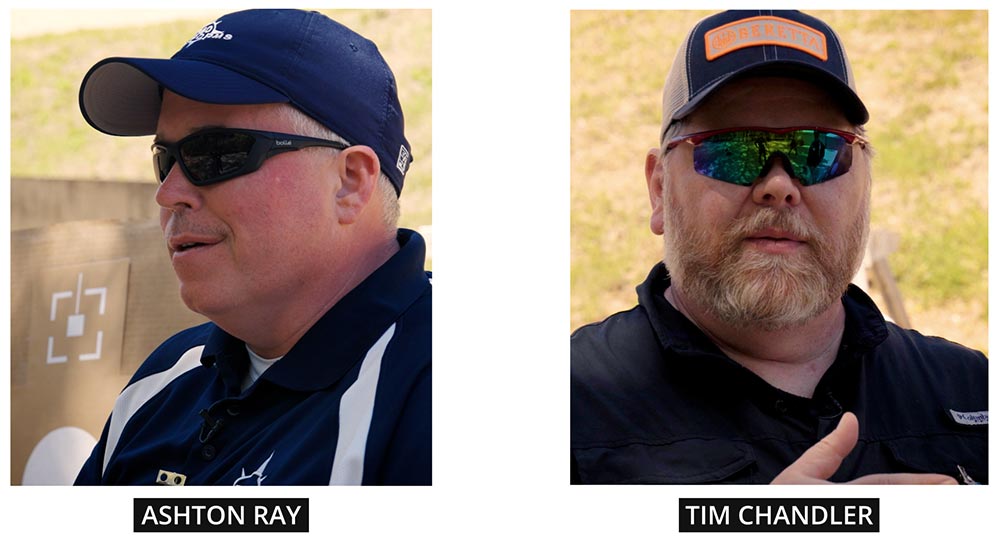
A few months ago, I had a conversation with Tim Chandler about some new ideas he and Ashton Ray were trying out in their pistol classes. Some of it sounded like new and better ways to explain old concepts. And some of it sounded just plain new, at least to me. I was intrigued and that conversation eventually led to the video below where Ashton and Tim explain their approach to teaching pistol sights.

Details are in the video, or scroll down to read the transcript.


Hey everybody, I am Chris Baker from LuckyGunner.com. Sometimes you think you understand a concept really well. You’ve heard it explained a thousand times in a hundred different ways. You’ve even successfully taught other people about that concept. But then somebody comes along and offers a slightly different perspective, and it’s like you’re looking at that topic for the very first time.

My friends Ashton Ray and Tim Chandler from 360 Performance Shooting recently had an experience like this. They were training with another instructor and one little side comment he made about how he uses pistol sights just kind of blew their minds. That’s led to some major changes in how they teach the principles of aiming and sight alignment.

I think their approach should be thought-provoking for shooters at any skill level. They’ve got a couple of twists on some familiar ideas that bring clarity where there is often ambiguity. I caught up with Ashton and Tim at the Rangemaster TacCon last month, so I’m going to let them do most of the talking today. This is a super-distilled version of what they’ve been teaching in their pistol classes.

Revisiting Old Cliches

TIM CHANDLER: So we’ve encountered a number of things over the years where people were saying the right things but we didn’t fully understand what they meant.

One of the big ones is, “see what you need to see,” in reference to iron sights. There are a lot of people who struggle with iron sights because they’re told these euphemisms and these vague statements – “See what you need to see,” “equal height, [equal light].” But it isn’t super helpful. It doesn’t really help them have confidence in learning how to use them.

The way it’s taught is that the sights are the primary driver of accuracy on the pistol, but that’s not actually true. Once you get some time on your belt, once you get some experience, you kind of learn it works differently, don’t you?

Sights are the Windshield

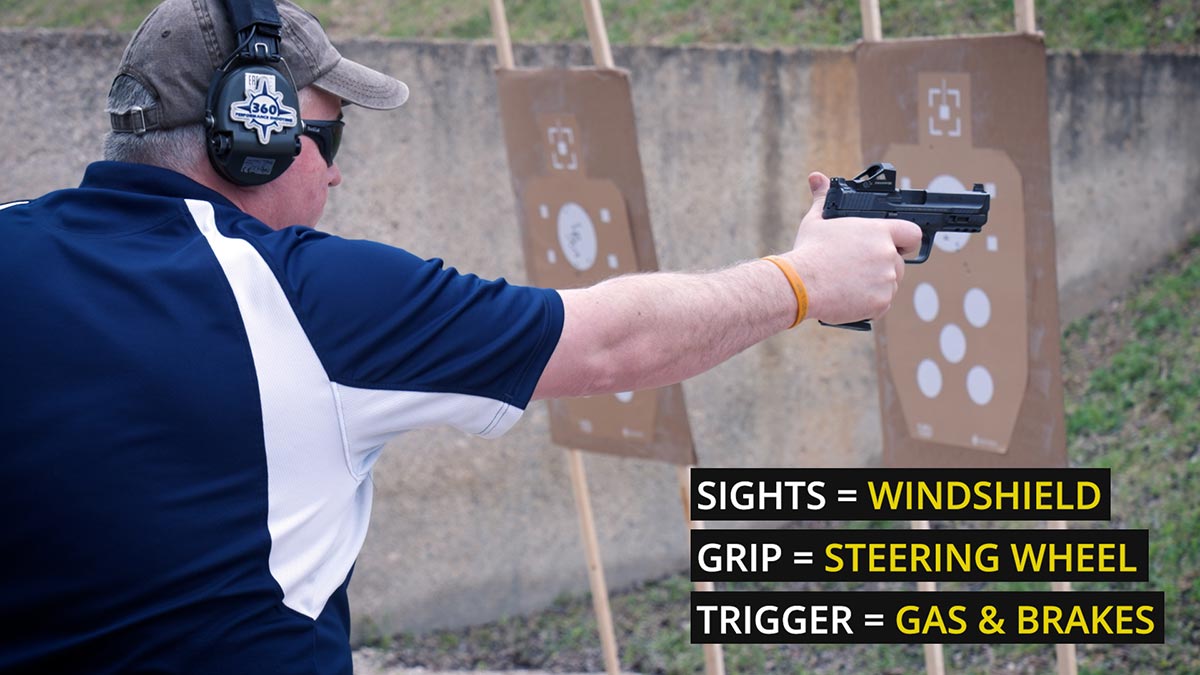
ASHTON RAY: Right. The analogy that we like to use is, we talk about driving a car. When you’re driving a car, the sights are your windshield, right? They tell you what exactly it is that’s going on. You look through them? You have the world around you and how you’re trying to interact with it and you look through that windshield and evaluate how well you’re doing with the operation of that vehicle.

If the sights are your windshield, your steering wheel is how you’re mounting the gun with your hands. Now, if you’re driving the car and the car is not going where you want it to go, very few people are going to tell you to “look through the windshield harder.” Because if your sights are telling you that you’re not keeping your car between the lines, you need to fix some things underneath that windshield. You need to fix some things about how you’re interacting physically with that gun.

So if you can go with me with this analogy: the sights are your windshield. You have the steering wheel, that’s how you grip the gun, how you mount the gun. And then the trigger is going to be your accelerator and your brakes.

Unpacking “See What You Need to See”

TIM: “See what you need to see.” right? Anybody who has done any level of firearms training, you’ve heard somebody talk about “see what you need to see” with iron sights.

But, you know, I spent God knows how many years – every time I heard that, I wanted to throw something hard at the ground because I don’t know what that means. Because all of our vision is different. And the fact that there’s somebody out there who has lots and lots of experience and they’ve sort of developed this “snatch the pebble from my hand” understanding of “see what you need to see” isn’t terribly helpful for your typical person.

So where we come in is taking somebody who’s basically safe and try to help them become proficient. Mastery is an endless quest but we can help you find proficiency. One of the greatest revelations we’ve had is changing how we use sights.

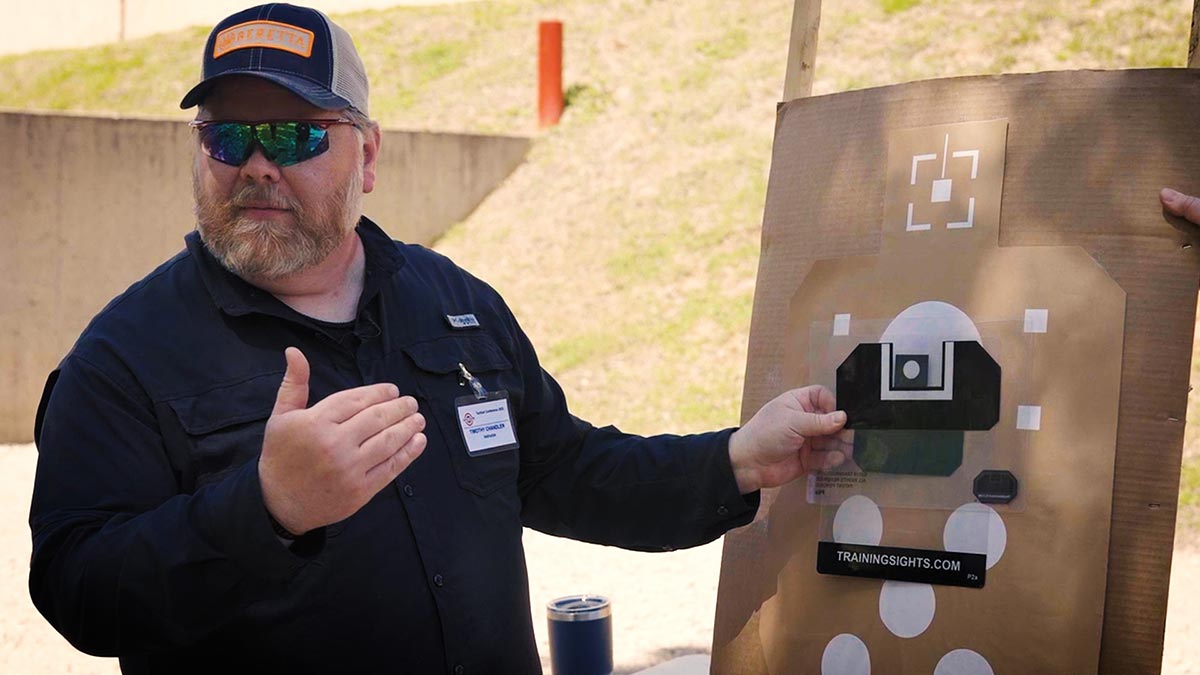
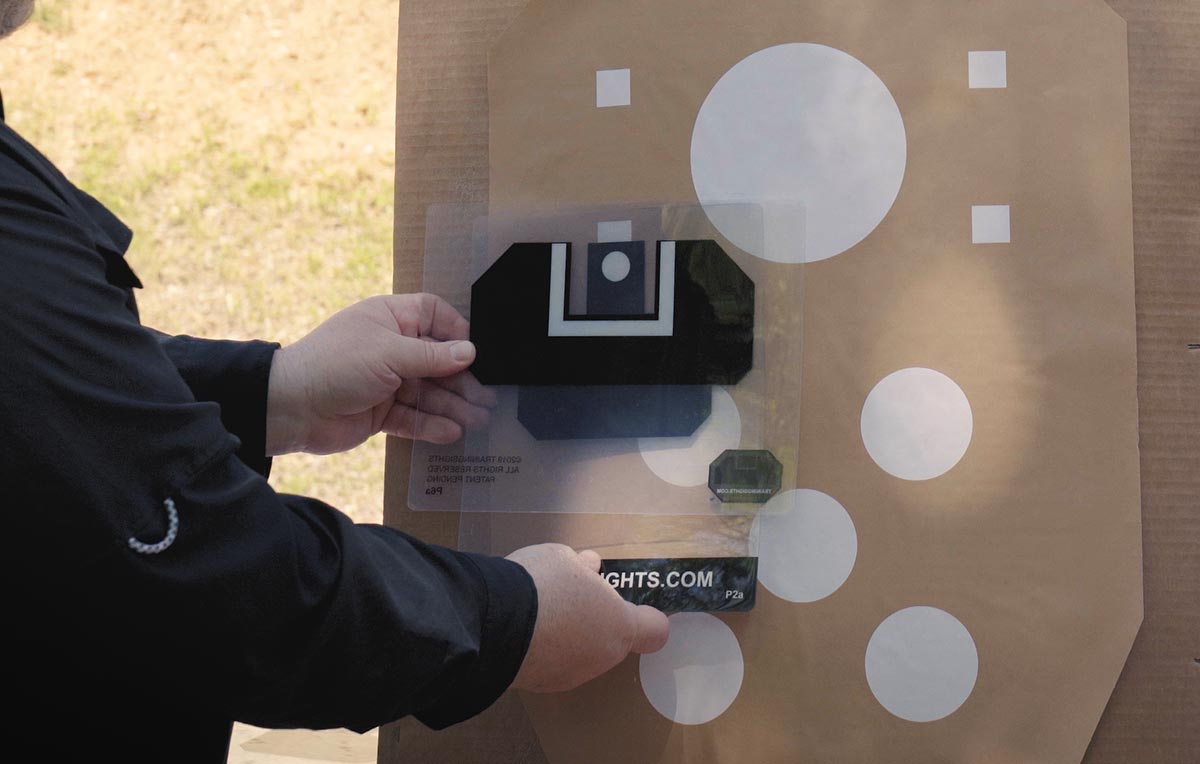
I have a little visual aid — this is a representation of iron sights. And what you’ve been told all your life, if you’ve done formal firearms training, police academy or something, you need to have “equal height, equal light.” Front sight centered. Or you’ve been told you don’t need that, you need to “see what you need to see.” Well, let’s talk about what that means.

Over here, we have a target with a number of different size hit zones. I have this radical theory – and we’ve kind of worked on this after doing a bit of training with Tim Herron. He uses sights completely differently because he didn’t come up through the institutions, he taught himself. And he thought, “why not use the rear sight as your primary cue?” And that, of course, is immediately going to make a lot of you all very, very uncomfortable because you’ve been told, “Focus on the front sight! Focus on the front sight!”

Think about this: I want to see what I want to hit through the rear sight, right? This part here, this void, that’s called the notch. It can also be called a window. What do we do with windows? We look through them! I want to see what I want to hit through my rear sight window. Now this is important – if what I want to hit is bigger than my rear sight window, and my front sight is in that window (albeit imperfectly), I’m still going to hit what I need to hit. That’s all I “need to see.” Because if it ends up anywhere in here, that’s going to end up being a hit inside this target.

ASHTON: Well what about distance? What if the distance is such that that’s not going to work out? Well, it’s really interesting, because what we’re working on is a relative relationship between size and distance. So if the target area is larger than the aperture of the rear sight, that window in the rear sight, this works. If it’s the next smaller size, that’s just about the same size. Guess what? That still works.

If you go to the smallest size, now we need to start using a little bit more refinement and a little more traditional view of those sight picture techniques that we’ve all been taught and talked about. That’s where it becomes a little more important. But whenever it comes to these larger, more forgiving relative target sizes, if it’s bigger than the rear window and the sight is visible, send it.

Sight Picture vs. Sight Movie

ASHTON: Now there’s another aspect of the “see what you need to see” part. Your sighting system is never going to be static. It’s always going to be moving, it’s alive. Gabe White calls it a sight movie, and I agree with him wholeheartedly. If your sighting system — whether it’s a dot or irons makes no dang difference — is moving around within the target area, and is not exiting the target area, press the trigger. Send it.

If it’s moving around without the target area, that means you need to fix it. That means you’re doing something that you need to correct in the steerage section. That means the way you’re mounted, the way you’re standing, all the stuff that goes into the grip and mount of the gun needs to be refined such that it stops. You arrest that movement, you keep it inside your prescribed aiming area, then you can send it.

How is This Relevant?

TIM: Here’s where the benefit is for your typical defensive shooter. If your typical defensive shooter just takes the rear sight and you drive the top of the rear sight to about armpit level, what’s inside your rear sight window now? We call that…

ASHTON: The soup kitchen.

TIM: Because that’s where all the good stuff is, right? And if our front sight is somewhere inside that window, what are we going to be hitting? We’re going to be hitting the areas of a threat that are most important to stopping them from doing whatever awful thing it is that’s causing us to have to shoot in the first place. We don’t need to spend a bunch of time staring at the sights, hoping that the answer to life’s problems appear.

What we’re really trying to do is just get enough on our sights. That’s where, “See what you need to see.” comes in. That’s really what it means. All I need is a reference that’s good enough to call whether or not I can send it, or I need to fix it.

And the smaller the target is, or appears in this relative reference of the sight window, the more of a focus I need on my front sight. I don’t need a hard front sight focus to do that at five yards.

ASHTON: Not at all.

TIM: Really, if you just grip the gun properly and get the gun in front of your face, and you get something like that, guess what? You’re gonna hit what you need to hit.

ASHTON: And, critically speaking, most of the shooting errors we see have little to do with sighting and much more to do with changing the grip before/during the trigger press. That’s what moves the sights off the target, that’s where your “low-left” comes from. That’s where the mistakes are usually made. It’s not made with the visual reference of looking through the windshield, it’s made with the physical interaction — that man/machine interface between the grip of the gun and the hands.

TIM: But the sights, because we’re visually oriented creatures, the sights are the only part of shooting that we can see. And so that’s where our brain and our focus wants to be. We want to focus on the part we can see. But — and I’m gonna say something that will sound slightly controversial but stick with me — the sights are the least important part of firing an accurate shot. I didn’t say they’re unimportant, I said they’re the least important. Just like your windshield is not what drives your car, these are a passive reflection of what you’re doing with the real controls. The real controls being your steering wheel and your pedals.

ASHTON: So when you’re working with your gun, when you’re dry firing or live firing, one of the most important things you can do is gather the information that your sighting system is giving you.

We’re talking about iron sights today but dots are absolutely the same. Dots, they scream at you. They’re a big neon billboard and they are shouting at you. Your iron sights are talking too, but they whisper. And you really have to pay attention.

But if you watch what those sights are doing while you are setting up and then executing through your trigger press and making that shot, they will tell you how successful you’re being in dry fire. And that translates directly to live fire. The problem is, most people are only looking for holes in the target. They’re not paying attention and taking this information back on how well they’re doing with mounting the gun, maintaining their grip and breaking that shot effectively.


A huge thanks to Ashton and Tim for sharing that with us. If you want to train with them in person you can find their upcoming classes at 360 Performance Shooting. And of course, the next time you need ammo be sure to get it from us with lightning fast shipping at LuckyGunner.com.


The post An Alternate Approach to Pistol Sights appeared first on Lucky Gunner Lounge.

Hollywood to Sell Gun Control Agenda with Brady United

0

The glamour and influence of Hollywood just ain’t what it used to be. That explains why Brady United for Gun Control’s recent announcement that they’re bringing on Hollywood executives and producers to help sell gun control makes perfect sense.

Hollywood Brought in to Sell Gun Control

Americans don’t want to be lectured to by out-of-touch actors who make millions and live in safe, gated communities and are protected by armed bodyguards. They don’t care what they think. They’re tired of paying good money to have “woke” movie directors bludgeon them with progressive politics in a movie theater.

The gun control industry, in the same light, continues to push an agenda that Americans aren’t buying. Recent history and polling has shown law-abiding Americans are fed up with the defund-the-police and soft-on-crime policies imposed on them in America’s biggest cities, including Los Angeles and Hollywood. 

They’re no longer remaining victims to politicians taking away their rights and letting criminals run the show. Instead, they’re taking personal safety into their own hands by embracing their Second Amendment rights.

With their announcement, Brady is joining other national gun control groups in trying to sell Americans on giving up more of their rights. That agenda is not an award-winning one.

In The Tank

The abysmal viewership numbers of the various yearly Hollywood awards shows are in the dumps. Recently, the Academy Awards, or Oscars, had just 10.1 million viewers. That’s a plunge of more than 55 percent from the year prior.

Anyone recall the 2020 Ricky Gervais monologue? (Disclosure: not safe for workplace viewing.) “So, if you do win an award tonight, don’t use it as a political platform to make a political speech. You’re in no position to lecture the public about anything,” Gervaise chastised the live audience of actors and entertainment industry suits.

The feeling is similar among Americans who see gun control groups lecture them about community safety, endorse and support prosecutors and elected officials who go soft on criminals, and then work to deny law-abiding Americans from taking lawful steps to protect themselves and their families. No amount of Hollywood dress-up will help.

Brady announced the addition of three big Hollywood names to help them sell more gun control. In a release, the gun control group touted the hires. It states they will “bolster efforts and cultivate new relationships in the entertainment industry.”

The goal is to “ignite a movement among culture leaders and creators to spark positive norm and behavior change and reshape America’s relationship with guns.”

America’s relationship with guns certainly has changed dramatically over the past three years, too. So much so that Americans have lawfully purchased more than 1 million firearms every month for 50 straight months.

This historic stretch includes large percentages of women gun buyers, minority gun buyers, and first-time gun buyers. This makes the gun-owning community the most diverse ever.

Deep Gun Control Ties

Joining the Brady gun control outfit are Christy Callahan, a former motion picture creative executive and TV writer; Jared Milrad, an “award-winning filmmaker, actor, entrepreneur and advocate for inclusion and social impact in entertainment”; and Matt Littman, who is leaving his position at the gun control group 97 percent.

Previously, he served as then-Sen. Joe Biden’s chief speechwriter and is currently a senior advisor to President Biden’s reelection campaign. President Biden, of course, continues to repeat lies about the firearm industry in his speeches and public appearances calling for more gun control.

Callahan helped spearhead an “open letter” that was signed by more than 200 Hollywood writers, producers and actors. The letter demonstrated how one-sided the effort is.

“Guns are prominently featured in TV and movies in every corner of the globe, but only America has a gun violence epidemic. The responsibility lies with lax gun laws supported by those politicians more afraid of losing power than saving lives,” the letter reads.

Among other goals, the letter states the signatories support “Limiting scenes that include children and guns, bearing in mind that guns are now the leading cause of death for children and adolescents.” 

The false statistic is repeated often by gun control groups, as well as President Biden. They knowingly ignore that most of the deaths included involve criminal firearm violence committed by persons aged 18 and 19. As such, they are legal adults.

I wonder how many acting gigs these signatories turned down because they depicted and glorified the misuse of gun violence. Let’s see them put their money where their mouth is.

Leading Real Change

The firearm industry supports safe and responsible gun ownership and has a proven track record of making a positive impact. NSSF’s Real Solutions. Safer Communities.® campaign has helped reduce unintentional firearm deaths to record low numbers since data was first tracked in 1903.

That includes supporting safe and secure firearm storage in the home and not in use. Through that effort, Project ChildSafe® has distributed more than 40 million free firearm safety kits. This includes locking devices, through partnerships with over 15,000 law enforcement agencies in all 50 states and five U.S. territories.

This campaign has been recognized by the National Safety Council’s Green Cross Awards and the Government Accountability Office for its efficacy in reducing the criminal and negligent misuse of firearms through voluntary safe storage.

Additionally, NSSF’s Operation Secure Store® and Don’t Lie for the Other Guy™ campaigns work with firearm retailers to provide educational resources and services to better secure their inventory and reduce robberies and burglaries and remind the public it is a serious crime to lie on the federal background check form to buy a firearm for someone else who cannot do so on their own. ATF data from this year confirms once again these programs help make communities safer.

Hollywood elites continue to ignore the real crime problems plaguing America’s cities. Gun control groups are no better and continue to advocate for policies that limit rights, leaving law-abiding Americans less safe. Hollywood and gun control working together won’t change anything.

Instead, the firearm industry will continue doing the hard work on safety initiatives that actually do make communities safer. All while protecting rights – not eliminating them.

Story originally posted to NSSF.org.

Didn’t find what you were looking for?

Cougar Killed in Colorado After Stalking Woman to Her Front Porch

0

Colorado wildlife officials shot and killed a mountain lion on November 21 after the animal tracked a woman to her front porch in the town of Montrose. According to the The Daily Sentinel, the wild cat wasn’t deterred by the homeowner’s large dogs, and it returned to the property even after local law enforcement agents shot it with a bean bag-loaded 12 gauge shotgun.

“The mountain lion had no fear of the three large dogs,” Montrose County Sheriff Gene Lillard told the outlet. “They also advised the mountain lion hissed … and was somewhat aggressive.”

There were five dogs on location during the cougar’s appearance, the The Daily Sentinel reports. Three of the dogs were great pyrenees, a sizable breed known for being vigilant guard dogs. 

A Montrose County Sheriff Sergeant hit the cougar two times with bean bags, but it was undeterred. It eventually left the area but returned the next night. That’s when a deputy shot the cougar with a firearm as it walked up the driveway. The animal reportedly ran into bushes where it died after a second shot.

“It’s a sad deal, but it was very unusual [to see] a lion acting that way,” Lillard said. “I hate to see something like that happen, but when an animal is acting aggressive like that, it’s the best you can do—especially since she [the property owner] had five dogs and the lion was not scared.”

 A CPW assessment of the dead cat determined that its carcass was in “good condition.” A final decision on whether or not to do a necropsy is still pending. 

Read Next: Black Bear Euthanized After It Cornered Colorado Homeowners in Their Kitchen

If you’re exploring online gaming options, it’s essential to consider betting sites not on gamstop for more variety and freedom.

“It’s another reminder that pretty much all of Colorado is good mountain lion habitat,” said John Livingston, a CPW spokesperson. “It’s important for people to remember that lions can always be around, especially when there are deer.”

Colorado’s mountain lion hunting season is currently underway, but activists have proposed a ballot initiative that could usher in a statewide hunting ban for mountain lions, bobcats, and lynxs. Pro-hunting groups have challenged the proposed ballot initiative in the Colorado Supreme Court.