Home Blog Page 19

Federal Judge Rules that ATF Pistol Stabilizing Brace Rule is Illegal

0

Follow the bouncing ball. The ATF pistol stabilizing brace rule, which banned ownership of the device, has been the hot potato of gun control. However, the hot potato may finally be cooling as a Federal Judge has determined the rule to be illegal. With previous injunctions only extending to the plaintiffs and their constituents, this recent ruling covers the entire nation.

A Federal Judge Determines that the ATF Pistol Stabilizing Brace Rule is Illegal

Although a resolution to block the rule has failed the Senate, the courts continue to pass injunctions against it. However, up to this point, the injunctions have only covered plaintiffs like FPC (Firearms Policy Coalition) and GOA (Gun Owners of America) (including their constituents). But the new ruling from Federal U.S. District Court Judge Matthew Kacsmaryk applies to the entire rule—nationwide.

According to The Reload, “Unlike previous rulings against the ATF, Kacsmaryk’s order applies to the entire rule. That means it could affect tons of gun owners nationwide, with the number of affected braced guns estimated to be in the millions or even tens of millions.”

Noting that the ATF exceeded its power when crafting the rule, Kacsmaryk’s ruling stays enforcement of the law, applying to everyone across the country.

The story continues, “That’s a significant departure from Judge O’Connor’s ruling, where he rejected a request to extend his preliminary injunction to all braced gun owners.”

In Britto v. ATF, Judge Kacsmaryk writes, “As explained in Garland, ‘[t]he controlling law of this case is that the Government Defendants’ promulgation of the Final Rule ‘fails the logical-outgrowth test and violates the APA’ and ‘therefore must be set aside as unlawful’ under the APA,’”

He went on to state, “[T]he Court is certainly sympathetic to ATF’s concerns over public safety in the wake of tragic mass shootings. The Rule ’embodies salutary policy goals meant to protect vulnerable people in our society. But public safety concerns must be addressed in ways that are lawful. This Rule is not.”

In addition, Kacsmaryk states that the law also puts businesses at risk. He states in Britto v. ATF that ATF admits the 10-year cost of the rule is over one billion dollars. Not to mention, the rule would cause certain manufacturers to close their doors for good.

What Does This Mean for Pistol Brace Owners?

Judge Kacsmaryk’s ruling places a preliminary injunction against the rule, staying the rule in its entirety. As such, the ATF is blocked from enforcing its ban on AR-15-style pistols equipped with the brace. So, as of now, you are free to own and use a pistol-stabilizing brace without risk of running afoul of the law.

Although the ATF may try to convince the 5th Circuit Court of Appeals to lift the injunction, it is not likely to happen. Judge Kacsmaryk made it clear that the case is likely to prevail on its merits. Not to mention, the 5th Circuit Court of Appeals has already determined that the rule violates the APA (below). Thus, sending it to the District Court, which has resulted in this ruling from Judge Kacsmaryk.

However, this does not mean that it is over. Because the ATF is facing challenges in several states and courts, it is likely to go to the Supreme Court. However, the SCOTUS is currently considering a similar ban on bump stocks, which could have an impact on this case.

According to the Washington Examiner, “Many experts expect that case to influence the pistol brace challenges. ‘What the Supreme Court does in the bump stock ban case will likely have big implications for the pistol brace ban because they are very similar rules carried out in very similar ways,’ said Stephen Gutowski, founder of The Reload, an authoritative Second Amendment news site.”

But for now, you can go back to using your pistol brace while things get settled once and for all. We will stay on top of it and keep you informed of any new developments.

On August 4, 2023, Tactical Life reported:

We recently reported that a resolution blocking the ATF pistol stabilizing brace rule suffered a loss in the Senate (below). However, lawsuits opposing the arbitrary rule just got a shot in the arm from the 5th Circuit Court of Appeals. In a 2-1 vote, the three-judge panel finds that the rule violates the Administrative Procedures Act (APA).

ATF Pistol Stabilizing Brace Rule Violates the (APA)

On Tuesday (August 1st, 2023), the 5th Circuit handed down a decision reversing a district court order that rejected a preliminary injunction against the stabilizing brace rule. Additionally, the panel remanded the case to the district court to reconsider its decision.

However, its ruling was not based on the constitutionality of the rule but on a procedural basis. Specifically, according to the court, the rule violates the Administrative Procedure Act (APA).

According to Breitbart News, “The Firth Circuit panel ruled two to one to reverse the district court order, remanding the case to the district court for reconsideration. In so doing, it noted that the district court had treated the ATF’s rule as “interpretive” rather than “legislative” in nature. Consequently, APA guidelines do not apply to a rule that is “interpretive” in nature.”

However, the panel feels that the rule is legislative in nature and, therefore, falls under APA guidelines. The panel notes:

“We move on to plaintiffs’ claim that the Final Rule violates the APA’s procedural and substantive requirements. On that front, plaintiffs establish a substantial likelihood of success on the merits. The ATF incorrectly maintains that the Final Rule is merely interpretive, not legislative, and thus not subject to the logical-outgrowth test. The Final Rule affects individual rights, speaks with the force of law, and significantly implicates private interests. Thus, it is legislative in character.”

In addition, the Fifth Circuit panel noted the difference between the ATF’s proposed rule and its final rule. According to the panel, the differences are so contrasting that it would be “impossible for a regular citizen to determine what constitutes a braced pistol.”

The Second Amendment Foundation (SAF) Responds

Following the decision, the SAF responded by stating that the decision gives credence to its own cases regarding the rule.

“This is a significant win for gun rights,” noted SAF founder and Executive Vice President Alan M. Gottlieb, “because the arguments in this case are essentially the same as we are making in our own challenge of the pistol brace rule.”

“This ruling,” said SAF Executive Director Adam Kraut, “is a serious setback for the Biden administration’s gun control agenda. As the court noted, the Final Rule was not the logical outgrowth of the original proposed rule, and therefore must be set aside. Thanks to this ruling, we can jump start our own case with very good prospects for success.”

Keep checking back with TL on this developing story.

On June 23, 2023, Tactical Life reported:

Unfortunately, the battle for our Second Amendment rights has suffered a setback. Specifically, the pistol stabilizing brace rule from the unelected ATF stands after H.J. Res 44’s narrow loss in the Senate. As we recently reported (below), the resolution to block the rule passed the House by a bipartisan 219 to 210 vote. However, it could not overcome the Senate.

Resolution to Block ATF Pistol Stabilizing Brace Rule Fails in the Senate

The resolution, H.R. Res 44, which passed the House last week, was an effort to block the unconstitutional rule of the ATF. Although it would have a tough fight in the Democrat-controlled Senate, there was still a chance. And surprisingly, it put up a good fight with the loss coming to a 50-49 vote.

However, what is not surprising is the fact that Sens. Sinema, Tester, and Munchin went against their constituents and voted against the resolution. One would expect that from Democrats Tester and Munchin, even though they represent red states. But Sinema is an Independent from the most gun-friendly state in the Union—Arizona. This does not bode well for her future in Arizona politics.

A fact not lost on Gun Owners of America:

As a result of the resolution failing to pass the Senate, law-abiding citizens are deemed felons in the eyes of unelected bureaucrats as of June 1st. However, all is not lost, and the fight goes on.

According to Breitbart News, “With the resolution defeated, the two remaining routes for defeating the rule are to have enforcement of the rule defunded in appropriations or to win a decision blocking the rule in the court system.”

The NSSF Responds

The NSSF (National Shooting Sports Foundation) has been on top of this ongoing battle for our rights from the beginning. And the recent setback is not sitting well with the organization, which has expressed disappointment.

“This vote was disappointing, if not expected. We are deeply troubled by the unchecked growth of the administrative state that threatens our fundamental rights and liberty,” said Lawrence G. Keane, NSSF Senior Vice President, and General Counsel.

The NSSF went on to point out that several senators are facing reelection in states where gun rights are critical to voters. According to the organization, these senators have ceded their authority and allowed their constituents to be “turned into criminals by administrative fiat.”

The NSSF lists the following senators facing tight reelection bids:

  • Tammy Baldwin (D-Wis.)
  • Sherrod Brown (D-Ohio)
  • Bob Casey (D-Pa.)
  • Joe Manchin (D-W.V.)
  • Jon Tester (D-Mont.)

“These senators must now explain to their constituents why they failed to act to safeguard against the Biden administration’s executive overreach that is chipping away at their fundamental Constitutional rights,” said Keane.

“Come election day, NSSF will work to educate gun owners in these states about how these legislators turned their backs on the Second Amendment and failed to uphold their duties as lawmakers who write the law not the Executive Branch. Failing to maintain the balance of power grants unchecked authority to President Biden to run roughshod on citizens’ rights,” he concluded.

Keep checking back with TL on this developing story.

On June 16, 2023, Tactical Life reported:

The battle for our Second Amendment rights continued in the House, and fortunately, it resulted in a win Tuesday. Specifically in regards to the ATF Pistol Stabilizing Brace Rule that recently took effect, making criminals of law-abiding citizens—overnight. As a result, the Republican-run House passed H.J. Res. 44, blocking the ATF’s unconstitutional rule, with 2 Democrats supporting.

House Passes Resolution to Block ATF Pistol Stabilizing Brace Rule

According to Breitbart News, “On April 20, 2023, Breitbart News reported that H.J. Res. 44 passed out of committee, at which time Rep. Clyde told Breitbart News he was convinced the resolution would reach the House floor for a vote.”

As expected, the resolution went to the House on Tuesday, June 13th, 2023, where it passed by a 219 to 210 vote. Despite the odd fact that we need a law to repeal a rule, the resolution now goes to the Senate. Since the resolution passed in the House, this allows a vote in the Senate without a filibuster.

After the bill, sponsored by Reps. Andrew Clyde (R-GA) and Richard Hudson (R-NC), passed, the two celebrated on Twitter.

Rep. Andrew Clyde tweeted:

And Rep. Richard Hudson tweeted:

CCRKBA Expresses Its Congratulations

Following its passage, the CCRKBA (Citizens Committee for the Right to Keep and Bear Arms) congratulated the effort.

“We’re encouraged that House Republicans have sided with the nation’s firearm owners in opposing this new arm brace rule,” said CCRKBA Chairman Alan Gottlieb.

“The rule was a complete reversal of earlier ATF policy which shows how insidious the Biden administration’s efforts to erode the Second Amendment have become. Joe Biden campaigned on a gun prohibition platform, and now his administration is trying to turn millions of law-abiding citizens, including disabled veterans, into criminals just to advance his agenda,” he continued.

However, Gottlieb urges citizens to contact their U.S. Senators to voice their opinion about the rule.

“We are urging our members and supporters to contact their U.S. Senators in order to speedily move this House resolution through the upper chamber. It is important that gun owners stand together against the Biden administration’s blatant effort to criminalize the exercise of a constitutionally-protected right.”

Gottlieb goes on to state that Senate Democrats need to hear from the citizens they represent. It is time that they stand with their constituents and the Constitution against the Biden Administration’s weaponizing of federal agencies.

In the CCRKBA press release, Gottlieb gives one final message of strength and resolve:

“Gun owners are not the enemy,” he noted. “We’re just honest citizens who are tired of being used as scapegoats and treated like criminals, which is what the pistol brace rule change is really all about. Blocking the pistol brace rule will signal the White House and the ATF to stop playing games with the Second Amendment.”

Keep checking back with TL on this developing story.

On March 23, 2023, Tactical Life reported:

As we reported in early February (below), Rep. Andrew Clyde was eyeing the Congressional Review Act to block the ATF pistol stabilizing brace rule. According to his website, Clyde and Rep. Richard Hudson introduced the resolution Monday.

CRA Resolution Introduced to Block ATF Pistol Stabilizing Brace Rule

On Monday of this week, Reps. Andrew Clyde and Richard Hudson introduced a CRA resolution against the ATF stabilizing brace rule. 180 House Republicans joined the effort, while Sens. John Kennedy and Roger Marshall introduced the companion resolution in the Senate.

According to Clyde, “Congress must swiftly move to block the ATF’s unconstitutional pistol brace rule, as this misguided measure turns millions of law-abiding gun owners, including many disabled veterans, into criminals for merely possessing legal firearms with stabilizing braces.”

He went on to state, “Unquestionably, this is nothing more than a reckless attempt to advance President Biden’s ultimate goal of an unarmed America.”

Gun Owners of America told Fox News Digital it fully supports both resolutions. Further, it states that it helped Clyde and Marshall draft the resolutions. Likewise, the organization dismissed any notion that the Biden administration was operating within its means to enforce the rule.

GOA went on to tell Fox News, “Biden’s ATF has no authority to mandate that the owners of up to 40,000,000 pistols destroy, turn in, rebuild, or register those guns with the federal government before their arbitrary May 31st compliance deadline.”

What Does This Mean?

Although the ink is still drying on the resolution, it looks like this could be the end of the rule. The Congressional Review Act, implemented in the 1990s, is a means to undo illegitimate rules by unelected officials.

According to the U.S. Government Accountability Office, “The CRA allows Congress to review “major” rules issued by federal agencies before the rules take effect. Congress may also disapprove new rules, resulting in the rules having no force or effect.”

Likewise, Fox News further clarifies, “The resolution would nullify the Biden administration rule if passed by the House and Senate and signed by President Biden, or if Congress were to override a likely Biden veto.”

This is still fresh, and we are monitoring it. Anything is possible in this crazy “new normal,” but this is looking very promising.

We will be sure to bring you the latest as it happens. Hopefully, the next update will include news of the rule’s ultimate demise.

Keep checking back with TL on this developing story.

On February 28, 2023, Tactical Life reported:

To say that the ATF kicked the hornet’s nest with its recent pistol stabilizing brace rule is putting it mildly. The reversal of nearly a decade of guidance on pistol classification threatens jobs and businesses. Not to mention the rights of law-abiding American citizens. And the industry will not just sit idly by and watch it happen. Now, Maxim Defense joins the fracas with its own suit against the agency.

Maxim Defense Partners with FPC Against ATF Pistol Stabilizing Brace Rule

Maxim Defense sells pistols equipped with pistol braces in the hundreds of thousands. So, the new rule threatens not only the livelihood of the company itself but also its employees. As a result, on February 21st, 2023, FPC and Maxim Defense filed a motion for preliminary injunction in Mock v. Garland.

According to Michael Windfeldt, Founder of Maxim Defense, the company’s history is linked to the pistol stabilizing brace. So, Maxim Defense adds a very important voice to the conversation.

“The recent ATF Pistol Brace Rule creates additional difficulty for an already burdened industry,” said Windfeldt. “This challenges us all. Everyone recognizes how important it is for lawful firearm owners to have a voice, and Maxim is committed to fighting for our rights.”

According to the lawsuit, the reclassification results from the—at the time—newly elected President Biden. His campaign ran on gun control, and when congress didn’t give him what he wanted, he used the ATF to “dramatically expand their interpretation of the congressionally defined term ‘rifle’ to accomplish the legislative agenda Congress declined to adopt.”

This is a completely unacceptable and unconstitutional end run around the Second Amendment and legislative process. If it is allowed to stand, it will not stop here. It is time to disband the ATF for good.

On February 9, 2023, Tactical Life reported:

SB Tactical formally announced a lawsuit today, in conjunction with the Firearms Regulatory Accountability Coalition (FRAC), against the ATF. The lawsuit challenges the legality of the ATF’s recent Final Rule reversing a decade of legality for pistol stabilizing braces.

SB Tactical Sues ATF Over Pistol Stabilizing Brace Final Rule

“Under the guise of ‘public safety,’ the ATF has placed millions of law-abiding firearm owners in legal jeopardy,” said Jeff Creamer, president and CEO of SB Tactical. “It’s a gross overreach of the Bureau’s authority and, if allowed to stand, will result in the largest gun registration scheme in U.S. history.”

FRAC, the lead plaintiff, filed the litigation in North Dakota. A coalition of 25 states, lead by West Virginia Attorney General Patrick Morrisey and North Dakota Attorney General Drew Wrigley, also joined the litigation.

“As we’ve seen with similar cases like Cargill v. Garland, wherein FRAC, SB Tactical, and B&T USA all appeared as amici curiae, the 5th Circuit Court of Appeals held that such regulatory overreaches are not within the ATF’s authority,” said Travis White, president and CEO of FRAC. “We feel that there is a positive trend towards regulatory accountability in the Courts, and we are confident that the Courts will continue to hold the ATF accountable for their pattern of regulatory overreach and ever-shifting positions.”

Keep checking back with TL on this developing story.

On Feb. 1, 2023, Tactical Life reported:

UPDATED: The ATF is about to learn who makes the rules in this country. Spoiler alert: it isn’t them. Fortunately for law-abiding citizens, we still have representatives fighting for us. In this case, Representative Andrew Clyde has plans to shut down the new pistol stabilizing brace rule from the ATF. Utilizing the Congressional Review Act (CRA), Rep. Clyde plans to introduce a resolution to override the unconstitutional new ruling.

ATF Pistol Stabilizing Brace Rule Under Fire

Soon after the ATF overstepped its bounds, Representative Clyde took to Twitter to announce action against the new rule. Specifically, he plans to reintroduce the Stop Harassing Owners of Rifles Today Act (SHORT Act). This would repeal elements of the National Firearms Act, which would, in turn, prohibit the ATF from registering and banning pistols with stabilizing braces.

Likewise, he plans to introduce a resolution of disapproval under the Congressional Review Act to override the new ATF rule.

According to the Brookings Institute, the Congressional Review Act creates a streamlined procedure by which Congress can disapprove and nullify regulations promulgated by various federal government agencies.

Likewise, the Congressional Review Act requires all rules to be reported to Congress. Congress then has 60 legislative working days to introduce a special joint resolution of disapproval of the rule. The resolution can then be discharged from the committee and avoid the Senate’s filibuster.

Similarly, the U.S. Government Accountability Office states that the Congressional Review Act allows Congress to review “major” rules issued by federal agencies before they take effect. Congress can also disapprove of the new rules. As a result, the new rules have no force or effect.

In other words, the ATF can pound sand. It does not make the rules in this country; the elected legislative branch makes the rules.

ATF in the Crosshairs

The ATF really kicked the hornet’s nest with this one. It seems that its decision to institute this unconstitutional rule has garnered a lot of negative attention for the organization. Aside from the pistol stabilizing brace rule being targeted by the CRA, there is also new legislation proposed to abolish the agency.

Representative Matt Gaetz introduced legislation this week titled Abolish the ATF Act. And it is quite clear what it aims to do. Gaetz filed the legislation in response to the new ATF rule on stabilizing braces.

In a press release following the ATF announcement, Gaetz states, “House Republicans have the ATF in our crosshairs. The continued existence of the ATF is increasingly unwarranted based on their repeated actions to convert law-abiding citizens into felons. They must be stopped. My bill today would abolish the ATF once and for all.”

As if that weren’t enough of a message, Gaetz told Fox News, “My bill would abolish the ATF. If that doesn’t work, we’re going to try defunding the ATF. If that doesn’t work, we’re going to target the individual bureaucrats at the top of the ATF who have exceeded their authority in rulemaking. And if that doesn’t work, we’re going to take a meat cleaver to the statutes that the ATF believes broadly authorize their actions.”

Things aren’t looking so good for the ATF at the moment. And it couldn’t have happened to a more deserving organization.

On January 15, 2023, Tactical Life reported:

UPDATED: Well the ATF finally did it. The agency released its Final Rule on the Pistol Stabilizing Brace, putting all previously legal gun owners of AR- and AK-style pistols using the device in serious peril of becoming felons.

ATF Pistol Stabilizing Brace Final Rule Released

The convoluted and confusing 293-page document becomes yet another bit of ATF guidance that proves difficult to understand. It appears the rule attempts to prevent anyone from using a pistol stabilizing device to fire from the shoulder. The rule stipulates it will “not affect ‘stabilizing braces’ that are objectively designed as a ‘stabilizing brace’ for use by individuals with disabilities, and not for shouldering the weapon as a rifle.”

For everyone else, the Rule says “Any weapons with ‘stabilizing braces’ or similar attachments that constitute rifles under the NFA must be registered no later than 120 days after date of publication in the Federal Register; or the short barrel removed and a 16-inch or longer rifle barrel attached to the firearm; or permanently remove and dispose of, or alter, the ‘stabilizing brace’ such that it cannot be reached…”

This one will most likely play out further in court, much like bump stocks. This is a developing story, so stay tuned for more updates.

ATF Goes After Pistol Stabilizing Braces

On Dec. 21, 2020, Tactical Life’s Will Dabbs reported:

PSB—Fallout. Nope, that’s not the title of the latest first-person shooter video game; it’s the ominous dark cloud you see building on the horizon. PSBs (Pistol Stabilizing Brace) are an entire world that seems about to change fundamentally thanks to the ATF.

Alex Boscoe’s PSB altered most everything about the American gun scene. Boscoe originally developed this delightful device to allow disabled shooters to run rifle-caliber pistols safely one-handed. However, there have been rumblings for literally years now that the ATF was trying to exert more control over PSB-equipped firearms. Now, with the pending arrival of a liberal Presidential administration, things have reached critical mass.

Fallout From the ATF Pistol Stabilizing Brace Guidance

A recent announcement of proposed rule making portends significant new restrictions on PSB-equipped weapons. These proposed rules also imply that there will be an amnesty of sorts. Presumably this would allow owners of PSB-equipped firearms to register their guns as short-barreled rifles (SBRs) easily and without payment of the $200 tax. If this is indeed the case, much will change about gun ownership in America. I’m no psychic, but here are a few of the changes I could see coming as a result.

1. Goodbye PSB-Specific Companies

If PSB-equipped guns are indeed reclassified as SBRs, then companies making PSBs will implode. SB Tactical is one of my favorite gun companies. It changed the paradigm of American gun ownership by successfully challenging the status quo. I love those guys. However, if PSB-equipped guns suddenly and administratively become SBRs, then SB Tactical’s market is irrevocably gone overnight.

There is a precedent. I’m old enough to remember when this happened to machine gun manufacturers in 1986. On May 19, they were engaged in a legally, albeit heavily, regulated business. The next day, everything they produced was untouchable by normal American citizens.

Don’t expect Uncle Sam to care about those who lose their livelihoods because of any new regulations. He won’t. These are gun guys, not violent social justice protestors. There won’t be any verklempt celebrities weeping on national TV over their sordid plight.

2. Flooding the SBR Market

If this is indeed an amnesty allowing us to register guns as SBRs tax-free, then we will have some hard decisions to make. I own several PSBs myself. It will be tempting to sign up all those AKs and AR receivers as SBRs. It would admittedly be great fun to replace my PSBs with real-live buttstocks. However, that would absolutely flood the market with SBRs.

If that’s the case, the resale potential for those guns drops to nothing. If everybody and their grandmother suddenly has amnesty registered SBRs, then nobody is going to be willing to pay $200 to transfer one. The decision to be made will be whether to register the gun or just remove the PSB and run it as a conventional old school big-boned pistol.

3. Wait Time Increase

Current estimations have around four million PSBs in circulation. As of 2017, there were 5,203,489 firearms listed in the National Firearms Registry and Transfer Record (NFRTR). A sweeping SBR amnesty could easily bump the number of guns in the registry by 50 percent. All those new American gun owners added to a spooky government database should put a smile on Kamala Harris’ face.

The current wait time for processing a Form 4 (the ATF form used to transfer an NFA item to an individual) is seven months, as per the ATF website. One Form 4 I did a while back took a full year. Dumping another couple million guns into the NFRTR won’t do much to speed that up.

The ATF folks in Martinsburg really are working their butts off to process these things. They moved 2.6 million forms in 2016; that’s 9,731 forms each and every work day. Now we propose to add another several million guns to the registry. I don’t envy them.

Conspiracy Theories

This has been done before. In 1994 the ATF reclassified the USAS-12, Striker-12, and Streetsweeper shotguns as Destructive Devices under the NFA. I guess just because they looked scary. This seems awfully silly in light of the subsequent Saiga shotgun. Regardless, there was a tax-free amnesty covering these three models that ran from 1994 until 2001. During that time, Americans registered some 8,200 guns. A potential PSB amnesty, however, would be on an altogether different scale.

The Internet is awash with conspiracy theories. The most prevalent seems to be that the ATF has been planning this crackdown for years awaiting the advent of a suitably liberal president and his administration. Perhaps that is the case. However, the possibility of an SBR amnesty—despite the unconstitutional nature of the parent law—seems to me to be a fairly compassionate way to go about it.

There’s another angle at play here, though. The skeptic will appreciate that this move does potentially bring millions of guns and, more importantly, gun owners into a registration scheme that involves demographic data, fingerprints, and photos. There will be inevitable concerns about this sweeping registration being used as a stepping stone to gun confiscation.

I’m not much of a conspiracy theorist myself. I used to work for the government. The government I worked for wasn’t competent enough to manage a proper sweeping conspiracy without botching it up. However, this is not 1994.

Final Thoughts on the ATF and Pistol Stabilizing Brace

We put-upon American gun guys grumbled at the 1994 Assault Weapons Ban. However, unlike 1994 there are nearly 400 million firearms in circulation in America today; 20-30 million of those are “scary” black guns. There are 20 times as many guns in America as there are soldiers serving in every nation on the planet combined. I wouldn’t want to be the guy who tried to force American gun owners to give up their firearms.

Didn’t find what you were looking for?

308 vs 556: A Breakdown of Each Cartridge

0

We may earn revenue from the products available on this page and participate in affiliate programs. Learn more ›

Some cartridge comparisons like the “308 vs 556” can seem ridiculous because the two cartridges are so different in size, power, and performance. However, both cartridges have a military lineage, and both are commonly considered general purpose in nature. But general purpose application can vary depending on your area of operation. So, let’s look at these two rifle cartridges to get a better idea of what they’re actually capable of.

5.56x45mm NATO

Rifles chambered for the 5.56 NATO can also safely chamber and fire 223 Remington ammunition. Sabastian “Bat” Mann

The 5.56 NATO cartridge came about during FN’s development of a light machine gun and was standardized by NATO in 1979. It’s essentially a .223 Remington cartridge that’s loaded to higher pressures. You could say the 5.56 NATO is a 223 Remington +P, except for the fact the chamber that’s cut in 5.56 NATO barrels is a bit different. Though it’s not advisable to shoot 5.56 NATO ammo in a rifle chambered for the .223 Remington, it’s perfectly safe to shoot .223 Remington ammunition in a 5.56 NATO rifle. Because the throat in the chamber of a 5.56 NATO rifle is a bit longer, you might see less precision when shooting .223 Remington ammo, unless the rifle has what is known as the .223 Wylde chamber, which is optimized for both cartridges.

.308 Winchester

Photo of a hunter holding a .308 Winchester rifle cartridge over harvested game
Though it began its life in development for the military, the 308 Winchester is one of the best big game cartridges of all time. Sabastian “Bat” Mann

The .308 Winchester began life much like the .223 Remington, with the U.S. military looking for a new rifle cartridge. Winchester felt a cartridge similar to what the military was developing would have appeal to hunters because it nearly duplicated .30-06 Springfield ballistics from a shorter action. So, in 1952 Winchester introduced the 308 Winchester. Winchester was right; the .308 Winchester has become the most popular short-action centerfire rifle cartridge ever introduced, and it is very popular for big game hunting, precision competition, law enforcement. Much like the .223 Remington, the .308 Winchester has a military/NATO equivalent: the 7.62x51mm NATO.

308 vs 556: Cartridge/Action Length

This can get confusing because the .223 Remington/5.56 NATO cartridge is shorter than the .308 Winchester and is just as, if not more, popular. In fact, many .223 Remington/5.56 NATO bolt-action rifles are built on the same action as .308 Winchester rifles. Short-action cartridges are generally defined as cartridges with an overall length of 2.8 inches or less. But the 5.56 NATO, like any cartridge compatible with the AR-15 platform, has a maximum cartridge length of 2.26 inches. Bolt-action rifles specifically sized for AR-15 compatible cartridges are sometimes called super short actions or mini actions. So technically, a true short-action cartridge is a cartridge with an overall length of between 2.26 and 2.8 inches.

308 vs 556: Rifle Weight

With bolt-action rifles, there usually isn’t a tremendous weight difference between 5.56 NATO and the .308 Winchester rifles, unless the .223 Remington is built on one of the mini actions. However, when it comes to semi-automatic rifles, the weight difference can be substantial. The 5.56 NATO is perfectly suited to the AR-15, but the .308 Winchester requires the longer action of the AR-10, which generally weigh a pound and a half more than AR-15s. In fact, some AR-10s chambered for the .308 Winchester approach 8 pounds before a riflescope is added.

308 vs 556: Ballistic Comparison

Ballistic comparison of various loads for the 5.56 NATO and the 308 Winchester. (Data was obtained from factory literature and recoil force was calculated with an eight-pound rifle.)
Ballistic comparison of various loads for the 5.56 NATO and the 308 Winchester. Data was obtained from factory literature and recoil force was calculated with an eight-pound rifle.

The external ballistics of the .308 Winchester and the 5.56 NATO are similar. Depending on bullet weight, both will generate muzzle velocities of between about 2600 and 3300 fps. Downrange trajectories are are also similar; with a 100-yard zero, the drop with each cartridge will be somewhere between about 45 and 70 inches at 500 yards, depending on the load. The major difference between these cartridges is in bullet weight, energy, and recoil. Bullets weights for the 5.56 NATO range between 55 and 77 grains, whereas .308 Winchester bullets weigh between 130 and 180 grains. The heavier .308 Winchester bullets translate to more than twice the energy achievable with the 5.56 NATO, but with that power comes increased recoil. The .308 Winchester will kick about three times as hard as the 5.56 NATO.

308 vs 556: Accuracy/Precision

Both of these cartridges are capable of producing great precision; in bolt-action rifles, sub-MOA performance is expected with each. Over the years, I’ve tested a lot of AR-15 and AR-10 rifles chambered for the 5.56 NATO and the .308 Winchester, and have found five-shot groups generally average around 1.5 MOA with either platform/cartridge. Both cartridges also reach out to around 500 yards well, but beyond that distance, the higher ballistic coefficients of the bullets fired by the .308 Winchester buck the wind much better. However, at more moderate ranges, the lighter recoil of the 5.56 NATO usually translates to more accurate shooting.

Terminal Performance

For those interested in a rifle for protection from bad guys or bad critters, or for those who want to hunt big game, terminal performance is what matters most. There is factory ammunition available for both cartridges that’s loaded with great bullets, but you’ll find more variety with the .308 Winchester. With something like the 62-grain Barnes VOR-TX TSX load, the 5.56 NATO—where legal—is more than sufficient for feral hogs or deer. On the other hand, the .308 Winchester is considered suitable for any non-dangerous game animal in the world, and if I had to fight off a ticked-off grizzly, I’d much rather do it with a .308. For personal protection, the 5.56 NATO is probably a better choice when loaded with .223 ammunition because of the wide variety of .223 Remington loads specifically tailored for that application.

Ammunition Availability and Cost

There are five times as many factory loads offered for the .308 Winchester as there are the 5.56 NATO. But if you include .223 Remington ammunition, which can be fired in the 5.56 NATO, the available options are about the same. However, most 5.56 NATO and .223 Remington ammunition retails for about half the price of .308 Winchester ammunition. And similarly, if you load your own ammo, you can reload the smaller cartridges for about half what it costs to load the .308 Winchester. On the other hand, .308 Winchester ammo is more readily available; you’ll be lucky to find a box of 5.56 NATO ammo behind the counter at your run of the mill mom-and-pop general store.

General Purpose

If you want a rifle that’s fun to shoot, and you want to shoot a lot, a bolt gun or AR-15 in 5.56 NATO is the better option. If you’re going to target shoot inside 500 yards, the 5.56 NATO wins again due to its light recoil and affordable ammunition. For shooting at longer distances or for use as a primary big game rifle, the .308 Winchester is the better option, whether in a bolt-action rifle or an AR-10. However, if your primary interest is in varmint and predator hunting, go with the 5.56, as you don’t need .308 Winchester power (or recoil) for those critters.

For most shooters, the probably comes as no surprise; no one believes the 5.56 and the .308 are ballistically equivalent. In my opinion, it’s the general-purpose application that gets overlooked. If you want one rifle that will allow you to do anything you commonly do where you live, the 5.56 NATO could be a better option. In the southeastern United States, you could handle most any rifle shooting task with the 5.56 NATO. If your domain is west of the Mississippi or worldwide where the bigger critters live, the .308 is the way to go.

Camfour Offers an Exclusive New NAA Pug with “The Duke”

0

When it comes to pocket pistols, NAA (North American Arms) models, like the Pug (below), have long been a staple. Chambered in .22 WMR, the Pug easily hides away anywhere on your person. For this reason, Camfour released an exclusive model with its “The Duke.”

The Camfour Exclusive NAA (North American Arms) Pug – “The Duke”

Marking an immediately recognizable departure from the standard Pug lineup, The Duke features a black frame, trigger, hammer, and barrel. The 1-inch slab-side barrel reduces weight and enhances the overall aesthetic. Likewise, a series of grooves runs along the top to help reduce glare when using the XS Sights White Dot sights.

In place of the standard slip-on rubber pebble grip, The Duke features pearl grip panels for a classic aesthetic. Running along the backstrap is engraving signifying the model name, “The Duke,” in bold white, Western-style lettering. As with all North American Arms pocket revolvers, The Duke keeps a small profile by foregoing a trigger guard.

Chambered in .22 WMR, the 5-round stainless bull barrel contrasts beautifully against the black frame. In addition, the exclusive Pug model includes a .22 LR conversion barrel for a more enjoyable plinking experience. Although there isn’t a trigger guard, there are notches between rounds in the chamber to rest the hammer down, making it safe.

Availability

The Camfour exclusive NAA Pug “The Duke” is available now with an MSRP of $426.00. For more information, please visit Camfour.com.

Camfour “The Duke” Specs

Caliber: .22 WMR Includes 22LR Conversion Cylinder
Capacity: 5
Finish: Black Frame & Barrel with Silver Cylinder and Cylinder Pin
Length: 4.56 inches
Height: 2.81 inches
Width: 1.06 inches
Weight: 6.4 ounces
Barrel Length: 1 inches
Sights: XS White Dot
Action: Single Action
Grips: Pearl Grip
Duke Engraving
MSRP: $426.00
On December 16, 2020, Personal Defense World reported:

In a world gone double-stack striker-fired, carry optics and more, sometimes its good to take a step back. Take in the simpler ways to accomplish a goal. In the world of concealed carry pistols, the NAA Pug fills a unique niche.

Shooting the NAA Pug

We recently got some much-needed time reacquainting ourselves with North American Arms and its unique array of self-defense guns. At the 2020 Athlon Outdoors Rendezvous we put some rounds downrange, again reaffirming the Pug’s rightful place as a viable defensive option.

When it comes to concealability, these guns arguably stand unrivaled. The Pug serves as a five-shot, single-action revolver. It weighs around 6.5 ounces unloaded. Its 1-inch barrel fires either .22 Magnum or .22 LR, depending on the cylinder installed. The interchangeability delivers a cool practice/carry combo.

“We make a lot of mini-revolvers. So, this one is really popular,” said Sadie Sweat, North American Arms. “It’s got a .22 Magnum cylinder in it, with the option of a .22 LR cylinder as well.”

(Photo by Alex Landeen)

Using the guns, you pull down a spring-loaded mechanism, then pull out the cylinder pin. Place the revolver in half-cock, allowing the cylinder to rotate out, facilitating loading/unloading of the pistol.

These guns come with this really slick cobble rubber grip. And that’s really nice, just for the size of our gun, it gives you something really nice to hold onto when you’re shooting it.

The NAA Pug looks like something straight out of the late 1800s, and in some ways it is. But for those worrying about the safety aspect, NAA has got you covered with modern upgrades.

“There’s notches between the rounds,” Sweat said. “So to use our safety you’d rest the hammer down in these notches instead of on a round, so it makes it safe to carry as well.”

The NAA Pug, with both .22 Magnum and .22 LR cylinders, retails for $380. For even more information, please visit northamericanarms.com.

Specs

  • Caliber: .22 Magnum
  • Capacity: 5
  • Overall Length: 4.56 inches
  • Overall Height: 2.81 inches
  • Width: 1.06 inches
  • Weight: 6.4 ounces
  • Barrel Length: 1 inches
  • Sights: XS Tritium Dot
  • Action: Single Action
  • Grips: Slip-on Rubber Pebbled
  • MSRP: $380 (with .22 LR conversion cylinder)

Didn’t find what you were looking for?

New York Mayor Adams Blurs Truth for “Assault Weapons” Ban

0

New York City Mayor Eric Adams is sounding more and more like one of his predecessors, Michael Bloomberg. A hypocritical gun control activist with truth problems. It’s notable given the mayor’s “Gotta get tough on criminals” campaign platform that earned him New York City voters’ approval in 2021. And now, Adams is pushing for an “assault weapons” ban in New York that will mostly only affect law-abiding citizens.

New York Mayor Eric Adams Pushes “Assault Weapons” Ban

Residents in The City that Never Sleeps have serious concerns that aren’t going away – crime. Instead of addressing it and getting tough on violent criminals who break the law, Mayor Adams is blame-shifting and calling on law-abiding New Yorkers to give up more of their God-given rights.

It’s a familiar call from gun control activists who can’t understand that criminals don’t follow the laws.

Leading From Behind

Mayor Adams, Co-Chair of the Bloomberg-founded Mayors Against Illegal Guns, sent a letter to Speaker of the House Mike Johnson (R-La.) demanding Congress to ban so-called “assault weapons.”

That’s the same gun ban on commonly-owned firearms that failed in Congress last year. Likewise, it failed when Democrats held majorities in the House and Senate. Not to mention the White House – under both former President Barack Obama and President Joe Biden. More than 60 mayors signed the letter and most have crime issues of their own.

During a press conference, Mayor Adams called for a new gun ban while speaking about the recent tragedy in Lewiston, Maine, and revealing a bigger issue.

“Eighteen Mainers were stolen from us by yet another disturbed man, wielding an assault rifle…,” Mayor Adams said. “When you allow someone with a mental health illness to have access to these assault rifles, it can create a great deal of danger…”

The mayor ignored that the “disturbed” murderer did, in fact, demonstrate numerous signs of serious mental health issues. He was known to authorities to have made serious and repeated threats of violence – including targeting a National Guard center.

State and local law enforcement agencies very likely made mistakes that should have placed the murderer on the FBI National Instant Criminal Background Check System (NICS) prohibited list. This possibly even could have led to firearms being seized. Those questions are still awaiting answers.

For Mayor Adams and his colleagues, the details don’t much matter.

“It’s easier to buy a weapon of war than it is to buy a Sudafed,” the mayor repeated, citing a claim former Moms Demand Action founder Shannon Watts posted to social media following the tragic shooting.

That claim is dubious and was fact-checked.

Big Bucks Behind Gun Bans

It’s no surprise the same lies around banning the most popular-selling semiautomatic rifle in America are repeated by the same gun control activists. They’re nearly all bankrolled by the same money.

Former New York City Mayor Michael Bloomberg founded and funds Mayors Against Illegal Guns. He finances Everytown for Gun Safety too, as well as the gun control mouthpiece The Trace and Moms Demand Action.

He ran for president on a gun control platform, but voters recognized his glaring gun control hypocrisy, too. In a town hall, he was questioned about his desire to ban and confiscate firearms while at the same time employing private, armed security guards. He proudly stated Americans shouldn’t need armed security because most of them don’t have enough money to deserve it.

“Alright, look… I probably get forty or fifty threats every week…” Bloomberg said. “That just happens when you’re the mayor of New York City, or very wealthy, or campaigning for the president of the United States.”

Same Story, Different Mayor

It’s the same gun control hypocrisy from the mayor. Mayor Adams came into office promising he’d forgo the mayor’s security detail and noting he’d carry a concealed firearm.

“Yes I will carry, number one, and number two, I won’t have a security detail,” he declared in 2020. “If the city’s safe, the mayor shouldn’t have a security detail with him.”

The streets aren’t safe, and New Yorkers remain fed up with criminals running the show. Crime and safety remain a serious issue for residents. Yet Mayor Adams has focused on punishing law-abiding New Yorkers and limiting their rights and ability to protect themselves.

Added to the ongoing “normal” crime surge the city is living through, a rise in antisemitic threats and violence since the Hamas terrorist attacks on Israel have led to a surge in Jewish Americans buying firearms for the first time.

Wrong Facts. Wrong Solution.

The only thing Mayor Adams got right in his letter is that the murderer in Lewiston had severe mental health issues. Those are well-documented. There should have been coordination and communication between state and local agencies, law enforcement and FBI NICS that would’ve prohibited the murderer from purchasing or possessing firearms.

That is an effort on which NSSF led with the FIX NICS Act. It’s named for the firearm industry’s FixNICS® initiative to get all states to submit disqualifying records into the FBI’s NICS. NSSF changed the laws in 16 states and in Congress to get the background check system to work as intended.

It’s been a 30-year effort that has led to a 270 percent increase in the number of submitted adjudicated mental health records to NICS.

The mayor also falsely suggested the previous “assault weapon” ban had a significant impact on “reducing shooting deaths.”

The Centers for Disease Control and Prevention (CDC) says otherwise. After the 1994 ban expired in 2004, CDC studies reported the impact on criminal misuse of firearms by renewing the 1994 ban would be “too small for reliable measurement.”

There are more than 24.4 million Modern Sporting Rifles (MSRs) in private circulation since 1990. Law-abiding Americans use them for lawful purposes every day. Mayor Adams, and his colleagues, should stop wasting time calling on Congress to ban legal firearms and instead focus on holding criminals accountable for crimes in their cities.

That’s what his employers – New York City residents – want.

Story originally posted to NSSF.org.

Didn’t find what you were looking for?

Pistol Caliber Carbines: The Best or Worst of Both Worlds?

0

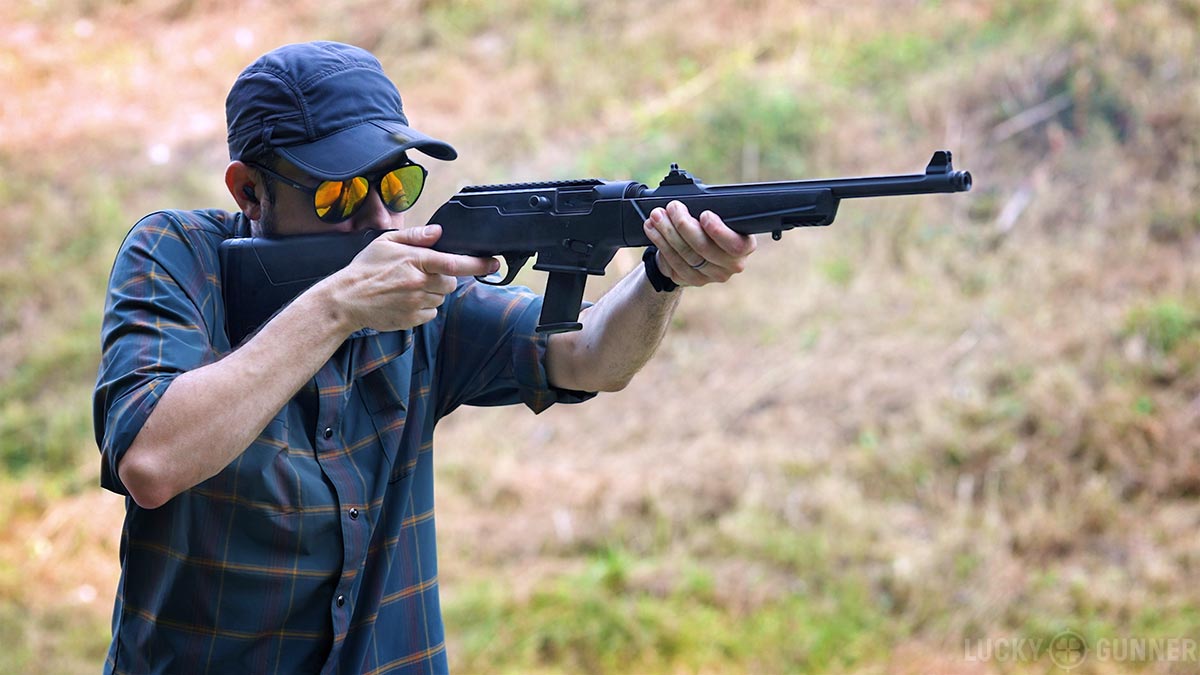
Today, we’re diving deep into the world of pistol caliber carbines (PCCs), discussing their strengths, weaknesses, and why you might want to consider one despite the disadvantages.

Details are in the video below, or keep scrolling to read the full transcript.


Hey everybody, I’m Chris Baker from LuckyGunner.com and today I’m going to tell you why pistol caliber carbines (or PCCs) are silly and pointless. And then I’m going to make a case for why you might want to consider one anyway.

The Rifle-Pistol Performance Gap

In our last video, we looked at the basics of terminal ballistics and the huge gap in effectiveness between rifle and pistol cartridges. That’s mostly due to the large temporary cavity created by a rifle. There’s just no contest. If you need to take down an animal, or you need to make a human stop doing bad things right now, you’re going to get more reliable results with a rifle (or a shotgun).

Even if all you care about is target shooting, rifles are still superior. Rifle cartridges have much longer usable range than pistols. And they’re inherently more accurate, even at short range.

The only reason pistols exist at all is because they’re more portable and concealable than rifles. They are a compromise solution. Long guns are easier to shoot than handguns. They’re quicker to learn how to shoot well. They require less practice to maintain a decent level of proficiency. That goes for rifle or pistol caliber carbines.

But if you’ve already decided to use a long gun, why would you get one chambered for the weaker cartridge of a pistol? Pistol caliber carbines are the worst of both worlds. They are feeble and anemic like pistols but carry the size penalty of a rifle.

Pistol Caliber Carbine Barrel Length Misconceptions

You might argue that a carbine-length barrel grants the pistol cartridge some additional velocity, thereby increasing its effectiveness on target beyond what is capable with a handgun. And I would argue that you’re wrong.

Well, maybe not 100% wrong. A magnum revolver cartridge fired from a lever action rifle can gain significant velocity. For example, we’ve measured some .357 and .44 Magnum loads at over 2000 feet per second out of 17.5-inch barrels. That was roughly 50% faster than what those loads were doing out of a 4-inch revolver. That’s not quite true rifle velocity, but it’s probably close enough to make that extra barrel length worthwhile.

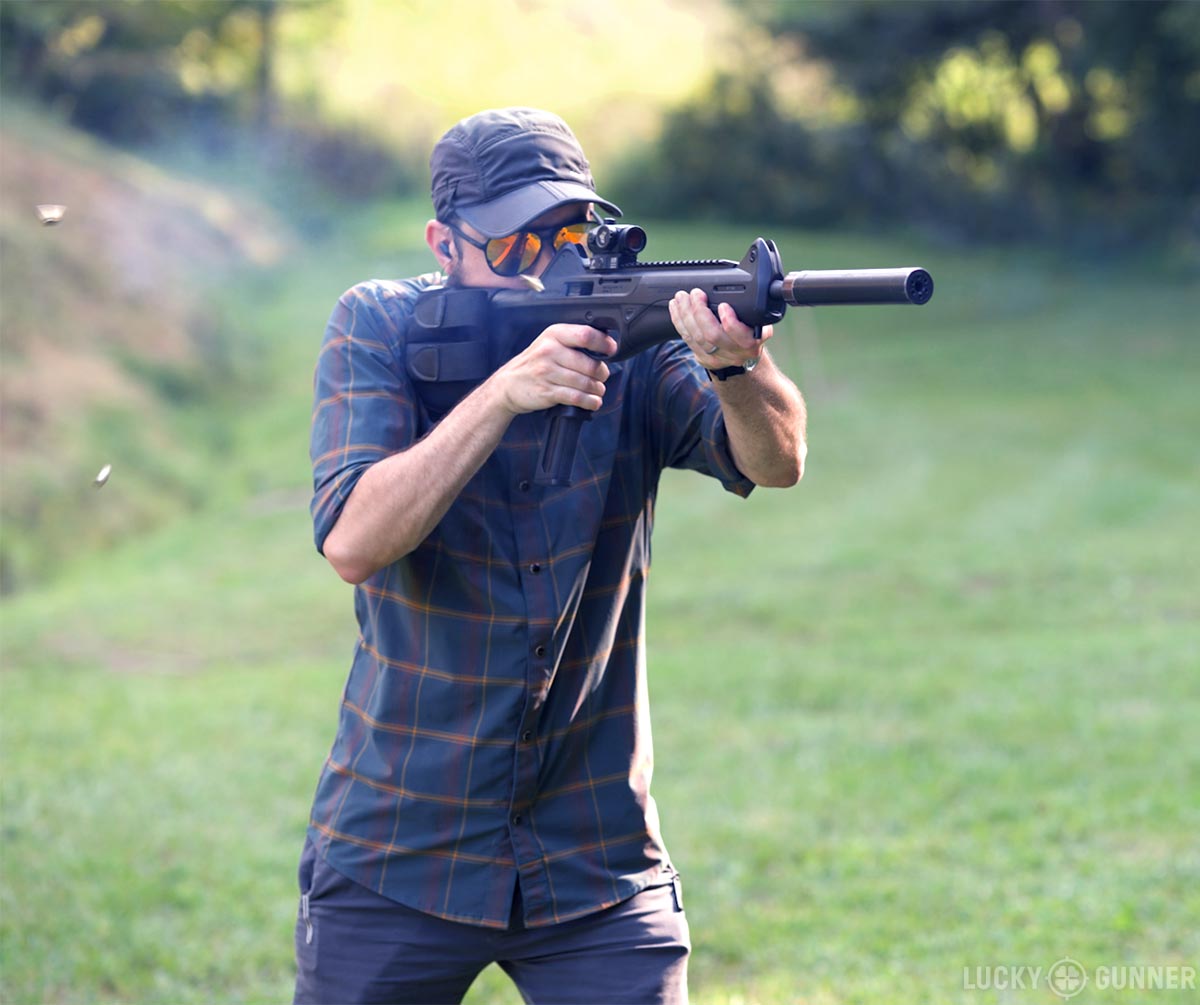
But usually, when we talk about pistol caliber carbines, we don’t mean lever actions. We’re talking about 9mm semi-automatic carbines. Or maybe .45, or something weird like 10mm. Ballistically speaking, these cartridges benefit a lot less from the added barrel length.

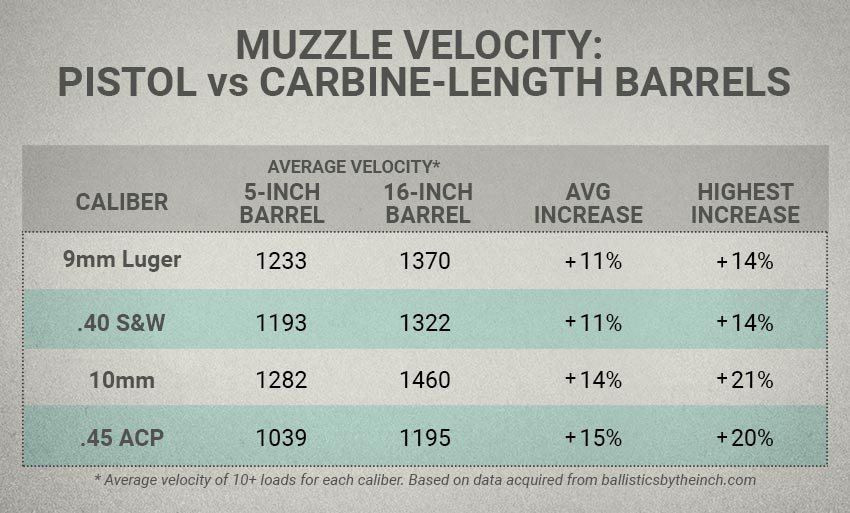
Going from a full size handgun to a 16-inch carbine, semi-auto cartridges see an average velocity gain around 100 to 200 feet per second, which is 10-20%. You get severely diminishing returns with anything longer than about a five inch barrel.

That 100 to 200 feet per second is simply not enough to make the pistol bullet do anything remarkable. It’s still just a pistol round. And hollow point loads are not typically designed for those increased velocities anyway. Most modern loads will still do okay, but in some cases, the bullet might actually perform worse out of a carbine than it would out of a handgun. It might expand too much and under-penetrate.

Penetration Issues

Occasionally someone will suggest that pistol calibers are better for home defense because they’re less likely to penetrate through interior walls compared to a rifle cartridge. Actually, the opposite is true, at least in the case of 5.56.

Some 5.56 loads will tumble or fragment after going through a couple of walls and quickly lose velocity. Most pistol bullets will sail right through ten or more layers of drywall before stopping. Any projectile that’s capable of reliably stopping a human attacker will also penetrate at least two or three interior walls, and that’s enough to be a danger to anyone else in your home. There are other ways to mitigate that risk besides ammo selection. But if wall penetration is a major concern, a pistol caliber is among the worst possible options.

So why do pistol caliber carbines even exist? We’ve got a plethora of AR, AK, and other carbines chambered for intermediate rifle cartridges like 5.56 NATO, 7.62×39, and 300 Blackout. They are affordable and come in all shapes and sizes. They have proven, time and again, to be more effective on target than anything chambered for a pistol cartridge. What good is a PCC other than as a range toy?

Ammo Cost

Well, it’s because terminal performance isn’t everything. What PCCs lack in that department, they make up for in several other areas. Today, I’m going to focus on four of those advantages.

First, it costs less to feed a pistol caliber carbine. Right now, .223 range ammo costs roughly 75% more than 9mm.

Ammo prices fluctuate quite a bit over time, so that price difference might grow or shrink, but historically, 9mm has always been at least a little bit cheaper. Depending on how much you shoot (or want to shoot), that might be a major advantage.

Less Noisy

Second, pistol caliber carbines are less noisy. This is an easily overlooked advantage. It might even seem like a non-advantage, assuming you always wear proper hearing protection at the range. But less noisy guns have a few side benefits.

Intermediate rifle cartridges, especially 5.56, deliver very little felt recoil to the shooter’s shoulder. The difference between an AR-15 in 5.56 and a 9mm carbine is negligible. However, 5.56 is much louder and that can create the perception of recoil, especially for a novice shooter, or for anyone at an indoor range. Even with decent hearing protection, it’s a less pleasant experience, and has the potential to induce a habitual flinch response.

Gunfire Noise and Home Defense

I also would not totally disregard the advantages of using a quieter gun in a home invasion emergency. If you’ve ever been exposed to gunfire indoors without hearing protection, then you know any caliber is extremely loud. Under life-threatening stress, you may experience the phenomenon known as auditory exclusion – the gunshots will sound muted, or you may not notice any noise at all. But whether or not you’re conscious of it, that noise is 100% guaranteed to permanently damage your hearing. Possibly severely.

Exposure to loud noises doesn’t affect every individual the same way. A mild case of noise induced hearing loss and tinnitus might end up being merely inconvenient. A moderate case will cause a significant reduction in your quality of life. It’s a gamble, but the less loud gun will tip the odds in your favor a little bit. I’m not saying it’s the first thing you should consider when choosing a gun for home defense, but it’s probably worth factoring in.

Of course, if you really want to avoid damage to your hearing, you can always keep a set of electronic earmuffs next to your gun, and hope that you have enough time to put them on. Or, if they’re legal in your state, you could use a silencer. That opens up a whole can of worms about how a silencer might be perceived by law enforcement, prosecutors, and juries. But that’s a discussion for another day.

We’re still just on advantage number two. All of that falls under the heading of “less noisy.”

Shooting Range-Friendly

Let’s move on to number three. And I kind of alluded to this one a minute ago: pistol caliber carbines are more shooting-range friendly. Especially indoor shooting ranges. That’s partly because of the noise thing. Nobody likes to be next to the guy shooting 5.56 or an AK at the indoor range. Because of that and, I’m sure, other reasons, lots of indoor ranges prohibit the use of rifle cartridges altogether. I’ve even seen some outdoor ranges that only allow pistols and shotguns, or restrict rifles to certain designated areas. A lot of outdoor gun clubs are run by angry retired guys who still look down their noses at evil black rifles. But usually, if they have an area where pistols are allowed, pistol caliber carbines also get a pass.

I know plenty of shooters who own rifles, but have had a really hard time finding a range where they’re actually allowed to shoot them. A pistol caliber carbine can go a lot of places other long guns cannot.

Ideal SBR Option

And the fourth and final advantage of pistol caliber carbines is that they are fantastic candidates for registered SBRs (or short-barreled rifles). Thanks to the ATF, the pseudo-SBR pistol brace party is over, so this might not have as much appeal as it did a couple of years ago. But if you’re willing to jump through the hoops and get a tax stamp, SBRs still have advantages. They are more portable, more maneuverable indoors, and balance better with a suppressor attached.

SBR barrel lengths typically range from around eight to twelve inches. The downside is that those reduced barrel lengths also reduce the bullet velocity, and for a rifle cartridge, that can really tank your ballistic performance. You have to be a lot more picky about caliber and load selection. SBRs are also significantly louder with more muzzle blast. And they have a bit more felt recoil.

Technically, you get the same disadvantages with a short-barreled pistol caliber carbine – decreased velocity, increased noise and recoil – but on a much smaller scale. You don’t lose much, if anything, in terms of terminal ballistics. The bullet will actually be closer to the velocity window it was designed for. You can go all the way down to a five-inch barrel without giving up much. A rifle cartridge out of that barrel length is really going to struggle to perform.

What’s Best for Home Defense?

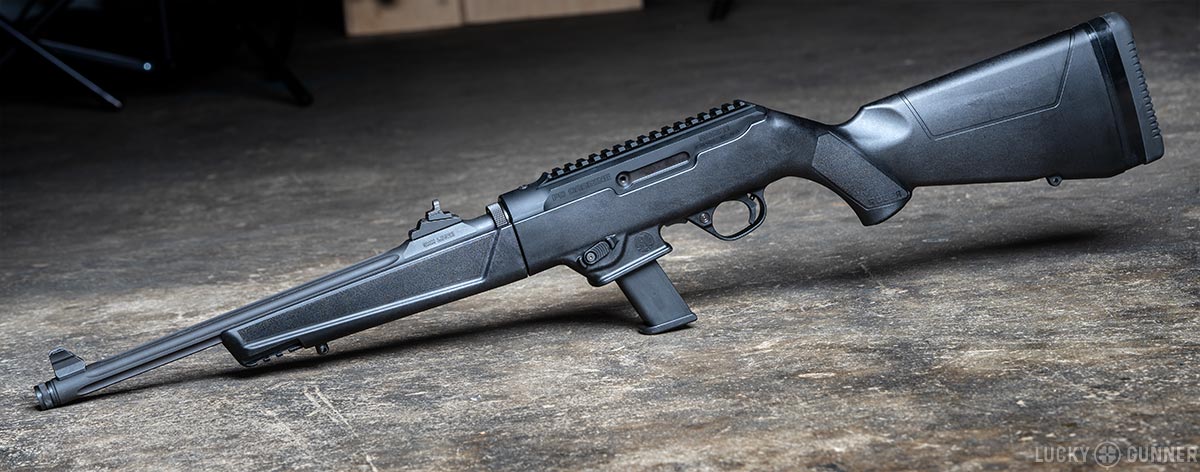
We could go around in circles all day about what type of firearm is best for home defense. There’s really no right answer. But I think PCCs often get left out of that discussion. One case where I do think they are often the best option is for the inexperienced shooter who is unlikely to pursue regular training and practice. I have often suggested the Ruger PC Carbine in particular. It’s not necessarily the best PCC on the market, but it’s affordable, reliable, easy to use, and widely available.

One other advantage that I didn’t really talk about is that pistol caliber carbines are a whole lot of fun to shoot. Whether you pick up the Ruger or some other PCC, you’re going to have a blast with it at the range. But only if you have enough ammo. So when the time comes, be sure to get that ammo from us with lightning fast shipping at LuckyGunner.com.

The post Pistol Caliber Carbines: The Best or Worst of Both Worlds? appeared first on Lucky Gunner Lounge.

The Peacemaker CCW Jacket from the Self Defense Company

0

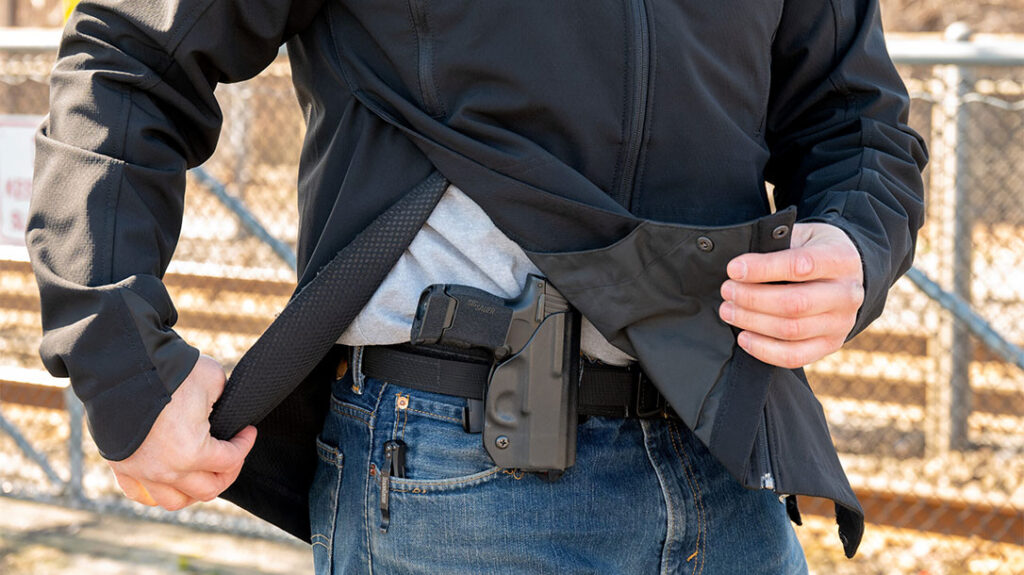
I’m not normally a fan of Winter, but I do like the Fall. Specifically because Fall makes concealed carry a lot easier due to jackets and bulkier clothing. In this case, the Self Defense Company makes concealed carry and body armor more convenient with its Peacemaker CCW Jacket. And it does both discreetly while providing fast access to your firearm.

The Self Defense Company Peacemaker CCW Jacket

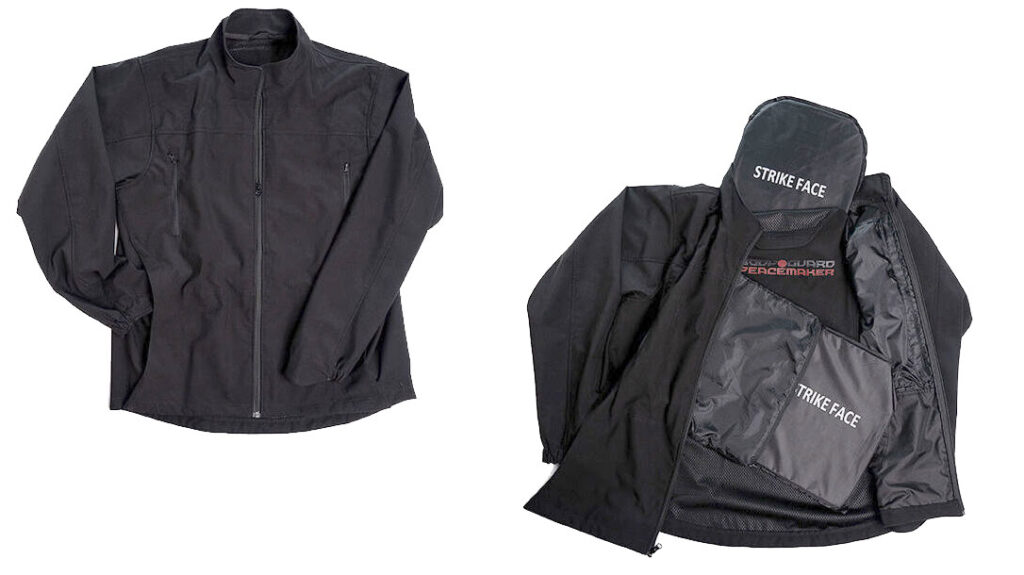
Featuring a waterproof, lightweight, and breathable nylon spandex mix, the Peacemaker protects you and your firearm from the elements. Likewise, the triple-layer construction is capable of withstanding winds up to 100 miles per hour. Additionally, the jackets are TSA-compliant and capable of going through security without a concern.

Unique to the Peacemaker jacket is the Hidden Draw System (HDS). This system provides full access to your firearm at all times and works with any carry system. The unique system allows you to draw and point your pistol at the threat without brandishing it. Likewise, if things go south, the breakaway pockets let you present your pistol without hindrance.

(Photo by The Self Defense Company)

In addition, the jacket provides vital front and back ballistic protection via the patent-pending Body Armor Concealment System. Unlike most body armor options, the construction and design of the jacket delivers comfortable all-day wear and armor concealment. Likewise, it’s as easy to take off and put on as any regular jacket.

The armor kit includes two soft level 3A armor panels capable of stopping handgun rounds ranging from .22 LR to .44 Magnum. Additionally, the level 3A armor panels are the same panels used in the company’s Bodyguard Backpack lineup. So, if you have the backpack, you can move the armor between platforms, depending on operational requirements.

The Peacemaker CCW Jacket is available with or without the armor. So, if you already have 10×12 soft armor or a Bodyguard Backpack, you’re ready to go.

Availability

The Self Defense Company Peacemaker CCW Jacket is available now with MSRPs of $195.00 (without plates) and $349.00 (with plates). For more info, please visit BulletproofBodyguard.com.

The Self Defense Company Peacemaker CCW Jacket.
(Photo by The Self Defense Company)

Self Defense Company Peacemaker CCW Jacket Features

  • Patent Pending Body Armor Concealment System
  • Centerline Front and Back Protection – NIJ Level IIIA
  • Meets and exceeds NIJ Standard 0101.06 for ballistic protection
  • Hidden Draw Conceal Carry System
  • Lightweight Waterproof, Triple Layer (Nylon – Spandex Blend)
  • MSRP: $195 – $349
The Self Defense Company Peacemaker CCW Jacket.
(Photo by The Self Defense Company)

Didn’t find what you were looking for?

Tactical Cold Weather Gear: A Buyer’s Guide

0

Whether you’re hunting, shooting a match, training, or working outside, having the right tactical cold-weather gear can make the difference between a good day and a miserable, exhausting day. Our guide will help you select the best gear for your mission.

Tactical Cold Weather Gear Primer!

New Gear: Insulated 5.11 Apparel Featuring PrimaLoft Insulation

Right in time for the coming cooler weather, 5.11 just announced the launch of a new Technical clothing line featuring PrimaLoft Insulation. The high-performance insulation brings wide line of jackets, pants and vests for outdoor pursuits.

“We are excited to expand the collaboration between our two great brands and to offer our customers a larger selection of products that live up to our Purpose-Built Gear motto for this fall and winter, ” said Francisco J. Morales, CEO, 5.11. “By combining our expertise in creating durable and reliable apparel with PrimaLoft’s innovative insulations, we’re able to offer our customers unparalleled performance that will help them to live the Always Be Ready lifestyle.”

The Adventure PrimaLoft Insulated Jacket ($130) and Starling PrimaLoft Insulated Jacket ($130) come packable. The weather-resistant outer shells feature 80 grams of PrimaLoft Gold Insulation in the body and 60 grams in the sleeves and hood. With nylon ripstop construction, these shells should make a welcome addition on the trail.

Fans of vests get the Adventure PrimaLoft Insulated Vest ($98) and Starling PrimaLoft Insulated Vest ($98). Weather-resistant shells wrap around 80 grams of PrimaLoft Gold insulation. Pair them with a Dylan Reversible PrimaLoft Shirt Jacket ($155) for a versatile layered system. The Shirt Jacket features 100 grams of PrimaLoft Gold Insulation and a Nylon shell. For more info, visit 511tactical.com.

The Principles of Cold Weather Gear

Cold weather” can mean a lot of things to different people. Someone from Miami might define cold weather as anything below 60 degrees. On the other hand, someone from Minnesota thinks that 60 degrees is shorts weather, and it’s only chilly when it goes below zero. But because definitions can be fluid, when you’re selecting tactical cold weather gear it’s important to bear in mind what cold weather means to you. Additionally, making sure that you’re adhering to the proper principles of cold weather operations will drive your gear selection as well. In cold environments, it’s important to 1) stay hydrated, 2) dress in layers, and 3) avoid overheating.

Cold Weather Base Layers

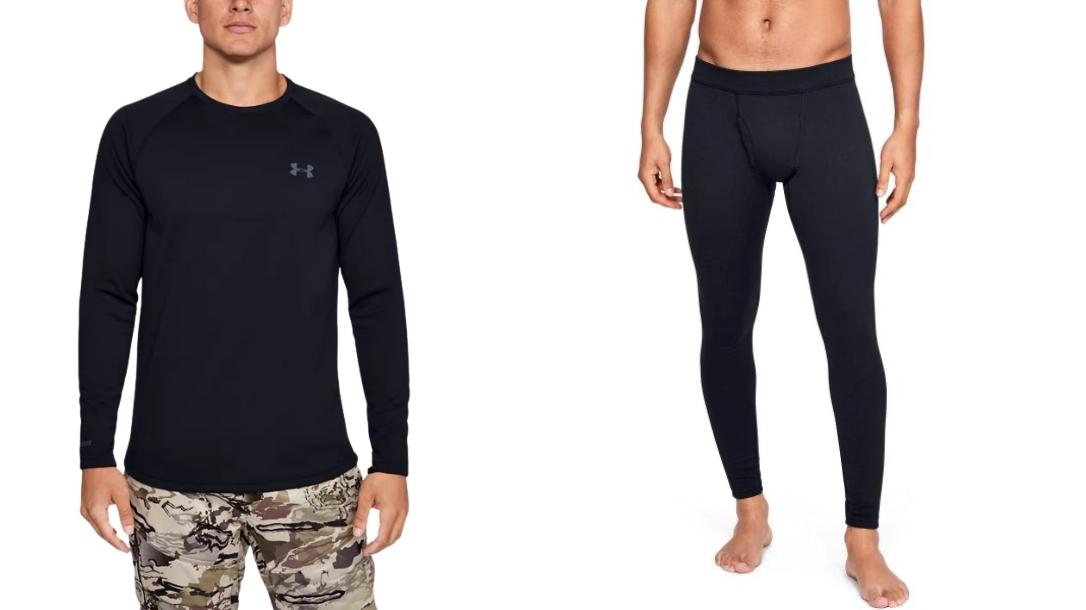
Preparing for the cold starts with an inward-to-outward approach. Selecting your tactical cold weather gear should start with the base layer, and move outward from there. Base layers will include a top and bottoms, depending on how cold your operating environment is going to be. Base layers range in all types of material and can run from very lightweight and breathable to very warm. Some companies try for a “one size fits all” approach to their base layer, trying to craft a product that will work for most people in most conditions.

ua coldgear 4.0 is a great choice for a base layer
(Photo by Daltech Force)

Our pick: Under Armour ColdGear Base 4.0. The UA ColdGear Base 4.0 represents the fourth generation of cold weather base layers from the apparel company. Available for both shirts and leggings, the UA Base 4.0 is designed with a “jack of all trades” approach in mind. It’s not the warmest nor the most breathable, but by taking a middle-of-the-road approach, it performs well in most situations. Even so, in extremely cold temps it would still be a viable choice if paired with the correct outerwear.

Tactical Cold Weather Jackets

People like to fixate on the jacket, or tactical winter coat, that they’re going to select. Despite the importance of base layers, many people will simply choose a jacket or coat and call that good. Furthermore, jackets and coats are not “all environment” items. A light jacket for fall wouldn’t be functional standing post in the Rockies in the middle of January. Similarly, that coat you have for working outside in Minnesota in February would roast you in temps over 30 degrees. We have two tactical cold weather gear options for your jacket.

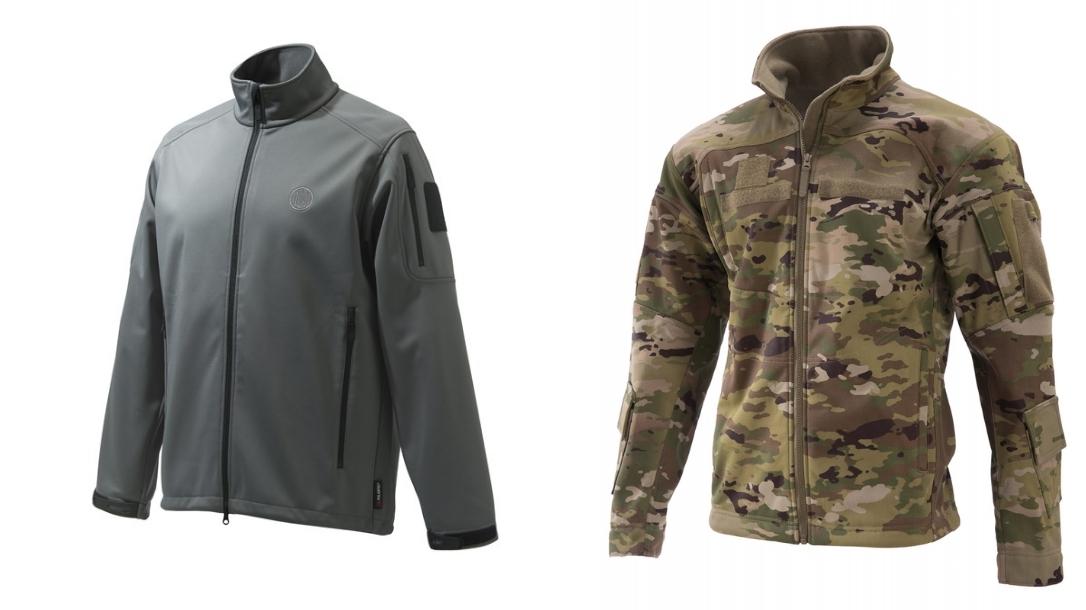
Our pick for mild cold weather: Beretta USA Flank Windbloc Jacket. This jacket from Beretta incorporates PolartecWindbloc, providing maximum weather protection from wind, water and cold conditions. This jacket is great in conditions to the mid 30s, and if paired with a warm base layer could go colder than that. Large pockets provide ample storage, and each sleeve has an additional zippered pocket. These are perfect for credit cards, credentials, or other small items. The sleeve pockets also feature a hook and loop patch panel.

Beretta and Massif both make excellent tactical winter coats

Our pick for severe cold weather: Massif Elements OCP Jacket. Designed for hard-use military and law enforcement users, this piece of tactical cold-weather gear is fantastic. In addition to protecting from the cold, it’s also flame resistant. This is a great feature for first responders or military members who might encounter dangerous environments in winter. The Massif jacket has loads of pockets, including a zippered sleeve pocket that can be accessed while wearing body armor. A fleece-lined collar also flips up to protect your neck from the wind. At almost $600 the Massif jacket is pricey, but what’s the price of staying warm?

Tactical Cold Weather Pants

For some reason, pants get overlooked almost as often as the base layer. Again, maybe it’s because pants aren’t as cool as a sweet jacket, but they’re just as important. Yes, while keeping your core warm is key to staying alive, it’s easier to regulate your core temp if your lower body is also well protected. To that end, tactical cold weather gear for your lower half needs to take into account the same considerations as jackets. 

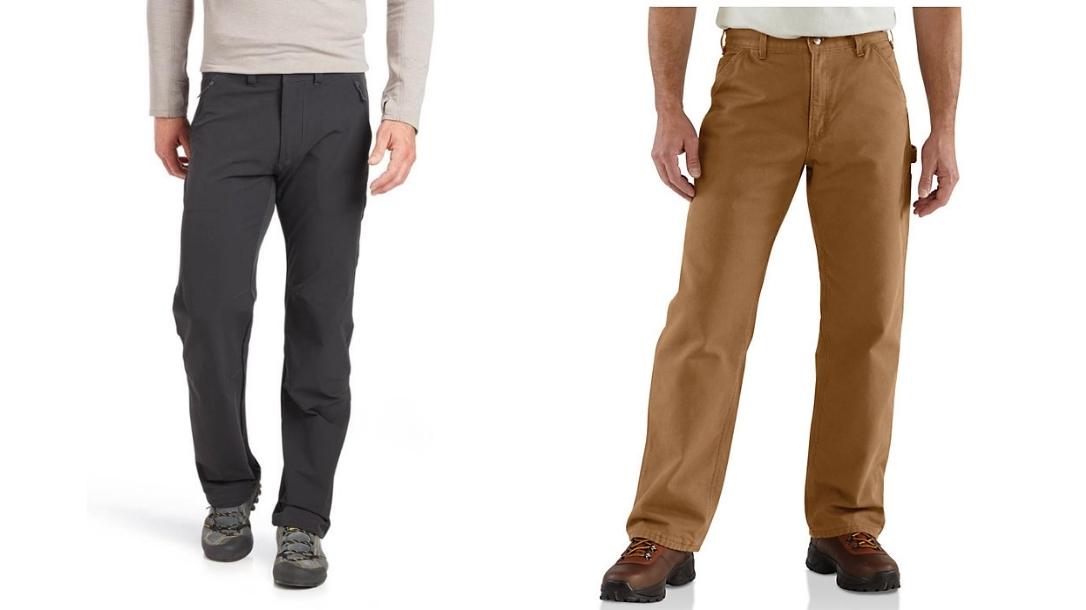
Our pick for mild cold weather: KUHL Transcendr Pant. The Transcendr is a fantastic choice for active pursuits in lousy weather. It incorporates wind and water resistance, as well as an enhanced range of motion. Designed for wear with or without a base layer, the KUHL pant has articulated knees and a bottom drawstring to close the leg off against moisture.

kuhl and carhartt both make great pants
Kuhl Transcendr left, Carhartt right (Photo by Daltech Force)

Our pick for severe cold weather: Carhartt Men’s Washed Duck Dungaree Flannel Lined Work Pant. Carhartt may not be an explicitly tactical brand, but its pants are well-known for holding up in winter weather. Beloved by blue-collar workers, the flannel-lined dungarees will also enhance your gray man appearance. Sometimes the best way to be tactical is to not appear tactical.

Tactical Cold Weather Accessories

Getting the base layer, jacket, and pants is important. But your accessories are going to matter a lot too, whether that’s tactical underwear, gloves, boots, socks, or a hat. You could make great choices with your outerwear and base layer, but choose bad socks and boots and end up miserable. Imagine you’re standing on top of a HMMV in -20 degree weather wearing summer weight boots and thin socks. Your chest and legs may be warm, but the steel roof of the vehicle is sucking every ounce of warmth out of your body through your toes, which you can’t even feel after 20 minutes. That’s why tactical snow boots, or just good cold weather boots and socks are so important.

Our choice: North Face ThermoBall Lifty II Boot. Your feet will thank you in the North Face boots. Built in lightweight ThermoBall Eco insulation keeps your toes warm, and the boot’s waterproof upper will also keep your feet dry.

Socks and tactical winter gloves are very personal choices. For socks it’s hard to go wrong with merino wool socks from any number of reputable companies. Gloves are a very personal purchase, since some users prefer to sacrifice warmth for mobility, and others prefer maximum warmth. No matter what, your glove choice must reflect your environment and the equipment you’ll need to operate with your hands. If shooting might be called for, your gloves need to allow you to properly manipulate the gun. Even little things like using your phone are affected by your glove choice, so choose wisely.

Ultimately, selecting your tactical cold weather gear is the same as any other gear. Mission drives the gear train, so make selections that are appropriate for your environment and goals. Just because high speed operators use a piece of kit doesn’t mean it’s the right choice for you. Conversely, just because something’s affordable and popular doesn’t make it the right choice.

Didn’t find what you were looking for?