Ball and Buck just announced a new clothing item in partnership with one of our favorite pro-gun fiction writers. The Ball and Buck X Jack Carr Limited Edition Shirt #002 brings a bit of that Terminal List swag into your next range shirt.
Ball and Buck Jack Carr Limited Edition Shirt
“Run to the sound of the guns!” Ball and Buck listened to that ethos when designing the do-everything hunting, field, range or everyday shirt. Designed with Jack Carr and military-inspired materials, including wetsuit neoprene, this shirt should hold up well to hard use. But the launch limits to just 400 bundled pairs of shirts with a sgined copy of Carr’s new book, Only the Dead. So you better act fact.
“It was a blast to work with Jack again designing this 2nd launch edition shirt,” said Mark Bollman, founder of Ball and Buck. “In order to tie in the storyline of Only the Dead, we incorporated military-inspired materials like wetsuit neoprene and ocean blue fabrics. Those fabrics combined with the iconic Jack Carr touches, makes this limited-edition shirt a must have for any loyalist.
The Carr shirt features Jack’s favorite martial, with the iconic crossed tomahawks subtly interwoven into the shirt’s design. The shirt also features “Long Live The Brotherhood,” printed inside the from placket. A curved bottom hem line makes this shirt wear well either tucked or untucked. A blaze orange bottom button hole, Tech Vent Underarm Ventilation and a 9mm Casting Rivet on the lower side seam round out the custom touches. For more info, visit ballandbuck.com.
Ball and Buck Jack Carr Limited Edition Shirt Features
4.5 OZ 100% cotton reverse french twill
“Long Live The Brotherhood” print inside front Placket
Curved bottom hem line for tucked or untucked wear
Blaze orange bottom button hole
Tech Vent underarm ventilation
9mm Casing Rivet on lower side seam
Crossed Tomahawk embroidery on elbow patches and front Placket
Does recoil cause the muzzle to rise while the bullet is still in the barrel, or is the bullet long gone by then? Could a loose grip cause bullets to impact higher on the target? We used a high speed camera to help figure out what’s really going on in the eyeblink after you pull the trigger.
Details are in the video below, or scroll down to read the full transcript.
Hey everybody, I am Chris Baker from LuckyGunner.com and today we’re going to look at how recoil affects accuracy in handguns. Now, that’s a pretty broad topic. Practically speaking, there are lots of ways recoil affects accuracy. Most of them are related to the shooter’s technique. Recoil moves the sights off target and it can move the gun in our hand. It can cause recoil anticipation or pre-ignition push. We have to apply good shooting techniques to counteract those effects.
But today, I want to focus on an aspect of recoil that’s mostly out of our control. Does recoil have an objective, mechanical effect on the bullet’s point of impact? Or, to phrase it another way, does the muzzle begin to rise before the bullet leaves the barrel. And if so, does it rise enough to cause a noticeable change in where the bullet ends up?
I’ll go ahead and tell you up front that, regardless of the answer, there is not a whole lot of practical application here for the average shooter. This is something gun nerds debate on occasion. We’re going to have fun finding out the answer. But for shooting handguns at typical handgun distances, it doesn’t matter much. There are a couple of very narrow use-cases where it might come into play, and I’ll get to those at the end.
To aid us in our mostly useless quest, we’ve called upon some assistance from a Chronos 2.1-HD high speed camera. We did one batch of shots at 4370 frames per second, which is 182 times slower than real time. Then we did a second batch of shots with a lower resolution at just over 10,000 frames per second, or 437 times slower than real time. If we crank up the frame rate any higher than that, the resolution gets too fuzzy to really tell what’s going on.
Okay, back to our big question: does the bullet leave the barrel before the muzzle rises? It depends on the gun.
Semi-Autos
Let’s start with a semi-auto. This is a 9mm Sig P365 XL. I’ll just let it play through in real time first. And here it is in slow motion. There goes the bullet, and there’s plenty of recoil. The gun wants to move straight back. The shooter’s hand stops that rearward motion, so the gun takes the path of least resistance, which is up. The result is a rotational movement, or what we sometimes call muzzle rise.
But let’s go back and look at it frame by frame. Did that rotation start before the bullet exited the barrel? First, we see a little smoke, and then a couple of frames later… there we go. That gray blur there is the bullet. Let’s back it up one frame when we know for sure the bullet is still in the barrel. If we compare that to our last pre-ignition frame, we can see the slide and barrel have started to move to the rear while the bullet is still in the barrel, but we’re not seeing any of that rotational movement yet. There is no upward movement of the barrel. That doesn’t start until right about… here, and by then the bullet is already out of the frame.
So, for the Sig, at least, it looks like muzzle rise should not be a factor in the bullet’s point of impact.
Let’s look at another semi-auto. This is the new .380 Beretta Cheetah 80X that I’m in the process of reviewing. This gun has a straight blowback operated action. The Sig was recoil-operated. Let’s see if that makes any difference in when the muzzle rise begins.
There goes the hammer and there’s the bullet. Before I even go frame by frame, you could probably see what happened there. With a blowback pistol, the barrel doesn’t move with the slide, it stays locked to the frame. There’s the bullet right there. We back up a frame, compare it to the frame when the hammer stopped moving. There’s slide movement, but the barrel hasn’t moved at all. The rotational movement doesn’t begin until the slide is almost completely open.
Revolvers
Okay, you know what’s coming next. What about revolvers? We’ve got a Ruger GP100 and let’s start with a really mild load. This is a .38 Special 148-grain wadcutter from Black Hills. It’s puttering along at 660 feet per second with almost no muzzle flash, so it’s pretty easy to see. Let’s go frame by frame. There’s the bullet. Back up a frame. Compare it to the pre-ignition frame. There is definitely some rotational movement there while the bullet is still in the barrel.
But how much movement, and is it enough to really matter? I tried a half dozen different methods for measuring the change in the barrel’s angle and I wasn’t really satisfied with any of them. We would need a high speed camera capable of much higher resolution and framerate in order to measure that accurately. And that’s not in the budget right now.
But my best estimate is that the barrel moves roughly .2 to .3 degrees before the bullet exits. That doesn’t sound like much, but at 25 yards, that translates to a point of impact that’s between 3.1 and 4.7 inches higher than if the muzzle had remained in place.
So let’s say you locked the gun in some kind of mechanical rest so that it could not move, and you zeroed the sights to be dead-on at 25 yards. If you took the gun out and shot it with your hands, you would be hitting three to five inches high.
Now, that wadcutter was moving pretty slow. What if we tried a magnum round? Would it exit the barrel before the muzzle rises? This is a Remington 125-grain jacketed soft point moving at 1400 feet per second. It definitely spends less time in the barrel compared to the wadcutter. Only five frames versus nine. But there does still seem to be some rotational movement taking place before the bullet exits.
So muzzle rise does influence the point of impact for revolvers. The degree of that influence probably changes depending on the load you’re shooting, although it’s hard to see that in our high speed footage. But we know a slower bullet will spend longer in the barrel, which means it should rise more before the bullet exits. That’s at least one of the reasons slower bullets typically have a higher point of impact than faster ones.
Theoretically, a bullet that recoils more (like a magnum) might have more muzzle rise before the bullet exits. That could be a factor. But looking at the footage of our wadcutter and magnum, there is not much difference in the amount of rotational movement of the gun in that short period while the bullet is still in the barrel. I’m inclined to believe the amount of time the bullet spends in the barrel is more important than the magnitude of the recoil because most of that recoil happens after the bullet is gone.
Can Grip Influence Point of Impact Shift?
So what about grip? Does a firm grip cause less muzzle rise than a loose grip? I tried firing a magnum load with a firm two-handed grip and again with a loose one-handed grip. Obviously, the loose grip allowed a lot more rotation overall. I could not really tell a difference in the amount of movement before the bullet exited.
What I did notice is that no matter how hard I gripped the gun or how little or how much recoil the gun had, the grip appeared to move in my hand before my hand reacted. Our hands are covered in squishy things like skin, fat, and muscle, so they’re always going to have some give. Regardless of how tight you squeeze, the gun will be able to move at least a tiny bit before it encounters the full resistance of your grip.
Having said that, I did not want to dismiss grip as a possible factor in shifting the point of impact.
The Sandbag Test
So I tried Plan B. Instead of gripping the gun differently, I tried firing with sandbags for support. First, with only the frame of the gun supported, and then again with an additional sandbag under the grip. I compressed it down as much as possible so the grip was firmly planted on that sandbag. This is not the same as immobilizing the gun. The sandbag does not prevent that rotational movement, but I figured it would cause the gun to recoil in a different way. If that was enough to alter the point of impact, then I think it stands to reason that it’s at least possible that the way you grip the gun could also change the point of impact.
Here it is first without the bottom sandbag. The rotation looks pretty much the same as shooting unsupported. Now, with the bottom sandbag, it’s a little different. The gun moves back and then up. Again, this is not something I could easily measure and compare based on our high speed footage. Instead, I just shot some groups at 25 yards.
Here’s a five shot group with the Black Hills wadcutter at 25 yards. First with the bottom sandbag supporting the grip. And another group without the bottom support. That’s about three and a half inches higher than the first group. It looks like that bottom sandbag delayed the muzzle rise, which caused the lower point of impact.
And now the Remington 125-grain Magnum load. With grip support on the left, without it on the right. About two and a half inches higher. Same effect as the slower bullet, but with less muzzle rise, maybe because of less time in the barrel.
So what can we take away from all of this? For most of us, not much, except that shooting is fun and so are high speed cameras. But if you like to shoot revolvers at 25 yards and beyond, there might be something here. It’s probably a good idea to make sure your grip is unsupported if you zero your revolver from a bench rest. Always confirm your bench rest zero by shooting a couple of groups without the bench. Any time you’re shooting at those longer ranges, try to make sure you grip the gun exactly the same way every time. And of course, the next time you need some ammo, be sure to get it from us with lightning fast shipping at LuckyGunner.com.
Back in May, I reported that a U.S. District Judge issued a preliminary injunction against the Illinois “assault weapons” ban. However, in a recent decision, a three-judge panel of the United States Court of Appeals for the Seventh Circuit overturned the decision. What’s more, they indicate that AR-15s are not protected by the Second Amendment.
Seventh Circuit Court Overturns Injunction Against Illinois “Assault Weapons” Ban
As reported below, the original injunction was issued by U.S. District Judge Stephen P. McGlynn in Barnett v. Raoul. Following his decision, an appeal was filed with the Seventh Circuit court. The three-judge panel is made up of Ronald Reagan appointee Frank Easterbook, Bill Clinton appointee Diane P. Wood, and Donald Trump appointee Michael P. Brennan.
According to Breitbart News, “Easterbrook and Wood constituted the panel majority in overturning the injunction. They noted that Heller (2008) held, ‘[l]ike most rights, the right secured by the Second Amendment is not unlimited.’”
The panel noted that in Heller, the Supreme Court of the United States determined that machine guns are not protected by the Second Amendment. Specifically, because they are not “bearable” and can “be dedicated exclusively to military use.”
For this reason, Easterbrook and Wood worked to highlight the similarities between AR-15s and M16s. However, the similarities highlighted only occur when currently illegal modifications are made to the AR platform. Such as adding a “bump stock” or auto-sear. Likewise, they make the correlation between the two regarding the same ammunition and kinetic energy.
Breitbart News states, “Judge Brennan dissented from the majority decision, stressing that the Illinois ‘assault weapons’ ban fails if tested by Bruen (2022) because the ban has no historical precedent in American tradition.”
Fortunately, according to a post from the Firearms Policy Coalition on X, there is still a pathway to victory.
The post states that the court does “not rule out the possibility that the plaintiffs will find other evidence that shows a sharper distinction between AR-15s and M16s (and each one’s relatives) than the present record reveals.”
The Firearms Policy Coalition promises to fight forward.
To clarify, the Seventh Circuit reversed the preliminary injunction (halt of the law’s enforcement on the likelihood of victory) we secured at the District Court level. They claim there is still more to be learned as the case moves forward, leaving the door open that victory is…
We will continue to follow this case as it moves forward and will provide updates as they happen.
On May 2, 2023, Joshua Swanagon reported:
U.S. District Judge Stephen P. McGlynn apparently shares the views of many law-abiding American citizens. Specifically, there are already enough gun laws on the books that aren’t enforced, and there’s no need for more. For this reason, he issued a preliminary injunction against the Illinois “assault weapons” ban on Friday, April 28, 2023.
U.S. District Judge Issues Preliminary Injunction Against Illinois “Assault Weapons” Ban
Judge McGlynn presided over Barnett v. Raoul, which consolidated numerous suits against the Illinois “assault weapons” ban. The ban, known as the Protect Illinois Communities Act (PICA), was brought about following the attack on an Independence Day parade in Highland Park, Illinois (details below). Occurring just weeks after the SCOTUS issued its Bruen decision, Democrats used the attack to justify PICA.
In his decision, McGlynn acknowledged the attack, and the Democrats attempt to take advantage of it:
“As Americans, we have every reason to celebrate our rights and freedoms, especially on Independence Day. Can the senseless crimes of a relative few be so despicable to justify the infringement of the constitutional rights of law-abiding individuals in hopes that such crimes will then abate or, at least, not be as horrific?
“More specifically, can PICA be harmonized with the Second Amendment of the United States Constitution and with Bruen? That is the issue before this Court. The simple answer at this stage in the proceedings is ‘likely no.’”
Appropriately, McGlynn pointed to Bruen in his decision to block enforcement of PICA until a ruling on its constitutionality is finalized:
“Amongst other things, the Bruen Court reaffirmed that ‘the right to “bear arms” refers to the right to “wear, bear, or carry…upon the person or in the clothing or in a pocket, for the purpose…of being armed and ready for offensive or defensive action in a case of conflict with another person.”’ 142 S. Ct. at 2134 (quoting D.C. v. Heller, 554 U.S. 570, 584 (2008)).”
Likewise, he went on to say that the SCOTUS decision in Bruen states that “the Second Amendment protects the possession and use of weapons that are ‘in common use at the time.’”
McGlynn Suggests Enforcing Current Laws
Concluding his decision, McGlynn called attention to the fact that there are enough gun laws on the books. However, those laws are being ignored or diminished in severity. So, he suggests that Illinois look to enforce its current laws before trying to enact more:
“The Court recognizes that the issues with which it is confronted are highly contentious and provoke strong emotions. Again, the Court’s ruling today is not a final resolution of the merits of the cases. Nothing in this order prevents the State from confronting firearm-related violence.
“There is a wide array of civil and criminal laws that permit the commitment and prosecution of those who use or may use firearms to commit crimes. Law enforcement and prosecutors should take their obligations to enforce these laws seriously.
“Families and the public at large should report concerning behavior. Judges should exercise their prudent judgment in committing individuals that pose a threat to the public and imposing sentences that punish, not just lightly inconvenience, those guilty of firearm-related crimes.”
This really gets right to the heart of the issue. Law-abiding American citizens are punished for the crimes of a few, while criminals are “lightly inconvenienced” and walk free. So, while criminals become ever more emboldened, law-abiding citizens are being stripped of their Second Amendment rights. No country can survive this kind of lopsided justice.
Injunction Leads to Surge in Gun Sales
As you might have already guessed, the injunction led to an rapid surge in gun sales. In fact, immediately following the ruling, weekend crowds filled gun shops. One gun shop owner indicated that there was a line outside the door before he could open in the morning.
According to the Chicago Tribune, “Suburban gun shop owners were swamped with weekend crowds after a federal judge in the district court for the Southern District of Illinois issued an injunction Friday, blocking enforcement of the state’s January ban on military-style firearms.”
Some were just happy to enjoy their Second Amendment freedoms again:
“I’m fairly excited that I got my rights back,” Johnson said. “We live in the United States, we should follow the Constitution and be able to do what law-abiding citizens are able to do.”
Others expressed concerns over unsafe living conditions in Chicago:
“Living in Chicago raises obvious self-defense issues,” Eldridge said. “If somebody is ready to spend $250 and 16 hours of their time on a concealed carry class, that’s a pretty good indication that they do have some concerns about personal safety.”
Instead of paying attention to his constituents, Democratic Attorney General Kwame Raoul has filed an appeal to McGlynn’s ruling. Likewise, he has filed a motion in federal court to stop the ruling from going into effect, pending the outcome of the appeal.
Until that time, the people of Illinois are taking advantage of the injunction and buying what they can now. Proving once again, Democrats make the best gun salesmen.
On January 13, 2023, PDW reported:
Well, that was fast. As it turns out, the new “assault weapons” ban in Illinois isn’t too popular among law enforcement or state representatives. The ink was barely even dry on the document before they voiced their opposition. Although this legislation mostly affects point of sale, current owners of banned firearms are supposed to register them (story below). But it doesn’t look like anyone will be enforcing it in at least two counties.
Opposition to Illinois “Assault Weapons” Ban Turning to Defiance
Quickly after the bill was signed, Edwards County Sheriff Darby Boewe issued a statement. In the statement, he makes it clear that he will not be supporting the bill at all. Specifically, he states that it is a violation of the constitution.
“Neither myself nor my office will be checking to ensure that lawful gun owners register their weapons with the State, nor will we be arresting [or] housing individuals that have been charged solely with non-compliance of this act,” a statement from Sheriff Darby issued on Wednesday and reported by WEVV News, says.
According to the WEVV report, a nearly identical statement was issued by the Wabash County Sheriff’s Office following Darby’s statement. The statement from Wabash County also opposes the bill and contains the same quote as above. Likewise, several other sheriffs in the area and around Illinois have issued similar statements.
Illinois State Representatives Chime In
The newly signed legislation did not sit well with members of the Illinois House or Senate either. Many called the legislation out for endangering Illinois citizens, highlighting that people who break the law are not going to register their firearms. However, some went on to openly defy the ban.
According to CBS News, Illinois State Rep. Blaine Wilhour (R-Beecher City) said, “We will not comply, and you’re not going to do a darn thing about it, because the law, the Constitution, and the founding principles are on our side.”
Likewise, outgoing Illinois State Sen. Darren Bailey (R-Xenia) tweeted a message of defiance:
It looks like this legislation is heading for an uphill battle, and many opponents are confident of a win. It may be a long road, but as long as the constitution is upheld, as it should be, this should be struck down forthwith.
On January 11, 2023, PDW reported:
You might have already seen the headlines. Four dead and three wounded in a rash of criminal shootings in Chicago on Monday alone. What is Gov. Pritzker’s answer? Does he address the growing epidemic of violent crime in his state? Nope. Instead, he is focusing on making it harder for law-abiding citizens to defend themselves. To be specific, on Tuesday night, he signed an “assault weapons” ban in Illinois.
Illinois “Assault Weapons” Ban Signed Tuesday
Illinois becomes the ninth state to enact an “assault weapon” ban. The legislation bans the sale of supposed “military style weapons” and high capacity magazines in the state of Illinois. The legislation banning “assault weapons” passed the Illinois House in a 68 to 41 victory.
According to Fox2Now, “The ban took effect immediately, so it is now illegal to sell assault weapons in the Land of Lincoln. The legislation also caps the purchase of ammunition magazines at 10 rounds for long guns and 15 rounds for handguns. Rapid-fire devices, known as “switches,” are also banned because they turn firearms into fully automatic weapons.”
ABC News states, “Just hours after the legislation’s passage in both chambers of the Illinois General Assembly, Gov. J.B. Pritzker signed the “Protect Illinois Communities Act” into law during a ceremony at the State Capitol in Springfield. Supporters, some of whom were gun violence survivors, erupted with applause and cheers as the governor presented the signed document.”
Reports indicate that pending sales will still be processed, but only if the required background checks have already been started. Gun owners who have any of the firearms affected by the legislation may keep them. However, they must register them with the Illinois state police by the beginning of next year.
The Illinois State Rifle Association (ISRA) promises to fight the legislation in court, claiming it affects nearly 2.5 million legal firearm owners in the state.
ISRA executive director Richard A Pearson said in a statement Tuesday, “Challenge accepted. The Illinois State Rifle Association will see the State of Illinois in court.”
Firearms Effected by the Legislation
You can find the bill below, and the long list of firearms affected begins on page 84. It is too long to list here, and I recommend you take a look. Quite frankly, the list is so long that it’s quicker to look at what isn’t subject to the ban.
Specifically, the following are all that is still allowed:
Any firearm that is an unserviceable firearm or has been made permanently inoperable.
An antique firearm or a replica of an antique firearm.
A firearm that is manually operated by bolt, pump, lever or slide action, unless the firearm is a shotgun with a revolving cylinder.
Any air rifle as defined in Section 24.8-0.1 of this Code.
Any handgun, as defined under the Firearm Concealed Carry Act, unless otherwise listed in this Section.
What you’ll find on the list of now unacceptable firearms are pistols with threaded barrels, AR pistols, AR-10s, AR-15s, AKs, .50 cals, some shotguns, “high capacity” magazines, and much more. Likewise, many firearms are listed specifically by name in the legislation. To be honest, it’s pretty much a gun lover’s wish list.
Read the entire list here:
Legislation Might Not Pass Muster
Fortunately, the Illinois State Rifle Association feels that this legislation will not pass constitutional muster and will be defeated. However, until that happens, Illinois residents are subject to it and are living at the whim of criminals. Until these myopic legislators decide to empower law enforcement to enforce current laws, things will continue to deteriorate.
But I wouldn’t count on that. They only care about dismantling the Second Amendment and disarming law-abiding citizens. All the while, they could care less about gangs and thugs like these guys:
These are members of the MBlock set of Black Disciples near 69th and Maplewood in Chicago.
Has anyone thought to inform these gentlemen of Chicago’s strict gun laws? I thought being a member of a violent gang would show up on a background check. How’d they get the guns????? pic.twitter.com/kMbOEQvlOl
A woman was killed during a shark attack earlier this week while paddleboarding in the Bahamas. According to a government press release, she had already died by the time rescue technicians arrived at the scene.
The paddleboarder has since been identified as 44-year-old Lauren Erickson Van Wart of Lowell, Massachusetts. According to Boston 25 News, she was three-quarters of a mile from the beach net to her Sandals Resort on the island of New Providence when the attack occurred.
“Preliminary reports indicate that the victim, along with a male relative, was paddle boarding away from the shoreline in waters at the rear of a resort in western New Providence when she was bitten by a shark,” reads a news release issued by the Royal Bahamas Police Force and later shared by CNN. ““The victim suffered significant trauma to the right side of her body.”
The incident comes on the heels of another fatal shark attack in Mexican waters. That attack occurred on Saturday, December 2 and involved an unidentified woman whose leg was reportedly severed by a shark near a beach resort on Mexico’s Pacific coast. An unverified video referenced by CNN appears to show that woman being carried from the beach with one leg missing.
When questioned by reporters, a Bahamian tourism official said that recent shark attacks involving tourists have caused alarm in the small island nation. “As an industry, I think we can review and see if there is anything we can do to improve,” said Tourism Director General Latia Duncombe. “But we’re in the open waters. The waters are pristine. We protect sharks here in the Bahamas. It’s important that we are as responsive as we can be when these unfortunate incidences occur. Our prayers go out to [victims], but we have no control over some of those different components.”
The sixth annual Athlon Outdoors Rendezvous brought together the Athlon Outdoors editorial team, contributors and some of the best firearm and accessory manufacturers in the business. The event offers the opportunity to mingle and get to know some of the latest products from approximately 30 companies. Thousands of rounds were sent downrange, and we came away with an informative sneak peek and will share some of the highlighted products here. The annual Rendezvous Roundup and linked stories package all the guns, gear and shooting from the annual Rendezvous event.
Athlon Outdoors Rendezvous Roundup
BURRIS/STEINER
The folks at Steiner were nice enough to let us shoot its Predator 8 riflescope, which was doped in at one mile with many hitting the target on their first or second shots. We also got to take a look at a new high-tech scope coming out at SHOT Show 2023. More to come on that in later issues and online. (burrisoptics.com) (steiner-optics.com)
CENTURY ARMS/US PALM/CANIK
Known for its tough and durable polymer AK mags, US Palm showcased its limited-edition AK Alien Green 30-round mag. The bright green AK mag stands out from the crowd, so beware of friends “borrowing” this little gem. Also at Rendezvous, US Palm’s sister brand Canik brought along its Steel Rival 9mm pistol, which enjoys the cover of this issue and can be found on page 26. (uspalm.com) (canikusa.com)
IWI
This Israeli company continues its line of Masada pistols with the Masada Slim 9mm pistol. The thin profile and compact design offer easy concealed carry. The striker-fired polymer pistol features a modular, serialized trigger mechanism housing that can be removed for cleaning. It comes with two 13-round mags and sports a slide cutout for mounting red-dot optics. IWI has some fantastic new rifles coming out later on in Q1. You won’t want to miss them. (iwi.us)
RISE ARMAMENT
While known for its superb triggers. Rise Armament also offers AR parts and accessories, including a mag release button, an M-Lok QD Sling Mount and Extended Charging Handle Latch. These parts can be had in a variety of colors for personalizing your AR-15. Also, you get a full rundown of Rise’s new Iconic independent two-stage trigger on page 20 of this issue of Tactical Life. (risearmament.com)
SAR USA
Among the many pistols SAR USA let us shoot was a competition-ready 9mm priced for just about any shooter. The K-12 Sport X features a 4.7-inch, match-grade ported barrel with a recessed crown for accuracy. Along with a forged alloy steel frame and slide, the pistol boasts an ergonomic grip, flared mag well for quick reloads, skeletonized hammer, low bore axis and ambi manual safety. (sarusa.com)
SILENCERCO
SilencerCo brought a plethora of cans and was nice enough to let us shoot until we were tired. In fact, there were too many suppressors to list here, but check out Karen Hunter’s piece on all things SilencerCo on page 14 of this issue of Tactical Life. (silencerco.com)
SPRINGFIELD ARMORY
Many are familiar with Springfield’s latest additions, the Prodigy pistol and Hellion bullpup rifle. The Prodigy enhances the proven 1911 design by building the pistol around its double-stack magazine for a whopping 20+1 capacity of 9mm. The wild-looking Hellion redefines the semi-auto rifle with its 16-inch barrel and a diminutive overall length of just over 18 inches. Although we can’t divulge any details right now, we did get some good intel about a new product coming soon that will make shooters smile. (springfield-armory.com)
VERSACARRY
Belts and holsters go together like peas and carrots. Versacarry offers its Classic Carry Belt in black and distressed brown. Fashionable looks combine with durable performance for everyday carry. Go covert with the Comfort Flex IWB Holster. The rig combines buffalo leather with a custom-molded front for secure retention. The raised padded backing gives all-day carry comfort. (versacarry.com)
5.11 TACTICAL
Just about everyone needs a pack when they hit the range or the field. The folks at 5.11 Tactical offer it the second iteration of its LV10 Sling Pack with the 2.0 version. The Duraflex buckles have been updated for easy use while the redesign of the bag provides the most versatility possible with a removable holster retention strap, securing strap to the tablet sleeve and a quick-release main crossbody strap. (511tactical.com)
BARRETT
A familiar sight at Rendezvous, the guys at Barrett once again brought their coveted MK22 rifles for us to test our shooting skills out to a mile. Shooting the civilian version of the USSOCOM’s Advanced Sniper Rifle made hits out that far easier. The rifle offers the ability to convert from 7.62x51mm to .300 Norma Magnum and .338 Lapua Magnum using the same chassis. (barrett.net)
DANIEL DEFENSE
Along with some sweet-shooting rifles, Daniel Defense brought along their SoundGuard Suppressor Powered by KGM that emphasizes back pressure reduction. State-of-the-art KGM technology significantly lowers impulse noise levels, and a patent-pending baffle stack and proprietary coating on internal parts reduce a firearm’s flash signature to virtually zero. (danieldefense.com)
DEAD AIR SILENCERS
Among the ridiculous amount of quiet cans available to test, the Sierra-5 Xeno stood out to many shooters. Dedicated to the 5.56 round, this suppressor takes punishment and keeps going with its stainless steel baffles while also being full-auto rated. (deadairsilencers.com)
HORNADY
The team at Hornady continues to push the envelope on what a cartridge can do. This is exemplified by their latest offering—the 7mm PRC. Bridging the gap between the 6.5 PRC and the 300 PRC, the 7mm PRC features long, heavy-for-caliber bullets for a standard long-action rifle. You can get a more in-depth dive by checking out Jay Langston’s take on the new round at ballisticmag.com. (hornady.com)
NIGHTHAWK CUSTOM
Known for their painstaking attention to detail, Nighthawk Custom lived up to their reputation at Rendezvous. One favorite handgun was the Korth Mongoose .44 Magnum. Featuring a classic revolver design, the Mongoose comes in 3-, 4- and 6-inch barrels to suit different needs. While this piece brings power and performance, the ventilated rib, DLC finish and Turkish walnut grips give a striking aesthetic. (nighthawkcustom.com)
MOSSBERG
Mossberg was one of the first companies to offer a complete rifle chambered for Hornady’s new 7mm PRC with their proven Patriot Predator bolt-action rifle. Two synthetic-stocked models are available with a 24-inch barrel with a 1-in-8 twist to best take advantage of the new cartridge. You can get a thorough rundown of the rifle at ballisticmag.com. (mossberg.com)
SILENCER CENTRAL
Silencer Central has backcountry hunters covered with their Banish Backcountry new .30-caliber suppressor. Constructed from fully welded 100% titanium, the Banish Backcountry features a universal mount (1.375-24 HUB) for versatility and is safe shooting .300 Win Mag (approximately 138 dB). (silencercentral.com)
SMITH & WESSON
Athlon’s content creators got their hands on the new M&P9 M2.0 Metal pistol and the 350 Legend revolver. Both handguns were featured in the last issue of Tactical Life. A major crowd favorite this year was trigger time on Smith’s latest Volunteer X chambered in .308 Win. S&W also has some great other new firearms coming in the near future and will be featured in Athlon publications and websites soon. (smith-wesson.com)
WALTHER ARMS
Besides shooting the heck out of the new F-Series 9mm and the WMP in .22 Magnum, shooters really took to the new PDP Pro SD Full Size from Walther. Look for a future review in sister publication Combat Handguns. (waltherarms.com)
ZEV TECHNOLOGIES
If you want the advantages of a compensator without adding extra weight and length to a pistol, look no further than Zev Technologies’ OZ9C and OZ9X Hyper-Comp. The compact pistols feature four tapered vertical ports integrated into the top of the barrel along with a channel cut out in the slide to vent gas upward to reduce muzzle flip. Zev also pleased Rendezvous attendees by granting all plenty of trigger time on their high-speed, zero-drag AR-platform rifles. Several Zev OZ-9 pistol upgrades are also coming down the pike. (zevtechnologies.com)
CZ-USA
As you can see from the cover of this issue and the TL Night Shooter story on page 120, the new 600 Series Trail rifle was a real crowd-pleaser. And as always, CZ’s new shotguns were a blast. Their offerings included the new Bobwhite G2 Southpaw and Bobwhite G2 Intermediate. Some great videos will soon be posted at personaldefenseworld.com and ballisticmag.com. (cz-usa.com)
COLT
While Colt has some exciting guns set to debut soon, the King Cobra .22 revolver hit it out of the park in accuracy and pure fun. The “Baby Snake” features a 4- or 6-inch barrel and packs 10 rounds of .22 LR. The ventilated rib atop the full-lug barrel combines with an ergonomic Hogue grip to create an eye-pleasing look. Colt also showed off some of its newest AR variants that are shooter-friendly to the max. Big things are in store for Colt in 2023. (colt.com)
DARK STORM INDUSTRIES
Live in a state that restricts ARs? Dark Storm Industries may have a workaround for you. The company’s DSI Variant 1 non-NFA in 5.56 sports an SB Tactical Brace and, along with its overall length being longer than 26 inches, is not considered an “assault weapon” in many restrictive states. Its lightweight design and tight tolerances serve as a perfect foundation to add mil-spec AR-style parts. (dark-storm.com)
EOTECH
Red-dot optics ruled at Rendezvous and EOTech brought along their first ever red dot, the EFLX Mini Reflex Sight. This optic has been built to the same standards as their battle-tested sights. Constructed from aluminum, the housing takes on all comers in the dents and dings department. The large and crystal clear window gives super quick target acquisitions for shooters. EOTech’s newest magnifiers were also put to great use on the range. (eotechinc.com)
MAGPUL INDUSTRIES
While it is still in the works and not ready to come to market yet, we got to shoot the Magpul’s prototype FDP-9 Folding Gun. Other great products we got to test include the El Original Belt, BDA Arm Brace, Pro 700 Lite SA, MS1 Lite Sling, DAKA pouches and much more. (magpul.com)
PRIMARY WEAPONS SYSTEMS
New guns from PWS that are still under embargo are bound to get fans very excited. You’ll learn more after SHOT Show 2023. That said, we all got a taste of shooting PWS’ new BDE 762 suppressor and it was as sweet and quiet as can be. A real beast-taming beauty. (primaryweapons.com)
PULSAR/SELLMARK/SIGHTMARK
Both brands brought a ton of optics for us to check out. They included the Sellmark Presidio 3-18×50 LR2 Riflescope, Sightmark Latitude 6.25-25×56 PRS Riflescope, Sightmark Wraith 4K Mini 4-32×32 Digital Riflescope, Sightmark Volta Solar Red-Dot Sight (on 6.8 rifle) and Pulsar’s Thermion 2 LRF XP50 Thermal Riflescope. (pulsarnv.com) (sellmark.com) (sightmark.com)
RUGGED SUPPRESSORS
This was Rugged’s first year attending the AO Rendezvous. Taking center stage was its Alaskan360 suppressor that shines on the range and in the backcountry. This versatile can is full-auto rated and is multi-caliber for pistols and subguns up to 9mm and rifles up to .338 Lapua Magnum. Other great cans shooters got to run were Rugged’s Obsidian 9 and Razor 556. (ruggedsuppressors.com)
TAURUS/HERITAGE
Known for dependable guns at a great price point, Taurus gave us a look at some of the new up-and-coming guns that we will highlight down the road. Along with the Taurus guns, they brought along some of their Heritage rimfires, including the Rough Rider Revolver and Rancher Carbine. (taurususa.com) (heritagemfg.com)
WILSON COMBAT
The boys and girls from Arkansas brought along a boatload of firearms for us to shoot, including the SFT9, SFX9, 300 HAM’R Protector Carbine, Recon .308 Winchester and AR9X. Wilson Combat’s WCP320 and WCP365 Sig lower modules were also a big hit as well. Stay tuned for deeper dives more new Wilson Combat guns in the coming months. (wilsoncombat.com)
All handguns recoil. It’s a perfect demonstration of Newton’s Third Law. But the way we experience that recoil — the perceived or felt recoil — often varies dramatically from one gun to the next. Even if we compare two guns of equal weight firing the same cartridge and theoretically transferring the same amount of energy to the shooter’s hand via recoil, it’s possible for the felt recoil to be vastly different. We analyzed some more high speed footage to help explain why.
Details are in the video below, or scroll down to read the full transcript (although this time, it won’t make a whole lot of sense without watching the video).
Hey everybody, Chris Baker here from LuckyGunner.com. Today, we’re going to look at more high speed footage to better understand what happens during handgun recoil that we normally cannot see with the naked eye. This time, we’re looking for clues that might help explain why recoil feels different from one gun to the next.
I don’t just mean that some guns recoil more or less than others, although that’s part of it. Why do we describe recoil as snappy or soft, bouncy or smooth, harsh or flat? We’re not just talking about the magnitude of the felt recoil. And it’s more than the subjective differences based on factors like technique, hand size, and grip strength.
Every handgun recoils a little differently than others. We’re going to look at some comparisons where that difference is really obvious.
Revolver vs. Semi-Auto Felt Recoil
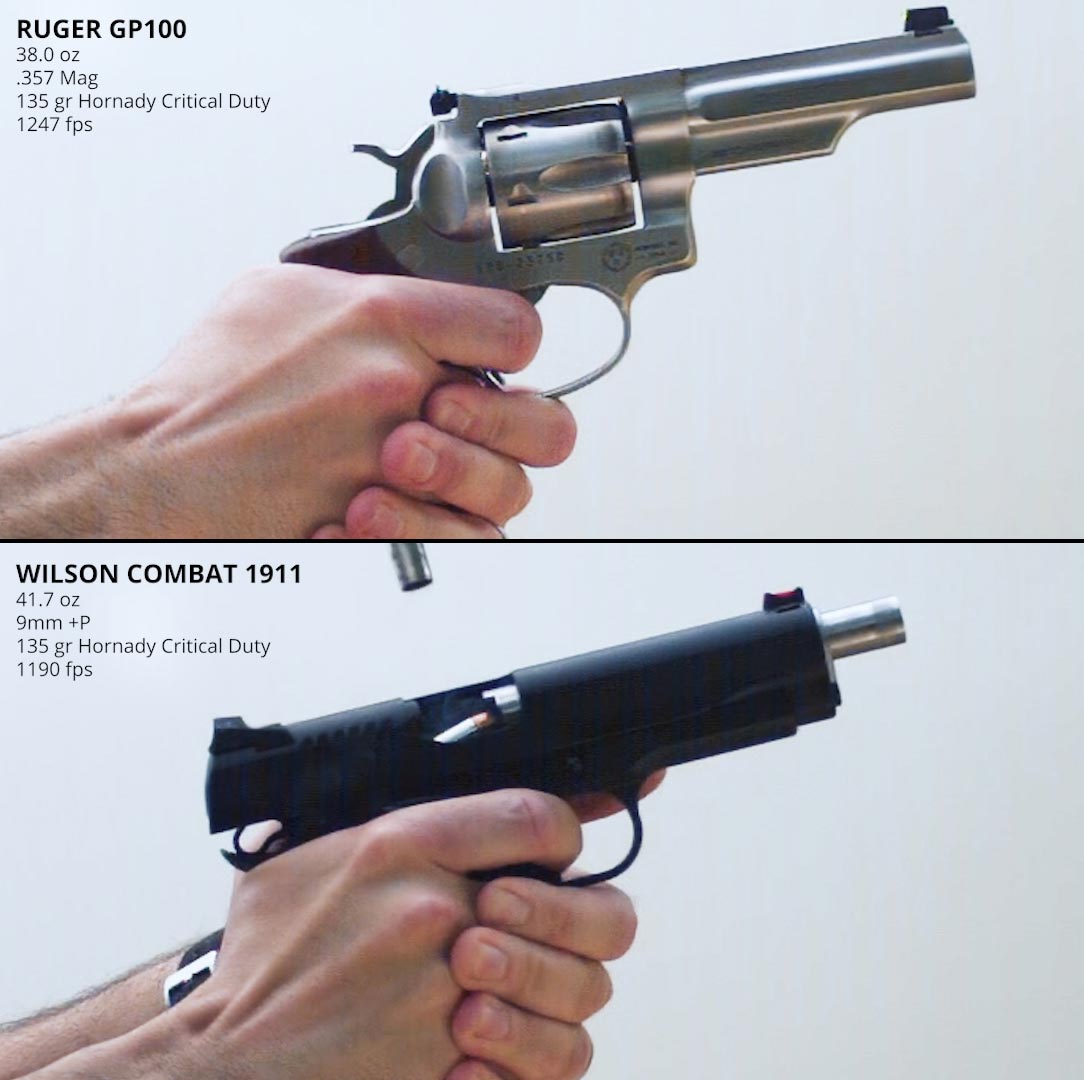
The most overt example is revolvers versus semi-autos. Here, we’ve got a Wilson 9mm 1911 and a Ruger GP100. They weigh about the same. They’re different calibers, but both are firing the same bullet weight at comparable velocities.
When you fire a revolver, all of the recoil energy is immediately transferred to your hand. With the 1911, there’s a short delay and the recoil is spread out over a longer period of time. The bore line of the revolver is also much higher relative to the hand and wrist. All of these factors combine to make the revolver feel like it has significantly more recoil even when the total amount of energy delivered to the shooter is roughly the same.
But there are other differences. For example, the revolver’s muzzle arcs up when it’s fired and immediately back down because of the pressure I’m exerting on the grip. The 1911 arcs up, and then there’s a moment when it seems to kind of stall. It’s moving back down, but very slowly at first. Then the slide closes and that has kind of a reverse recoil effect. It helps to push the muzzle back down on target.
If I speed it up some and let it play out, you can see another side effect of the slide movement. The force of the slide closing causes the muzzle end of the pistol to bounce up and down a few times. The revolver muzzle just snaps back on target and stays there.
I can still see the front sight on that 1911 while it’s bouncing around. If I’m just trying to throw rounds into the center of a big cardboard silhouette, I don’t have to wait for that sight to completely settle before I fire another shot. But it’s not ideal, and I much prefer the way the sights track on the revolver, even though it takes more effort to control the recoil.
Again, there is some subjectivity here. If you shot these two guns, you’d probably notice some differences but they might not be the same ones I just mentioned. Except that the revolver has more felt recoil – that’s pretty universal.
Small-Frame Revolver vs. Pocket Pistol
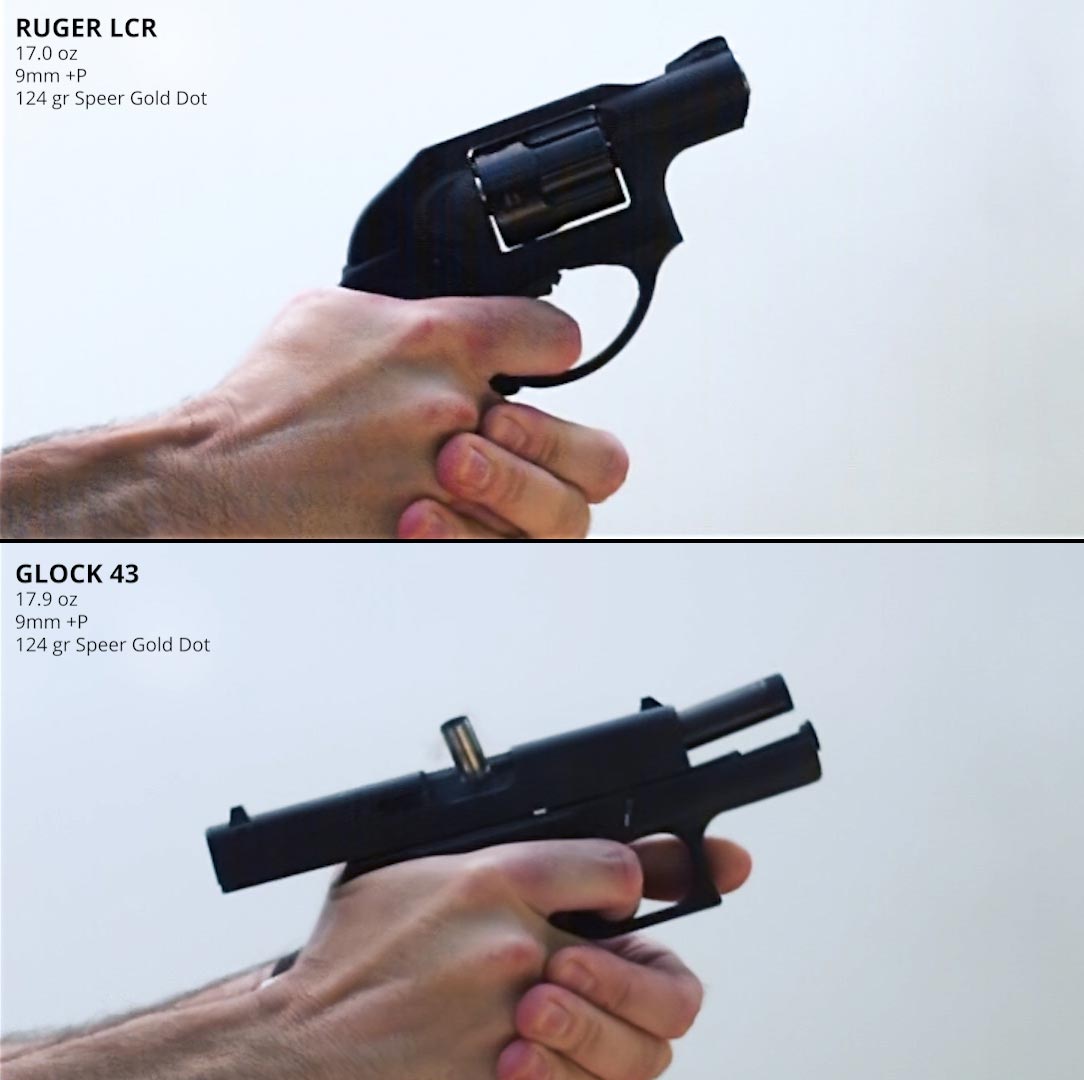
Let’s look at another revolver-semi-auto pair. This time, a Ruger LCR and a Glock 43, both in 9mm firing Speer Gold Dot 124 gr +P.
These are much lighter guns, so the felt recoil is more severe. Again, more so with the revolver. The LCR has a decent-sized grip compared to the Glock, but even so, you can tell it really wants to free itself from my hands. It’s quite a handful with +P ammo.
This time, the revolver is the one that seems to stall at the top of the recoil arc. The short slide on this Glock takes less time to cycle than the big heavy 1911 slide. So that little assist from the slide closing happens sooner.
Both of these guns have a little bit of that muzzle bounce at the end. They also don’t return quite to the same spot they started – you can see that the muzzles are not level – probably because the grips have shifted slightly in my hands. I would have to deliberately re-align the sights before my next shot rather than letting my grip do all the work subconsciously.
I haven’t fired either of these guns in a long time. And as you can see, they’re very unforgiving. If you don’t grip a lightweight 9mm just right, the recoil is difficult to manage. Even tiny shifts in how the gun sits in your hand will often lead to erratic shot placement on target.
.380 ACP Blowback vs. Locked-Breech Felt Recoil
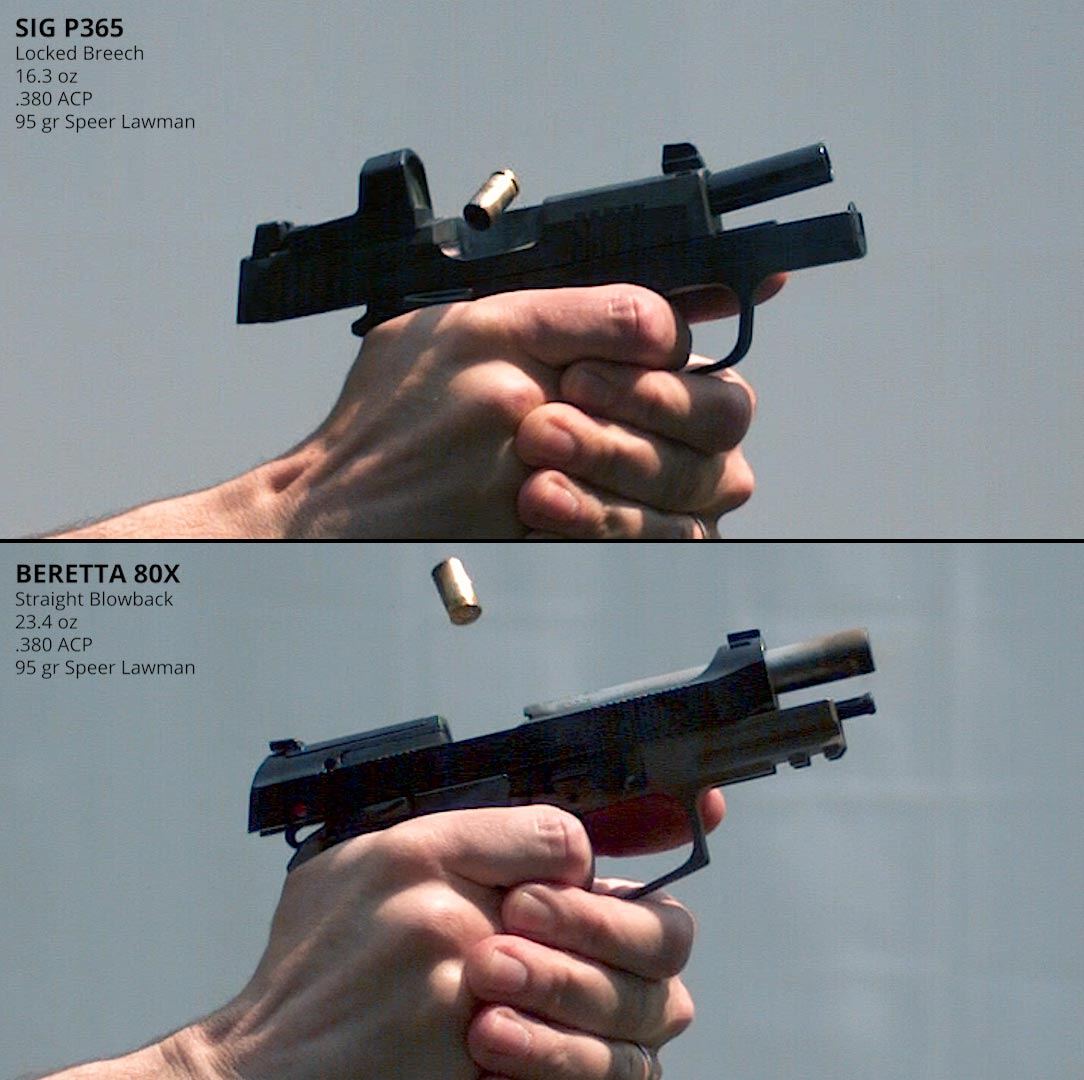
Let’s look at a different kind of comparison: blowback versus recoil operated pistols. Last time, I mentioned that I’m working on a review of this gun – the new Beretta 80X Cheetah. It’s an all-metal double stack chambered for .380 ACP. The recoil is not at all difficult to manage, but it’s also not insignificant. A lot of people use the word “snappy” to describe how this gun shoots.
That’s in stark contrast to something like the .380 version of the Sig P365. It’s a bit smaller and lighter than the Beretta, but the perceived recoil is very mild by any standard. That’s because the Sig is a recoil-operated or locked-breech pistol while the Beretta 80X is a straight blowback design.
A while back, I did a video on the difference between these pistol types in case you want the detailed explanation. For our purposes today, all you really need to know is that blowback pistols have a stationary barrel – only the slide moves. With a locked breech pistol, the barrel does move. It’s locked to the slide and they move together for the first couple of millimeters of travel, and then they unlock and separate.
You might have heard before that blowback pistols feel like they recoil more than locked breech pistols of the same size, weight, and caliber. But why is that, exactly?
I’m going to put the two side by side, but for now, focus on the Beretta. Let’s pause right there. At this point, the Beretta’s slide is completely open. So far, the frame and my hands are in exactly the same position they were at the beginning. Then that recoil force travels from the slide to the frame all at once and you can see my hand react.
I’ll play that again, but watch the Sig this time. We’re paused here at the same point. The Beretta slide is completely open but the Sig’s slide is not there yet. It takes a little longer, probably because the barrel was locked to it at the beginning. They’re not together for long, but it would be like if you had a ten year old riding piggyback for the first five feet of a hundred meter sprint – that’s gonna slow you down. We also can already see some muzzle rise at this point. The gun is not level anymore. If we go frame by frame, you can see movement begin in the pistol frame and my hand just after the barrel unlocks.
Since the slide is moving slower, it opens with less force than the Beretta slide. That results in less muzzle rise. Watch it one more time and pay attention to the back of my hand on the Beretta when the slide opens. That little ripple in the skin is probably what we’re feeling when we say a gun like this is “snappy.”
So we have two pistols firing the same cartridge. You’d expect to feel more of the recoil with the Sig because it’s a few ounces lighter. But because it’s a locked-breech design, that recoil is spread out over a longer period of time, which we perceive as less recoil. This principle has limits. For example, the Beretta 80X is far easier to manage than a locked-breech pocket pistol like the Ruger LCP. Not only is the LCP much lighter than the P365, the grip has very little surface area, which concentrates the recoil force and is not much fun to shoot.
.380 ACP Blowback vs. 9mm Locked-Breech
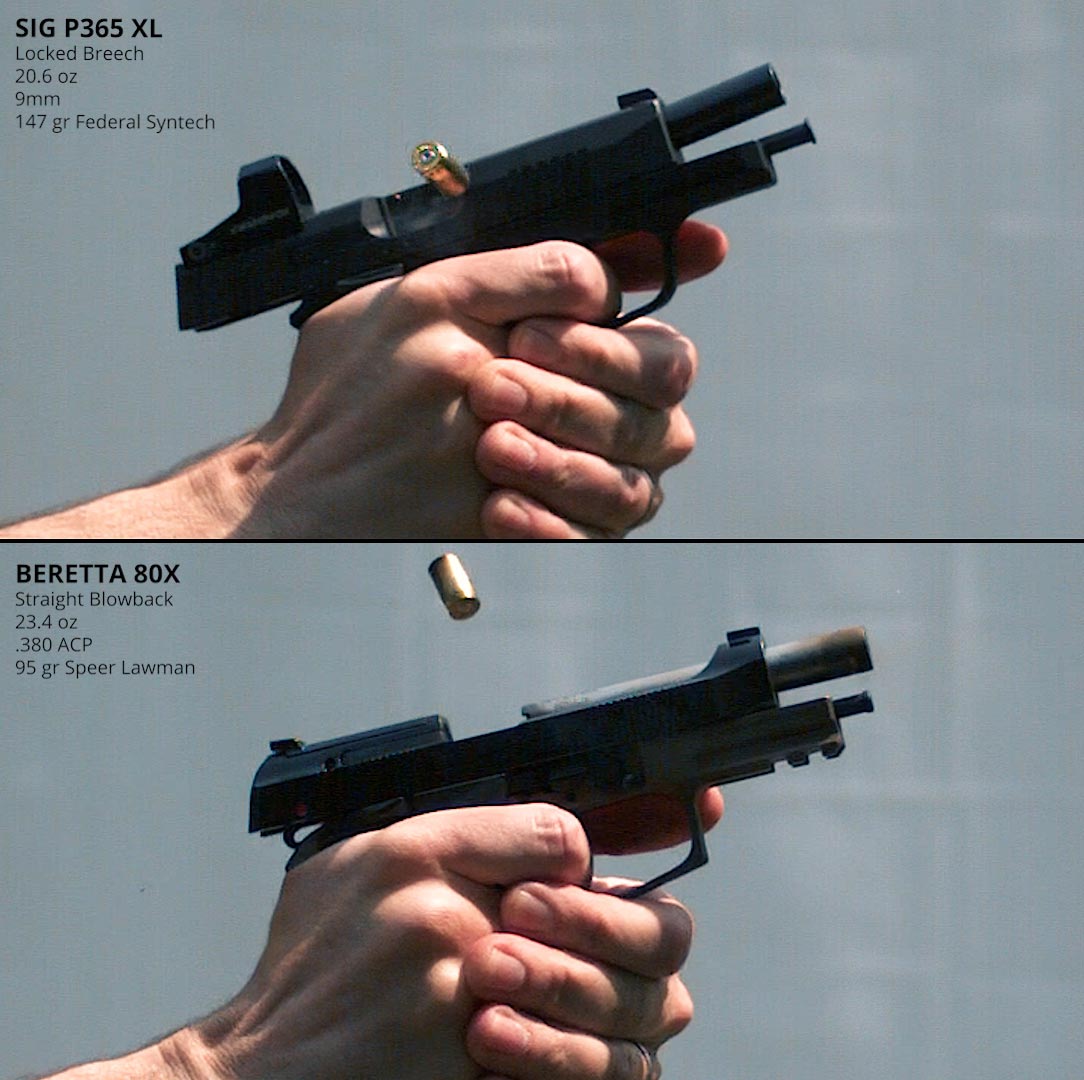
How about if we compare the Beretta to a locked-breech 9mm of similar size and weight? Something like this 9mm Sig P365 XL. That’s the gun I was reminded of after my first range session with the Beretta 80X. But then I shot them side by side, and they felt very different. The Beretta has a snap while the Sig has more of a push, which is what you might expect. But it also seemed like the Beretta’s sights returned to the target a little quicker than the Sig’s. It’s similar to what we saw with the GP100.
The 9mm Sig recoils like the .380 version, there’s just more of it. The impulse moves to the frame and the shooter earlier than with the blowback gun. But now watch the slides close. From fully open to fully closed, the Sig’s slide takes 33% longer than the Beretta’s. Like the 1911, The Sig slide appears to linger in the open position. That has an impact on my ability to recover from recoil. And then when the slide finally does close, the muzzle starts to come down, but also causes the frame to jerk forward in my hands a little, which I have noticed when I’m shooting.
In the meantime, the Beretta muzzle is already on its way back down from grip pressure alone, even before the slide is completely closed.
Does Any of This Matter?
Now, if we watch these guns in real time, this all seems pretty academic. And it is, depending what you want to do with the gun. With a halfway decent grip, they both seem to snap back onto target pretty much instantly. Any proficient handgun shooter should be able to manage the recoil in either of these guns well enough for practical purposes.
But if you go through ammo by the case instead of the box or if you’re chasing some high performance shooting goals, these little quirks in the perceived recoil do make a difference. Either consciously or subconsciously, we learn how to compensate for the unique recoil characteristics of each gun when we spend a lot of range time with it. If we then try to shoot a different gun, it might take a while to kind of recalibrate our technique. Of course, recoil is not the only factor. But if all handguns had zero recoil, switching from one to another would be relatively trivial.
Like I said last time, watching these clips may or may not have any practical value for you. But if nothing else, shooting is fun and so are high speed cameras. Hope you guys enjoyed it. If so, be sure to subscribe to our channel and the next time you need ammo, get it from us with lightning fast shipping at LuckyGunner.com.
Congressman Blake Moore (R-UT) and Congressman Jared Golden (D-ME) introduced the Tax Stamp Revenue Transfer for Wildlife and Recreation Act November 9 to reallocate the funding generated from tax stamp processing for the purpose of enhancing wildlife and habitat conservation and recreation programs. This change will supercharge funding for these critical funding streams while expediting processes at the Bureau of Alcohol, Tobacco, Firearms, and Explosives (ATF).
Tax Stamp Revenue Transfer for Wildlife and Recreation Act Details
Under the National Firearms Act of 1934 (NFA), all applicants seeking to transfer a suppressor are required to undergo a background check and pay a $200 tax stamp. This funding is currently deposited into the U.S. Treasury without any specific direction, even though total revenues generated from this tax are expected to approach $200 million this year.
The Tax Stamp Revenue Transfer for Wildlife and Recreation Act would strategically allocate these taxes to both support wildlife conservation and recreation and expedite ATF processing. Specifically, 15% of the total revenue would go to the ATF’s NFA division, aimed at expediting the processing of suppressor applications. The remaining 85% would be split further: 85% would be allocated to the Pittman Robertson Wildlife Restoration Trust Fund to support wildlife conservation, law enforcement, hunter recruitment, and other related lawful activities, while 15% would be provided for the development, maintenance, and operation of recreational shooting ranges. These dedicated ranges enhance safety, reduce environmental impact, and contribute to the recruitment and retention of ethical hunters and shooters.
I’m pleased to introduce the Tax Stamp Revenue Transfer for Wildlife & Recreation Act, an important bill that represents a transformative step in funding our nation’s wildlife conservation while streamlining federal processes. #utpolhttps://t.co/0ED82f3WSG
“I am pleased to introduce this important bill that underscores our commitment to conserving America’s natural heritage, investing in outdoor recreation, and making ATF’s processes for law-abiding citizens more efficient,” said Congressman Blake Moore (UT-01). “This bill represents a transformative step in funding our nation’s wildlife conservation while streamlining federal processes.”
“By paying fees for licenses and equipment, Maine outdoorsmen have sustained our state’s recreational opportunities for generations,” said Congressman Jared Golden (ME-02). “Applying this same principle to the sale of accessories like silencers will increase consistency with the law, bolster conservation efforts in Maine, and make the background check process more efficient and effective.”
Without changing the criteria for obtaining a suppressor, the Tax Stamp Revenue Transfer for Wildlife and Recreation Act would build upon our rich conservation heritage by increasing conservation funding and enhancing the capacity and efficiency of the ATF and FBI in the processing of applications for suppressors.
Directing ATF Tax Money Where We Want It
“This bill dedicates significant resources that would accelerate wildlife conservation and restoration efforts, such as habitat improvement, research and education. It’s a powerful commitment to conservation. It also improves ATF application efficiency, which will improve processing time for those seeking to legally obtain a suppressor.” -Joel Ferry, Executive Director of the Utah Department of Natural Resources
“The Tax Stamp Revenue Transfer for Wildlife and Recreation Act is a great opportunity to advance conservation and recreational shooting in this country by applying the revenue to areas that the consumers support. The additional funding for conservation will further advance the mission of the Mule Deer Foundation: ensure the conservation of mule deer, black-tailed deer and their habitat. The Mule Deer Foundation is proud to be a supporter of this legislation and we thank Congressman Moore and Congressman Golden for their leadership on this issue.” -Joel Pedersen, President and CEO of the Mule Deer Foundation
“SAM-ILA applauds the introduction of the Tax Stamp Revenue Transfer for Wildlife and Recreation Act. Conserving Maine’s wildlife by utilizing all the best hunting heritage tools that can generate the money to pay for them is always the best policy. Thank you Congressman Golden and Congressman Moore.” -David Trahan, Executive Director Sportsmans Alliance of Maine Institute for Legislative Action
“The Tax Stamp Revenue Transfer for Wildlife and Recreation Act will provide the single most consequential benefit to America’s wildlife, hunters and recreation that the Pittman Robertson Wildlife Restoration Trust Fund has received since it was signed into law in 1937, cementing the North American model of wildlife conservation for the next hundred years. I thank Congressman Moore and Congressman Golden for their leadership and for their commitment to conservation and America’s sportsmen.” -Brandon Maddox, CEO of Silencer Central & Congressional Sportsmen Foundation Board of Directors
Supporting Wildlife & Recreation Shooting
“The Tax Stamp Revenue Transfer for Wildlife and Recreation Act is no-nonsense legislation that will keep pace with the user-pays wildlife conservation efforts that have made the North American Model of Wildlife Conservation the envy of the world. Increasingly greater numbers of hunters use suppressors to harvest wild game, as it is legal to do so in 41 states. Suppressors are a safety tool that protects hearing and reduces noise pollution. This legislation is in keeping with the modern application of suppressors to ensure the taxes paid for suppressors are applied to wildlife conservation, recreational shooting range construction and improvements and reducing the lengthy processing backlogs for suppressor approval by the Bureau of Alcohol, Tobacco, Firearms and Explosives. Firearm and ammunition manufacturers fulfill a critical role funding wildlife conservation and this bill would bring the taxes paid by suppressor customers into those same vital efforts.” -Lawrence G. Keane, NSSF Senior Vice President and General Counsel
“Delta Waterfowl is proud to support the Tax Stamp Revenue Transfer for Wildlife and Recreation Act. This bill will provide a major boost to hunter supported conservation of America’s ducks and waterfowl habitat across the four North American flyways. Delta recognizes the leaders of this bipartisan effort, Representatives Moore and Golden, and offers its support to pass this bill into law.” -John Devney, Chief Policy Officer of Delta Waterfowl
“The Association of Fish & Wildlife Agencies thanks Representatives Moore and Golden for their steadfast support for conservation. Building on the proven success of the Pittman-Robertson Act will strengthen the partnerships between hunters, target shooters, and manufacturers that enable state agencies to manage healthy habitats, ensure abundant wildlife populations, and provide accessible outdoor recreational opportunities for the public.” -Chuck Sykes, Director of the Alabama Division of Wildlife and Freshwater Fisheries and President of the Association of Fish and Wildlife Agencies
“The Tax Stamp Revenue Transfer for Wildlife and Recreation Act will provide a significant plus up to the Pittman-Robertson account for the purposes of bolstering recreational shooting opportunities and enhancing wildlife conservation. Moreover, the legislation will provide ATF with the resources they need to process firearm suppressor applications in a timely manner. We are thankful for Congressional Sportsmen’s Caucus (CSC) Member Rep. Moore and CSC Vice Chair Rep. Golden for introducing this legislation that will support our hunters, target shooters, and our state fish and wildlife agencies through expanding Pittman-Robertson.” -Jeff Crane, President and CEO of the Congressional Sportsmen Foundation
“Safari Club International applauds the introduction of the Tax Stamp Revenue Transfer for Wildlife and Recreation Act. Expediting ATF processing while directly benefiting conservation is a win-win for all hunters and wildlife. Thank you Congressman Moore for your leadership.” -Ben Cassidy, Executive Vice President, Safari Club International
“For more than 80 years sportsmen and women have funded conservation through their purchases. We applaud Reps. Moore and Golden for this innovative bill that will build upon this tradition and commit additional resources to restoring wildlife habitat and supporting state-level professional wildlife management.” -Collin O’Mara, CEO of the National Wildlife Federation
“TRCP appreciates Rep. Moore and Rep. Golden for their leadership to increase funding for conservation through the Tax Stamp Revenue Transfer for Wildlife and Recreation Act. This bill will help fund projects that support abundant wildlife populations and public access for hunting and fishing.” -Whit Fosburgh, president and CEO of the Theodore Roosevelt Conservation Partnership
We may earn revenue from the products available on this page and participate in affiliate programs. Learn more ›
There are essentially three ways buy a gun. You can purchase one from a dealer, place an online order, or buy directly from an individual. Though the Second Amendment guarantees your right to keep and bear arms, factors such as where you live, your citizenship, legal status, and mental state play a role in your ability to purchase a firearm. Not only must you comply with federal law, but you must also adhere to all state and local regulations. Let’s look at the process of how to buy a gun and some of the restrictions.
How to Buy a Gun Directly From a Dealer
Caption Adobe Stock / JackF
Walking into a gun store and buying a gun is the most common method. Those operating a business for the purpose of selling firearms must have a Federal Firearms License (FFL), and all licensed dealers must follow all federal, state, and local laws as they relate to firearms transfers. At the most basic level, you and the dealer complete ATF Form 4473. You provide identification and the dealer must verify that your answers to the questions on the form are not prohibiting we’ll get to that in a minute). Next, the dealer will conduct a background check on you, but in about half the states a concealed weapons permit exempts you from that.
A background check compares the information you provide on Form 4473 with data in the National Instant Criminal Background Check System (NICS). A response is typically immediate, and the transfer is either approved, delayed, or denied. An approval is good for 30 days. If it’s delayed, some of your data likely matched that of someone who is ineligible, and the FBI has three days to sort it out. If it’s denied, you’re either prohibited or have been falsely identified. If denied, you can challenge the ruling. Additionally, dealers have the authority to deny a firearms transfer to anyone based on their own discretion.
Age and Address Matter
According to Federal law, a licensed dealer cannot sell a long gun—a rifle or shotgun—to anyone under the age of 18, and they cannot sale a handgun to anyone under the age of 21. However, when the transfer is between unlicensed individuals (no FFL), there is no age restriction on the transfer of a long gun and transfers involving a handgun must be to a person who is at least 18 years old.
Federal law also prohibits the sale of handguns to anyone who is not a resident of the state where the seller is located. There is no federal restriction on the sale of long guns to residents of another state, but some states prohibit it. This might seem confusing because you can buy a gun on the Internet, so how does that work?
How to Buy a Gun on the Internet
Buying a gun over the Internet is really just another way to purchase a firearm through a dealer. All the Internet does is provide you a shopping experience with more options. Various online listing services for new and used guns allow you to shop nationwide for the gun you want to buy. But when you purchase on the Internet, you’re only conducting a financial transaction, you’re not actually conducting the transfer or taking ownership of the firearm. Once you’ve paid for the gun you must provide licensed dealer information to the seller so the gun can be shipped there. When the gun arrives, you must go to the dealer and complete the transfer paperwork and background check as normal. You’ll also have to pay the dealer for their transfer services.
Individual Transfers
The legality of purchasing a gun from another individual is not prohibited by federal law, and federal regulations do not mandate a background check be performed. However, there can be local restrictions that limit or prohibit such transfers. Regardless, purchasing a gun from an individual is not a way to get around the federal restrictions associated with firearm purchases. If you cannot legally purchase a gun from a dealer, you cannot legally purchase a gun from an individual. Also, though there is no Federal requirement to document the sale of a gun between individuals, it’s a good idea. That way you can later identify the seller should the gun turn out to be stolen or somehow related to a crime.
Prohibited Purchasers
There’s a long list of reasons that you might be prohibited from buying a gun, and they apply no matter the method of transfer, even if you’re buying from an individual. You cannot buy a gun if you are a felon, a fugitive from justice, or an illegal alien. Additionally, you cannot buy a gun if you have been adjudicated as mentally defective, have a restraining order for stalking or harassment, have a domestic violence conviction, or have been involuntarily committed to a mental institution. You also cannot buy a gun if you’re an unlawful user or addict of controlled substances, have been dishonorably discharged from the U.S. Armed Forces, or if you’ve renounced your United States citizenship. These are all questions you must answer on the Form 4473, and that the dealer must review. And some of these things can be identified during the background check.
Doing the Deal
Beyond the legal requirements, when buying a gun, you want to get the best deal possible. Whether you’re buying from a dealer or individual, there’s always some negotiation. Understand there’s not a lot of markup on gun prices; dealers make most of their money on ammunition and accessories. You can shop around and find the best price, but instead of asking for a discount on the gun, pay the asking price and try to get a discount on some ammo or accessories like a riflescope, a sling, or a gun case. When buying from an individual, haggle all you want, as that’s half the fun.
It has been almost a decade since Garmin first introduced its Tactix watch. Since that time, the company has continued to bolster the model with features for the outdoor, tactical, and shooting industries. And now, Garmin introduces its latest upgrade to the Tactix 7 series with the AMOLED Edition. This new model delivers an adaptive AMOLED screen, optimized heart rate sensor, and night vision compatibility.
The Garmin Tactix 7 AMOLED Edition
The Tactix 7 AMOLED Edition is built to military standards (MIL-STD-810) for thermal, shock, and water performance. Featuring a fiber-reinforced polymer housing and titanium rear cover, the Tactix is ready for hard use in harsh environments. Likewise, rated to 10 ATM, the watch is capable of pressures equivalent to a depth of 100 meters.
In addition, the carbon gray DLC (Diamond-like coating) titanium bezel pairs with a scratch-resistant sapphire lens for ultimate protection. Similarly, the touchscreen pairs with traditional button controls for easy operation.
The new vibrant, sunlight-readable, adaptive AMOLED display delivers higher detail and can be dimmed below a single nit of brightness. Likewise, while in NVG mode, the display dims to levels functional to the user (even with night vision devices). However, the display remains nearly invisible to others, letting you go undetected.
Similarly, the Tactix 7 AMOLED includes a night vision-compatible flashlight. Building on the original white/green flashlight, the AMOLED now offers a dimming feature with the green flashlight. This allows users to preserve natural night vision while Night Vision Goggle (NVG) mode is activated.
(Photo by Garmin)
Another new feature focused on night vision is Red Shift Mode, which changes the entire watch face to shades of red. This helps preserve night vision by blocking the colors of light that constrict pupils. Along with helping to preserve night vision, this also helps reduce sleep cycle disturbances.
Additional Features
Along with the updated display, the Tactix 7 also receives an updated heart rate sensor for improved performance tracking. Likewise, other health and wellness tools, including Pulse Ox, respiration, and stress tracking, help you monitor and evaluate your progress. Additionally, wellness insights like Body Battery, Fitness Age, Morning Report, and Sleep Score with Advanced Sleep Monitoring let you evaluate your overall wellness.
Civilian and military aviators will benefit from the Direct-to-Navigation feature. This directs users to the nearest airport in the world aeronautical database. Likewise, users can access aviation weather, including NEXRAD radar, METARs, and TAFs to see winds, visibility, barometric pressure, and more. In addition, Jumpmaster provides functionality for HAHO, HALO, and Static jump types during airborne operations.
Delivering the global navigation features Garmin is known for, the Tactix 7 AMOLED accesses multiple frequencies from navigation satellites for improved position accuracy. Likewise, it comes preloaded with TopoActive maps, Public Land Boundaries Maps, SkiView Maps, and over 43,000 full-color golf courses.
The feature-rich smartwatch offers everything the outdoorsman could want, like altimeter, barometer, compass, and more. Also, customers who want enhanced shooting solutions can unlock the Applied Ballistic functionality for an unlock fee.
(Photo by Garmin)
The Tactix 7 AMOLED Edition ships with a black tactical nylon QuickFit band that is easily swapped out without tools. As a result, you can go from field to formal in under a minute.
“This highly adaptable, modern tactical smartwatch is ready for any environment or assignment. Its dedicated features are designed to meet the many unique situations tactix customers find themselves in, and most importantly – it will serve their needs efficiently and effectively. You can depend on this watch day or night, wherever the mission takes you.” – Dan Bartel, Garmin Vice President of Global Consumer Sales.
Editor’s Note:
I am an avid fan of the Garmin Tactix watches and have been wearing them since the first model. In fact, the first model made a trip to the Amazon jungle with me and faced some hard use. Years ago, I gave that watch to a friend in the Air Force who has worn it in Afghanistan on a couple of tours, and he still has it today.
I have been wearing the original Tactix 7 since it came out, and it is a beast. There are no environments or activities that prevent me from wearing it. But I will admit, I am excited to see the new AMOLED display in person.
Availability
The Garmin Tactix 7 AMOLED is available now with an MSRP starting at $1,399.99. For more info, please visit Garmin.com.
Pistol size categories are notoriously ambiguous. What’s the difference between a micro compact and a subcompact? We don’t know, and we’re pretty sure nobody else does either. But we do have some tips for how to evaluate a pistol’s size when you can’t handle it in person.
Details are in the video below, or scroll down to read the full transcript.
Hey everybody, I am Chris Baker from LuckyGunner.com and today I’m going to talk about handgun sizes. Specifically, I want to share some thoughts on how those sizes are categorized and then I’ve got a few tips that might be helpful whenever you’re evaluating a pistol’s dimensions and you’re not physically holding that gun in your hands.
This is a topic I bring up fairly often and that’s because size is important. A handgun’s physical dimensions – its size, shape, and weight – largely determine how well it will fit our hands and whether we’re likely to find it comfortable and concealable as a carry gun. The number of handgun models on the market has exploded in recent years. Even a well-stocked gun shop is unlikely to have a sample of every model you might want to look at. So we do a lot of our comparison shopping online.
Handgun Hero is an excellent resource for basic size comparisons. You can pick two handgun models and it’ll show you correctly-scaled images side by side. That helps a lot, but you still have to take it with a grain of salt. Unfortunately, it’s difficult to get a true sense of a handgun’s overall size just from seeing it on a screen or reading the specifications.
Pistol Size Categories
This has all been made a lot more complicated by the way pistol sizes have evolved in the last decade or so. For a long time, most semi-autos were based on full size or duty size pistols, usually with a double stack magazine. A compact was basically a duty pistol with two or three quarters of an inch chopped off the slide and the grip. Shave off a little bit more and you get a subcompact. Smaller calibers got their own unique designs called pocket pistols.
There have always been exceptions and guns that blurred the lines between the categories, but things really started to change around 2011-2012. That’s when the polymer single stack 9mm pistols like the Smith & Wesson Shield began to dominate the concealed carry market. It was nice to have all of these new options, but it did complicate our conversations about carry guns. We couldn’t just say “compact” and “subcompact” anymore. We had to specify “single stack” or “double stack.”
That wasn’t really a problem until the 2017 release of the Sig P365. It was a bit smaller than most of the single stack nines, but it had a double stack – or more like a one and a half stack — magazine with higher ammo capacity. That started another industry trend with every gun company trying to figure out how to cram double digit capacity into guns the size of their old single stacks.
We needed a name for this new category, and the one that seems to have stuck is “micro compact.” What’s the difference between micro compact and subcompact? Do the single stacks also count as micro compact? Nobody knows, and we’re all just making this up as we go along.
The latest evolution is exemplified in the Sig P365 XL. A micro compact with a longer slide and grip, followed by the P365 XMacro with an even longer grip. A few other companies have jumped on board with larger versions of their micro compacts like the Springfield Hellcat Pro. I’m not sure we have a name for these yet. I’m going to go with “longslide micro compact.”
What Does “Compact” Even Mean?
But maybe we don’t need a name for these because some of them are virtually the same size as the old style compact double stack pistols. And if you weren’t confused already, this is where things really get weird.
Why does Sig have the P365 XMacro and the P320 XCompact? On paper, they look like they would fill the same role, so how would you choose one over the other? Why does Smith & Wesson have the Shield Plus 4-inch and the M&P 4-inch Compact? Or how about the Springfield Hellcat Pro and the XD-M Elite Compact?
I don’t think the gun companies planned it this way. They already had the compacts in their lineup. Then the micro compacts got popular but some people wanted them to be a little bigger. Now there’s overlap.
In any case, we’ve got a ton of options now, and many of them, even when they come from the same manufacturer, appear to be roughly the same size. But a lot of these similarities are only superficial. So let’s take a look at how we can spot some subtle but very important distinctions.
Beyond Basic Dimensions
We’ll start with those two Sigs I just mentioned. At a glance, the most significant difference appears to be length. The XCompact is about four tenths of an inch longer. That’s probably not going to make a huge difference in terms of comfort or concealability. What’s going to be more noticeable is the overall bulk. To some extent, we can see that in the width measurement. The XCompact is two tenths of an inch wider. Another trick we’ve used to visualize this in some of our past reviews is to overlay the two profiles and give them different colors.
Look at the distance from the top of the slide to the bottom of the trigger guard. That is a significant difference. The XMacro has a much smaller footprint. A holster made for that gun will take up less room. That gives you more flexibility in where you place the gun on your waistband to find that concealment sweet spot.
Also take a look at the grip from front to back. Again, the XMacro is shorter in that dimension. That’s less gun that has to be concealed by your cover garment. However, it also means less surface area for your hands, so the Compact might end up being easier to shoot, depending on your hand size.
You can actually try the overlay trick yourself in Handgun Hero if you scroll down to where it says “tabletop comparison” and click the color palette switch. That’ll give you a better sense of overall size.
Footprint, Width, and Bulk
I’ve got another comparison to consider. After my review of the Beretta 80X, I got several requests to compare it to the Beretta PX4 Compact. That’s not a comparison I would have thought of, but when I looked at the specs on Beretta’s website, the two guns are within a tenth of an inch of each other in terms of height, length, and width.
But while I was making these graphics, I actually discovered that Beretta’s numbers are not quite right. Here’s what I got when I measured these guns myself. The main issue was the height. Beretta lists the 80X as one tenth of an inch shorter than the PX4 Compact. With a magazine in both guns, the 80X is actually three tenths shorter. So that’s another thing to keep in mind. The data you find online might not actually be correct.
If we do the overlay trick, we can see that the 80X has a smaller overall footprint. Even though it’s based on a design from the 1970s, the footprint is similar to a modern longslide micro compact.
Beretta lists both the 80X and the PX4 Compact as 1.4 inches wide, but that’s a little deceptive. That’s the width at the safety/decocking levers. The slide and the grip measure about 1.1 inches on both guns. But when you handle them in person, the 80X just doesn’t feel as wide. It has much more variation in its contour. The PX4 is wide everywhere. The 80X tapers in at the center of the frame. It’s got the open top slide. It’s not just the footprint that’s smaller, the 80X occupies less volume overall and that kind of thing is noticeable when you’re carrying it every day for several hours.
Or maybe it’s not noticeable for you. All of this is pretty subjective.
Let’s look at one more comparison: the Glock 26 and 43 – an old-style double-stack sub-compact and a single stack nine (which is also a subcompact, or possibly a micro compact, depending on who you ask). The profiles here are functionally identical. They look like basically the same gun except that the 43 is a quarter inch thinner and holds four fewer rounds. But I wouldn’t be quick to dismiss that quarter inch width reduction. When we’re looking at width, a little bit makes a big difference.
If you grip these two guns, you can tell they’re really night and day. Neither one of them are great, ergonomically speaking. I find the 43 to be a bit more difficult to control, but that’s going to be highly reliant on hand shape. In a holster, the 43 pretty much disappears for me, but the 26 is really awkward to conceal because of the width to length ratio. You wouldn’t necessarily guess any of that from looking at pictures online. Sometimes there’s just no substitute for hands-on experience.
You Have to Start Somewhere
Not too long ago, we had maybe a dozen or so decent options for reliable carry guns. You just had to pick something and figure out how to make it work, which is where we got the whole idea of “dressing around the gun” and other cliches that, I think, turned off a lot of people to the whole idea of concealed carry altogether.
Today, we are really spoiled for choice. There is a handgun out there to suit just about every need or preference you can imagine. We’ve gone from “make it work” to having the luxury to choose what’s optimal for our individual situation. But sometimes that can lead us to that whole problem of “analysis paralysis.” Hopefully, the stuff I talked about today will help you avoid that trap. Or maybe I actually made it harder to decide. I hope not.
Either way, keep in mind, there are no perfect solutions and there are plenty of options that are probably good enough for you. Just pick something. Buy a high quality holster. Get out to the range and practice, and be sure to buy some ammo from us with lightning fast shipping at LuckyGunner.com.