Home Blog Page 16

Video: Two Bull Moose Battle on Highway

0

There’s “sparring,” and then there’s “fighting.” And this is fighting. 

A recent video shows a truly brutal battle between two bull moose. The footage was initially shared on YouTube to an account known as “scorpion3375” on October 19 before being reposted on social media by Nature Is Metal earlier this week. 

Scorpion3375 did not disclose the exact date or location of the fight. The footage begins showing two big moose clashing antlers on a small dirt road. One of the moose soon gains the upper hand and charges into the broad side of the other moose, forcing it to stumble backwards down a steep slope. As it does so, the retreating moose tips over and crashes onto the side of a two-lane highway. 

“Holy s•••,” exclaims someone in the background. The dominant moose keeps the other moose pinned to the ground for a moment. The other bull lies still before clambering back to its feet. Both moose then resume battling while struggling to keep their footing on the asphalt. One of the moose again forces the other to fall on the road as the battle continues within feet of some construction equipment. It ends with both bulls in a seeming dead heat. 

While this is one of the fiercest moose vs. moose battles I’ve ever seen, rut battles are a common occurrence each fall. According to the National Park Service, “Bull moose are well-equipped to fight…Their shoulders are huge, and during the rut, their neck muscles expand to twice their normal size. Thick forehead skin acts like armor against punctures.”

Read Next: 72-year-old Man Survives Brown Bear Mauling in Alaska

“Sparring is practice fighting that bulls use to gain experience. It superficially resembles fighting as two or more bulls engage their antlers and push each other back and forth,” explains the agency. “Fighting is far more serious and violent. At worst, sparring results in minor breakage of antlers or perhaps minor wounds inflicted by accident. Fights often result in serious injuries, and at worst, result in death.”

New Concealed Carry Clothing from SHOT Show 2023

0

They say that clothes make the man/woman. I don’t know whether that is true or not. Personally, I feel that character makes the man/woman. However, when it comes to concealed carry, I do feel that clothing makes a difference. For that reason, I found some great clothing for carrying concealed while at SHOT Show 2023.

Concealed Carry Clothing from SHOT Show 2023

5.11 Hog Hunter S/S

Ok, like most of you, I am done with winter. It can go ahead and take off now and make way for warmer temps. With warmer temps comes lighter shirts like the Hog Hunter S/S from 5.11 Tactical. Featuring Vent-Tac properties, side vents, and a wicking finish, the Hog Hunter will keep you comfortable when things heat up.

Speaking of heating up, if your situation starts to get volatile, a center-front RAPIDraw placket with faux button snaps provides instant access to your concealed pistol.

For more information, please visit 511Tactical.com.

5.11 Defender Flex Jeans

5.11 Defender Flex Jeans: Concealed Carry Clothing.

I have been wearing Defender Flex jeans for a while now and really like them. However, earlier versions had very shallow pockets, which doesn’t work for me because I use my pockets. But 5.11 has changed that in its latest Defender Flex jeans with deeper pockets—perfect for pocket carry or EDC.

Constructed of innovative cotton/polyester mechanical stretch denim offers excellent stretch and recovery. As a result, the jeans remain comfortable all day, regardless of the level of activity involved. Additionally, each side features an extra rear yoke pocket, perfect for carrying an extra magazine or two.

For more information, please visit 511Tactical.com.

Viktos Zerodarker Down Jacket

Viktos Zerodarker Down Jacket.

As long as we’re stuck with winter for a little while longer, it doesn’t hurt to dress for the occasion. Constructed of mini-ripstop nylon, the Zerodarker from Viktos includes a megapack of 750-fill power-down insulation. As a result, you stay warmer longer in colder conditions. Likewise, NyCo reinforced elbows and shoulder overlays provide additional protection to the ripstop material. Not to mention offering additional protection for your shoulder when carrying a rifle.

However, when things go south is where the Zerodarker really shines. Fourstack dedicated rifle magazine chest pockets ensure you keep your rifle fed for the long haul. Likewise, Wingman upper chest pockets offer additional room for pistol magazines or other accessories. When it comes time to access your concealed carry pistol, each side features a Gunvent sidearm access zipper.

For more information, please visit Viktos.com.

Viktos Range Trainer Jersey

Viktos Range Trainer Jersey: Concealed Carry Clothing.

One thing I do like about cooler weather is that coats, jackets, and hoodies make it a lot easier to carry via a shoulder holster. However, even with the right holster, after a day of wearing a shoulder holster, it can be hard on the shoulders and garment. That is where the Range Trainer Jersey from Viktos comes in.

Making a good underlayer, the jersey features NyCo shoulder overlays for additional reinforcement. As a result, the shoulders are better protected from friction from slings, plate carriers, and shoulder holsters. During warmer days, the long sleeves protect your arms from UV rays, while the Coolmax/cotton blend keeps you from overheating.

For more information, please visit Viktos.com.

Beyond Clothing Arx 2.0 L6 Rain Jacket

Beyond Clothing Arx 2.0 L6 Rain Jacket.

Featuring a 3-layer Lutra waterproof membrane, the Arx from Beyond Clothing is ready for inclement weather. Likewise, rugged CORDURA ensures that the jacket can handle hard use in the backcountry without taking undo damage. A 20,000mm/20,000g waterproof/breathable rating keeps you and anything under/in the jacket protected from drenching downpours.

However, when heading into the backcountry, or city streets, concealed carry is a must. For this reason, Beyond Clothing included side zippers for quick access to your firearm when you need it most.

For more information, please visit BeyondClothing.com.

Dene Adams Concealed Carry Corset

Dene Adams Concealed Carry Corset: Concealed Carry Clothing.

Designed with the same benefits as actual shapewear, the Concealed Carry Corset from Dene Adams has a hidden surprise. Specifically, a holster and magazine pouch. The corset molds to your figure to better conceal your firearm or personal protection device. Correspondingly, the soft holstering compartment features a fast breakaway tab for increased draw time.

Providing all-day comfort, the corset features a new lightweight mesh back and fits under any garment. Likewise, the new corset offers twice the accessory storage in front. If you’re going to wear a corset, you might as well do it right and carry your firearm with it.

For more information, please visit DeneAdams.com.

Dene Adams Thigh Holster Shorts

Dene Adams Thigh Holster Shorts.

Dresses and skirts have a tendency to make concealed carry difficult for women. However, Dene Adams addresses this with the Thigh Holster Shorts. Featuring an inner-thigh holstering compartment (in your choice of right- or left-handed draw) you can keep your firearm close. As a result, you don’t have to worry about printing at all.

Taking into consideration the potential for the gun grip rubbing, Dene Adams positioned the holstering compartment appropriately. The compartment fits any personal protection device, such as a firearm, taser, pepper blaster, knife, stun gun, etc. Likewise, an additional accessories compartment rides on the outside of the opposite thigh for extra magazines, knives, etc.

For more information, please visit DeneAdams.com.

Madison Creek Outfitters Kennesaw

Madison Creek Outfitters Kennesaw: Concealed Carry Clothing.

Named for a town that once required every head of household to own a firearm with ammunition, the Kennesaw offers the ultimate in concealment. The vest from Madison Creek Outfitters features two specially designed interior pockets for concealed carry. Correspondingly, a removable holster comes with each vest. Likewise, an exterior vertical zip pocket provides storage for extra magazines.

The Kennesaw is constructed of Travel Twill (65% cotton/35% polyester) for extended life. Further expressing its intent, the Kennesaw proudly displays a Second Amendment lining graphic.

For more information, please visit MadisonCreekOutfitters.com.

Nexbelt NTAC-45

Nexbelt NTAC-45.

I’ve been wearing Nexbelt for a year now and cannot see any reason to go back to any other belt. So, I had to take a look at what they had at SHOT Show for 2023. Constructed of durable nylon materials that can withstand heavy loads, the NTAC-45 can carry anything you can and more. Likewise, the updated buckle features a double-trigger buckle mechanism for additional security.

Additionally, the NTAC-45 features an upgraded heavy-duty track system, so it can easily handle heavy loads. However, it is worth noting that the new NTAC-45 is 1.75 inches, so it is better suited to IWB or wide looped OWB, or duty holsters. Easy to resize at home, the NTAC-45 will fit up to a 50-inch waist. But it can be adjusted to fit much smaller waists.

For more information, please visit Nexbelt.com.

Didn’t find what you were looking for?

My Everyday Carry Gear and Why It’s “Wrong”

0

What have I got in my pockets? After numerous requests, we’re taking a look at my own personal everyday carry gear. Then, we’re going beyond the gear to break down the reasoning behind my approach to concealed carry and other carry gear, why it’s probably different from yours, and some tips for finding the best carry hardware for you.

Details are in the video below, or keep scrolling to read the full transcript.


Hey everybody, I am Chris Baker from LuckyGunner.com and today I’m going to talk about all the junk I carry around all the time, or what the cool kids call EDC or Everyday Carry.

I’ve put off doing a video like this because it always seemed a little immodest to assume the world should care about the mundane crap I keep in my pockets. But you guys do ask about my carry gear on a fairly regular basis. Mostly my carry gun and holster, but I also get questions about my watch and my pocket knife and stuff like that. So we’re gonna do this. But we’re gonna do it my way. Which means I’m gonna start off talking about the gear, but then we’re going to dive into some related issues that you guys had no idea you were signing up for when you asked for this. But you did ask for it, so you only have yourselves to blame.

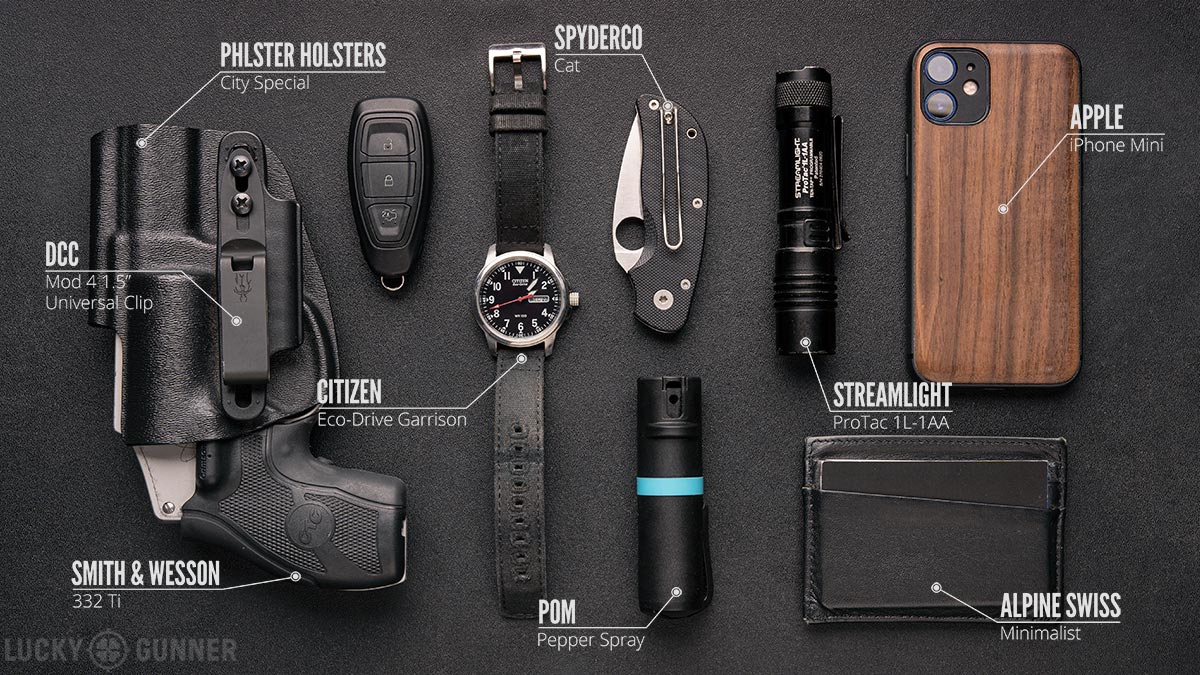
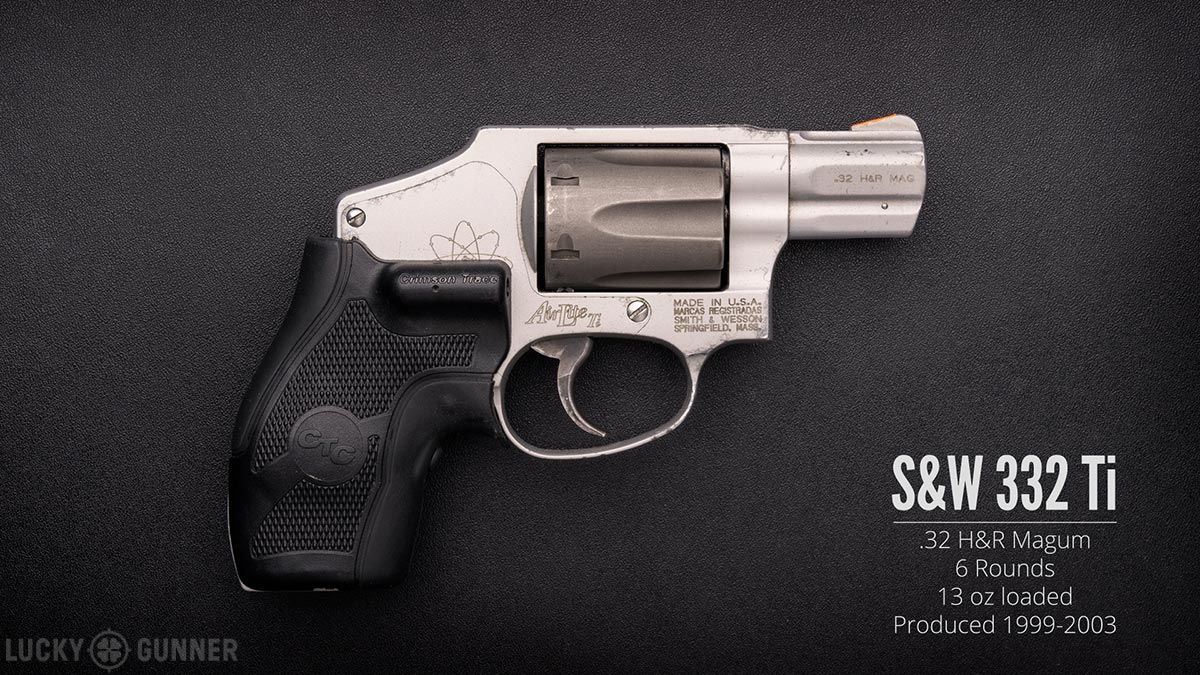
Let’s take a look at what we’ve got here. My carry gun is a Smith & Wesson Model 332 Ti snub nose chambered for .32 H&R Magnum. I carry that in a Phlster City Special holster with a DCC belt clip. The knife is a Spyderco Cat. For a flashlight, I carry a Streamlight Protac 1L. The watch I wear most of the time is a Citizen EcoDrive. I’ve also got a POM flip-top pepper spray dispenser. And then there’s my car key, an iPhone Mini, and my wallet, which is an Alpine Swiss Minimalist.

Why a Snub Nose?

I’ll talk a little more about the gun first because that’s probably what you all came here for. The gun I’m carrying day to day changes a lot more frequently than any of my other carry items. Part of that is just because of the nature of this job. But there are other reasons, and I’ll get into those more in a minute.

I always end up coming back to a lightweight snub nose revolver. My favorite so far has been the Smith & Wesson 332 Ti. It has an aluminum frame and a titanium cylinder, making it among the lightest of the J-frames at just 13 ounces loaded. Smith only made J-frames in this caliber for a few years in the early 2000s and they’re tough to find today. I got lucky and picked this one up at a bargain price because of the worn finish. But mechanically, it’s still in great shape.

I installed a set of Crimson Trace laser grips – the shortest ones they make, model LG-405. Even without the laser, these have the best grip shape that I’ve found for J-frames. The ballistics of .32 H&R Magnum are comparable to .38 Special out of a 2-inch barrel, but with less recoil and six rounds instead of just five. My carry ammo is the Black Hills 85-grain jacketed hollow point. It consistently penetrates about 15 inches in ballistic gel tests and it also tends to have better availability than most other ammo in this caliber.
The main thing I like about snubbies is the ratio of weight to size. They can be extremely light, but they’re not so small that I have a hard time fishing one out of my waistband. The angle and size of the grip make them easy to draw consistently. Any semi-auto that weighs 13 ounces is going to have some ergonomic challenges to deal with that I don’t have with a J-frame or a Ruger LCR.

Other Carry Gear

I’m not going to go into a ton of detail about these other items. I’ve been carrying some of these things for a very long time. The knife and the watch, I’ve had for over a decade. I have duplicate backups of each of them. They’re nothing special. They weren’t very expensive. Most of the things here were relatively affordable. The stuff I carry gets knocked around and abused. Some of it gets lost on occasion. I don’t want to have to stress over whether I should use or carry something because I’ve got a lot of money invested in it, so I tend to stick with stuff that’s “decent but affordable.”

The knife is not a fighting tool. 95% of the time, I use it to open packages. The rest of the time, it’s a makeshift screwdriver or pry bar – things I would never do with a $300 blade, but this was 45 bucks, so… no big deal.

I’ve owned a few of the Streamlight Protacs and I like them, but that’s one piece of gear I will probably change at some point. I use the light multiple times every day and I end up changing the battery at least once a week. In the near future, I’d like to replace it with one that has a rechargeable internal battery.

I never leave the house without a pepper spray dispenser. If I happen to encounter a potentially violent situation, there is a very good chance it will not require a deadly force solution. Pepper spray offers an option that is, in the words of Chuck Haggard, “between a harsh word and a gun.” The POM formula is reportedly very potent stuff and the dispenser is one of the most user-friendly on the market. They’re affordable. I buy these by the case and give them out to friends and family. It’s really hard for me to find a reason not to carry something like this every day.

A Minimalist Approach to Concealed Carry

A trend you might notice here is that each item is fairly small and lightweight relative to other options. The gun is small, of course. My phone is small. I wear a small watch – although, that’s mostly because I have a small wrist. My car key is the only key I carry – I’ve installed push-button combination locks on everything else I need regular access to. You might also notice the conspicuous absence of certain items like spare ammo, a fixed blade knife, or medical gear – stuff that a lot of people would consider essential.

I can and have carried those things and I’ve carried bigger versions of all of the things I do carry. But ultimately, I tend to default back to a somewhat minimalist approach. The upside is that I literally do carry it all day everyday, with very few exceptions. This stuff can go with me regardless of the weather or what I’m wearing or what I’m going to be doing. But my real reason for taking this route is that I like to be prepared, but I also have a low tolerance for the physical discomfort caused by carrying around a bunch of stuff. That is not something you’re supposed to say if you want to be taken seriously in the concealed carry and self-defense world. And that’s why we’re going to talk about it for a minute.

Does Comfort Really Matter?

I’ve brought up this issue of comfort in the past. It’s an aspect of concealed carry that doesn’t get nearly enough attention, especially the subjective nature of comfort. If our gear is uncomfortable, we’re supposed to just suck it up. Think of the lives that could be saved by having the appropriate gear. Think of the pain and anguish your poor orphaned children are going to go through when you’re killed in the streets for not carrying a spare magazine.

I think that’s a phase of the concealed carry journey that a lot of us go through at some point. Hopefully, as we develop in our knowledge and skills, we also develop a more nuanced approach to the hardware.

If you need a nudge in that direction, last week, my friend Sarah from Phlster Holsters released an excellent video on this topic. She explains why we should not just ignore discomfort from our carry gear. Then she outlines some extremely helpful tips on how to alleviate a lot of common comfort issues just by changing some minor details in how our carry gear is set up or positioned. I’d consider it required viewing for anyone who has ever found their carry gun to be uncomfortable – which is everyone.

Another great resource that explores these topics is the YouTube channel Armed and Styled. Tessah very clearly articulates some of the finer details of concealed carry. She actually breaks down and explains stuff that a lot of us had to just figure out through trial and error because nobody was really talking about it. A good video to start with is the Concealment Percentage Principle – that’s about how to get a ballpark idea of what size gun is likely to fit you best before you ever try one on.

Sensory Overload

Even with great resources like these, if you want to carry on a daily basis, you still might run into comfort-related problems that nobody seems to have a good answer for. I’ll give you a personal example. Like a lot of people, I often struggle with sensory overload. In my case, it’s nothing debilitating, but sometimes I find it overwhelming to be around things like loud noises or strong odors. I have a hard time tuning that stuff out, even when the people around me seem to be able to do that just fine.

Carrying around too much stuff in my pockets or on my belt is like the tactile version of that. Even the small amount of stuff I do carry occasionally drives me up the wall. At least once a week, I’ll be sitting at my desk working and I have to just empty my pockets, take off my gun, my watch, and even my wedding band. It’s like I can’t stop noticing that it’s there.

I don’t bring this up because I want you to feel sorry for me. It’s a fairly minor annoyance in the grand scheme of things. My sensitivity level has ups and downs for months, or even years at a time, and that’s a big reason why I vacillate between small guns like the J-frame and not-quite-as-small guns like the Sig P365 XL.

I know some of you out there are dealing with similar challenges, but nobody’s ever told you that that’s not normal. There are a few different medical problems related to sensory processing or sensory overload. Most people never receive an actual diagnosis. It’s an area of medical research that seems to be in its early stages. Even in my case, I’ve known about my sensory issues for decades, but it was only a couple of years ago that I connected that to the struggles I had with finding comfortable carry gear.

Maybe you don’t have sensory issues, but you’ve got something like a nerve disorder. Or maybe you’ve had abdominal surgery. There are a ton of issues, medical or otherwise, that can make concealed carry more of a challenge.

So when your favorite shooting instructor or Instagram star or whatever insists that “anybody” should be able to carry — fill in the blank with a specific size of gun or spare mag or a tourniquet or whatever — you feel like you’re doing something wrong when that doesn’t work for you. Now, anything new is going to feel uncomfortable at first, and there is a lot you can do to optimize your gear for comfort. Most issues can be resolved with a little coaching, experimentation, and patience. But it’s also possible to do everything right and still feel like your gun or your other carry gear is physically intolerable.

Individuals Require Individual Solutions

I don’t have any easy solutions for that. Carrying a smaller gun and minimizing my other carry items has worked pretty well for me. Of course, that has some drawbacks. I’ve had to put in extra work at the range to be able to shoot a snub nose at a skill level that I’m comfortable with. And I’m also okay with that compromise because, based on my own personal demographics and where I live and hang out, I’m at extremely low risk for violent criminal assault. I also carry some additional gear in a backpack that goes with me most places, at least in my car. I keep a medical kit in there, and other emergency items and everyday tools.

What I hope I’m getting across here is that everyday carry gear is a personal thing that has to be tailored based on the needs of each individual. That’s not to say there are no wrong answers. There definitely are. If you’re unclear about what your needs are and what gear is worth trying, you can fumble around for years with stuff that is either uncomfortable or ineffective. So don’t try to figure out all of this stuff on your own, but don’t carry something just because somebody else carries it. Seek out concealed carry advice from credible people who understand that everybody’s different and they need different solutions. Except, that is, when it comes to procuring ammo. There can only be one solution and that is to buy it from us with lightning fast shipping at LuckyGunner.com.

The post My Everyday Carry Gear and Why It’s “Wrong” appeared first on Lucky Gunner Lounge.

Stand Your Ground Law Explained

0

No person should be forced to let themselves be victimized. Our founding fathers understood that and enshrined it via our Second Amendment. While no one wants to have to use deadly force in self-defense, it is sometimes inevitable. For this reason, we have defense laws like Castle Doctrine laws and Stand-Your-Ground. But what is the Stand-Your-Ground Law, and does your state have it?

Stand-Your-Ground Law Provides Legal Defense of Your Self-Defense

In 2005 Florida enacted the first stand-your-ground law to the ire of gun control advocates and mainstream media. According to them, “shoot first laws” allow radical people with guns to kill freely without consequences. Of course, we all know this is nonsense, and no amount of misrepresenting gun violence statistics and homicide rates will make it true.

The reality is, that stand your ground is simply an avenue to claim self-defense for people who are compelled to use lethal force. Specifically, as a means to prevent imminent death or great bodily harm while in the public space. Likewise, the law allows for defense against serious crimes like rape, kidnapping, and in some states, robbery, burglary, or arson.

According to GunLaws101, “Stand-Your-Ground Laws are often expansions of the Castle Laws. They address the use of force outside of one’s home, place of work, or vehicle. They cover most of the same issues as the castle laws (the places where this law applies, the requirements [for] use of deadly force, if there is a duty to retreat, the amount of force that may be used in defending [oneself] or others) the main difference is the location.”

In essence, the stand-your-ground defense provides you protection under the law if you have to defend yourself against an attack or forcible felony. Likewise, it removes the obligation to retreat if you have a legal right to be where you are. In contrast, states without stand-your-ground laws require you to retreat if you can safely do so.

However, even those states allow you to meet force with force if you cannot safely retreat. For example, in the event of unlawful and forcible entry of an occupied vehicle by a carjacker.

Is Your State a Stand Your Ground State?

At the time of this writing, WikiPedia lists 38 stand-your-ground states. At least eleven of these states use specific “may stand his or her ground” language.

30 States with statutes enacted by the State Legislature providing “that there is no duty to retreat from an attacker in any place in which one is lawfully present” are:

  • Alabama
  • Alaska
  • Arizona
  • Arkansas
  • Florida
  • Georgia
  • Idaho
  • Indiana
  • Iowa
  • Kansas
  • Kentucky
  • Louisiana
  • Michigan
  • Mississippi
  • Missouri
  • Montana
  • Nevada
  • New Hampshire
  • North Carolina
  • North Dakota
  • Ohio
  • Oklahoma
  • Pennsylvania (limits the no-duty-to-retreat principle to situations where the defender is resisting attack with a deadly weapon)
  • South Carolina
  • South Dakota
  • Tennessee
  • Texas
  • Utah
  • West Virginia
  • Wyoming

According to WikiPedia, Puerto Rico is also a stand your ground state.

The remaining eight states have case law/precedent or jury instructions so providing and are listed as:

  • California
  • Colorado
  • Illinois
  • New Mexico
  • Oregon
  • Vermont
  • Virginia
  • Washington

Also within this category is the Commonwealth of the Northern Mariana Islands.

Should You Always Stand Your Ground?

The reality is that it might not always be in your best interests to stand your ground. As Sun Tzu once said, “He will win who knows when to fight and when not to fight.”

In other words, you don’t have to fight every fight. Just because you’re in a stand-your-ground state doesn’t mean you can’t retreat if you want to. It just means that you don’t have to.

Keep in mind stand your ground is just a legal defense. It isn’t a get-out-of-jail-free card. If you use deadly force to defend yourself, there will be an investigation, and you’ll have to defend yourself again.

Only this time in court. And potentially against a not-so-gun-friendly DA, prosecutor, judge, and jury who may find you criminally responsible. Not to mention the potential for a civil suit following the trial, whether you are found innocent or not. For example, here are a couple cases where the person defending themselves faced strict legal scrutiny.

Obviously, if you are in imminent danger and acts of self-defense are your only means of escape/survival, then defend yourself. But if there is time and distance, even if you have a legal right to be where you are, just get out of there. It might not be worth the aftermath.

Please note: This is not to be considered legal advice and is meant for general entertainment purposes only. All states have different variations of the laws mentioned here, and it is up to you to research these and other gun laws in your state. For any actual legal advice, please make sure to seek the counsel of a certified attorney.

Didn’t find what you were looking for?

The Biggest Burmese Python Ever Captured In Florida

0

THE NIGHT STARTED LIKE SO MANY OTHERS. I was cruising down U.S. 41 in my pickup truck, looking for snakes. I stood in the bed, shining a spotlight on the pavement, while my buddy Joe Sewell drove the truck. Along for the ride were a few of my classmates who were visiting my home town of Naples while we were on summer break from our classes at Ohio State. They’re all new to python hunting, and I was showing them the ropes. 

We were in the heart of south Florida’s Big Cypress National Preserve, where invasive Burmese pythons are devastating the ecosystem by wiping out native species like whitetail deer and swamp rabbits. I’ve been hunting them hard there for the better part of two years—with pretty good results, too. Last year, I made national news after I killed an 18-footer. 

Anyway, on this night I’d just aimed the light a couple hundred yards up the road when I spotted a snake’s head inching onto the pavement. At first, I figured it was maybe 10-feet long—12 tops. But it kept slithering onto the road until it was no longer concealed by the tall grass, and that’s when I realized it was the biggest python I’d ever seen—probably a record-setter. 

I needed to get this snake. 

“Pure Chaos”

I dropped the tailgate, jumped out of the truck bed, and approached carefully from behind. Usually I can walk right up on these snakes. As long as I keep the spotlight shining in their eyes, they’re not going to move. This python was different. As I moved toward the snake, it started to slither away, trying to find an escape route. The thing was moving so erratically that I couldn’t go in for the head like I usually do—unless I wanted to get bitten. Which, of course, I didn’t. Because if a python that big puts a bite on you and, God forbid, wraps you up, chances are good it’ll suffocate you.

Pretty soon, the scene was pure chaos. The whole crew was screaming over the sight of this giant snake that was also freaking out and bolting for the other side of the road, trying to dip into the canal so it could get away. 

That’s when I decided to grab the tail. I gripped with both hands and held on tight as I could while it dragged me all over the road. 

“Hissing Like Crazy”

It’s hard to comprehend how powerful and dangerous a python of that size really is until you’re gripping it by the tail. I was trying to manhandle it as best I could while dodging strikes from its teeth at the same time. My goal was to keep the snake out of the canal since pythons can move a lot faster in the water. A lot of the bigger snakes like to travel up and down the canals in the Everglades, using them as a kind of transport system. I knew that if it got into the canal, then the biggest python I’d ever seen would be gone for good.

As I was wrestling with the python by its tail, trying my best not to get bit, Joe was in charge of distracting it and keeping it on the road. To do that, he had to stand directly in front of the snake. I told him to pin its head down with a long net I had in the truck, but it was too strong for that trick. It dodged the net over and over again and kept darting toward the canal. By now, the snake was hissing like crazy. It’s an intimidating sound—the kind of noise you’d expect a snake like that to make, but louder and more high pitched. Joe tried to move in closer with the net, and that’s when it struck at his leg. It missed him by an inch, and he backed up screaming. 

“Those Teeth Rip Right Through Your Skin”

I’ve been at this enough to know that when pythons do bite, you have to resist the urge to pull away. Like most constrictor snakes, Burmese pythons have backward-facing teeth. If you pull away after a bite, those teeth rip right through your skin—and it hurts like hell. I once had my thumb sliced wide open by a 6-footer as I was pulling away to try to avoid the strike. Now I know: If you’re about to get bit by a python, just let it happen. Easier said than done. 

After about three and a half minutes wrestling the snake by its tail, I grabbed its midsection with both hands. It mustered one last strike that came dangerously close to getting my arm. But the strike left its head exposed. I shot my arms down and wrapped my hands around its neck. I was so tired from the battle that I collapsed on top of the snake. I tried to control it, but it still had a lot of strength, and it began coiling its body around my shoulder. 

“The Snake Was Finally Subdued…”

It was about that time that my friend Amy Siewe drove up. She’s a well-known python hunter with a ton of experience chasing snakes through the Everglades. It was a total coincidence, but we were lucky to have her on the scene. She got out of her truck and took control of the situation.

Amy noticed right away that the python was starting to wrap me up. She ran over and yanked it off my left shoulder. 

Then she used a roll of electrical tape to seal its jaws shut. With the jaws locked up, it no longer posed much of a threat, and it was running low on energy reserves at this point. The snake was finally subdued, and we were ecstatic. I thanked Amy—and we all started celebrating.

Amy offered to let us use her bolt gun to kill the snake, but we never needed it. As we were hoisting it up by the head for our last photo, its neck gave out. Pythons are durable animals, but the big ones aren’t built to withstand their own body weight. It was an accidental dispatch, but it was lucky because now I can preserve the snake’s head for a skull mount. 

Later that night, after measuring the snake at 19-feet long and weighing it in at 125 pounds, I knew it would set an all-time length record, but I couldn’t find anybody at Florida Fish and Wildlife Conservation Commission that was willing to record it. Luckily, my contact at the Conservancy of Southwest Florida was interested after listening to my story over the phone. I took it over there the next morning, and they took down the official measurements and confirmed what I already knew: It was the longest Burmese python ever captured in the Florida Everglades. 

Looking back, I can’t believe how lucky we were to spot that snake as it poked its head out onto the road that night—and I’m thankful that I got to share the experience with such a great group of friends. I doubt I’ll ever top it, but I know there are bigger snakes out there. And I’m not going to stop hunting them anytime soon.

13 Best Tactical Gloves [2023]

0

Often undervalued by desk jockeys counting beans at the department HQ, a good pair of gloves can be a street cop’s best friend. Quality gloves can protect law enforcement patrol and SWAT officers from abrasions, cuts, needle sticks, and bites. What makes a pair of tactical gloves worthy of being named on our list of best tactical gloves is that they not only have to act as a form of body armor but also as a partner on the job.

Like any other tool, there is not a single pair of gloves that is perfect for every occasion. Many cops have a general-use pair, another pair for winter duty, and a third for high-risk searches. Officers on a SWAT team will frequently have special needs such as fire resistance. Here is a look at some of the best tactical gloves on the market today.

1. M-Pact Covert Gloves

These tactical impact-resistant gloves were designed using ultradurable Thermoplastic Rubber (TPR) that meets EN 13594 impact protection standards. Wearers will appreciate the breathable TrekDry® technology that keeps hands cool in high-pressure situations along with the reinforced palms that absorb impact and vibration. The fingertips of the M-Pact Covert Gloves offer internal fingertip reinforcement to resist abrasion for long-term wear while also permitting the ability to use touchscreen technology.

For more information, visit mechanix.com

MSRP: $39.99

2. 5.11 Tactical Station Grip 3.0 Gloves

5.11 station grip 3.0 glove

The 5.11 Station Grip 3.0 Gloves are the perfect blend of durability and dependability due to their rugged nylon rib span construction that delivers a breathable four-way stretch. The breathable, molded-neoprene knuckles offer optimal protection for your hands during tense situations. Meanwhile, the synthetic suede palms with textured grip padding allow for a sure hold when duty calls. Lastly, the gloves’ incorporated touchscreen compatibility keeps wearers efficiently connected to their devices.

For more information, visit 511tactical.com

MSRP: $30.00

3. FREETOO® Knuckle Protection Tactical Gloves

freetoo tactical gloves

The FREETOO Knuckle Protection Tactical Gloves sport reinforced palms and double stitching for heavy-duty use. The palms also offer dual-layer synthetic leather with an anti-skid grid pattern for secure gripping. The integrated venting on the fingers prevents hands from becoming clammy for comfortable, all-day wear.

For more information, visit freetoogloves.com

MSRP: $31.99

4. Outdoor Research Ironsight Sensor Gloves

outdoor research ironsight sensor gloves

The Ironsight Sensor Gloves from Outdoor Research are both quick-drying and highly breathable without sacrificing dexterity. The synthetic leather fabric construction and slip-free grip pads on the palms and fingers provide optimal hold and tactility. These gloves are also touchscreen compatible to allow wearers to stay connected to their smart devices should the need arise.

For more information, visit outdoorresearch.com

MSRP: $36.00

5. Oakley Factory Pilot 2.0 Gloves

oakley factory pilot 2.0 gloves

The TAA-compliant Oakley Factory Pilot 2.0 Gloves are an ideal blend of all-weather protection, comfort, and breathability. The four-way stretch panels offer a more precise fit while the Airprene fabric technology prevents moisture accumulation. The integrated carbon fiber knuckle plates protect hands at all times and the proprietary Unobtainium® technology in the palms and fingers provides a reliable grip no matter the job. Gloves also feature touchscreen compatibility to allow wearers to manipulate their smart devices.

For more information, visit oakleysi.com

MSRP: $59.00 – $79.99

6. Condor Outdoor Stryker Padded Knuckle Gloves

condor outdoor stryker padded knuckle glove

For an affordable, sturdy pair of tactical gloves, look no further than the Condor Outdoor Stryker Padded Knuckle Gloves. The synthetic leather palms are padded and reinforced for long-term wear while the backhand area boasts two-way stretch Spandex for optimal flexibility and breathability. Fingertips showcase silicone anti-slip treatments and the knuckles possess high-density padding to absorb harmful strikes.

For more information, visit condoroutdoor.com

MSRP: $20.95

7. Blackhawk A.V.I.A.T.O.R. Gloves

blackhawk aviator gloves

The Blackhawk A.V.I.A.T.O.R. Gloves have been designed using form-fitting Nomex™ which protects against flash and flame while the seamless index fingers yield a “no catch” trigger finger. Critical areas have been double-stitched for added reinforcement and the goat skin palms offer soft and comfortable wear. Gloves also provide touchscreen compatibility to keep wearers communication-ready.

For more information, visit blackhawk.com

MSRP: $50.95-$53.45

8. Mechanix Original 0.5mm Covert

mechanix specialty .5mm covert gloves

For general-purpose patrol gloves that are ideal for weapon manipulation, it is hard to beat the ultra-flexible Original 0.5mm Covert Gloves from Mechanix Wear. The proprietary 0.5mm AX-Suede™ provides an optimal blend of tactile control and protection while the breathable TrekDry® helps keep hands dry. The stretchy flex joints improve trigger finger mobility for seamless firearm operation.

For more information, visit mechanix.com

MSRP: $35.99

9. Rothco Street Shield Cut Resistant Police Gloves

rothco street shield gloves

The Rothco Street Shield Cut Resistant Police Gloves are a rugged and reliable companion for law enforcement professionals. The 100% cut-resistant lining protects palms and fingers from knives and other sharp objects while the non-skid synthetic leather palms yield a sure grip. The neoprene and nylon Spandex backing deliver all-day comfort and the terry cloth patch on the outer thumb allows wearers to wipe their brows amid tense situations.

For more information, visit rothco.com

MSRP: $39.99

10. Outdoor Research Coldshot Sensor Gloves

outdoor research Coldshot Sensor Gloves

The Coldshot Sensor Gloves from Outdoor Research are lightly insulated with rugged, goat leather palms and a water-resistant DWR treatment. The breathable and moisture-wicking fabric technology promotes all-day comfort. Gloves are also wind-resistant to stand up to harsh weather conditions. The gloves are also touchscreen compatible for added convenience.

For more information, visit outdoorresearch.com

MSRP: $50.00

11. First Tactical Lightweight Patrol Glove

first tactical lightweight patrol gloves

The First Tactical Lightweight Patrol Glove manages to provide the perfect blend of style and substance. The stretchy, snag-proof fabric construction offers a snug fit while the sensitive TouchTac™ fingertips enhance tactility. The seamless wrap-around index fingers are touchscreen-friendly to allow wearers to stay in constant contact when every moment counts.

For more information, visit firsttactical.com

MSRP: $34.99

12. Viktos Zerodarker Glove

viktos zerodarker gloves

The Zerodarker Glove from Viktos is ideal for cold-weather environments. Designed by military veterans, the Zerodarker is more than just a pair of gloves, they’re a full-on battle buddy. The gloves incorporate Thinsulate® insulation throughout the backhands and palms along with a waterproof and breathable Hipora® membrane. The palms feature synthetic AX™ Laredo technology for added durability and flexibility. The gloves also offer a YKK® water-resistant access zipper on the trigger fingers along with touchscreen-compatible fingers and thumbs for added functionality.

For more information, visit viktos.com

MSRP: $60.00

13. Tacprogear Clutch Gloves

tacprogear clutch gloves

Concluding our list of best tactical gloves are the Clutch Gloves from Tacprogear. If you’re looking for protection, a sturdy grip, and long-lasting durability that yields ample mobility and comfort, you’ve got it all right here. The reinforced fingers and knuckles provide protection where it matters while the palms feature silicone grips for an optimal hold on firearm grips, knife handles, and more. Lastly, the gloves include touchscreen capabilities to accommodate smart devices.

For more information, visit tacprogear.com

MSRP: $28.00

Didn’t find what you were looking for?

My Pistol Red Dot Optic Broke

0

A red dot that was working fine on my Sig P365XL suddenly decided to be not fine. Today, we’re taking a look at what happened and some lessons we can learn from it.

Details are in the video below, or scroll down to read the transcript.


Hey everybody, I am Chris Baker from LuckyGunner.com where you can get all your ammo with lightning fast shipping.

This is a broken red dot optic. I try not to ever let broken equipment go to waste. An equipment failure is always a chance to learn something or demonstrate something. I know the die-hard iron sights guys are probably going to love this. But my goal here is not to make an argument for or against optics. I think the pros generally outweigh the cons. But we have to acknowledge that optics add a layer of complexity to the firearm. They can be much easier to use than iron sights, but they’re more administratively complicated.

Problems with optics can be especially difficult to diagnose. This optic failed in a way I have never seen an optic fail before. So today I’m just going to talk about what happened and some things we might be able to learn from it.

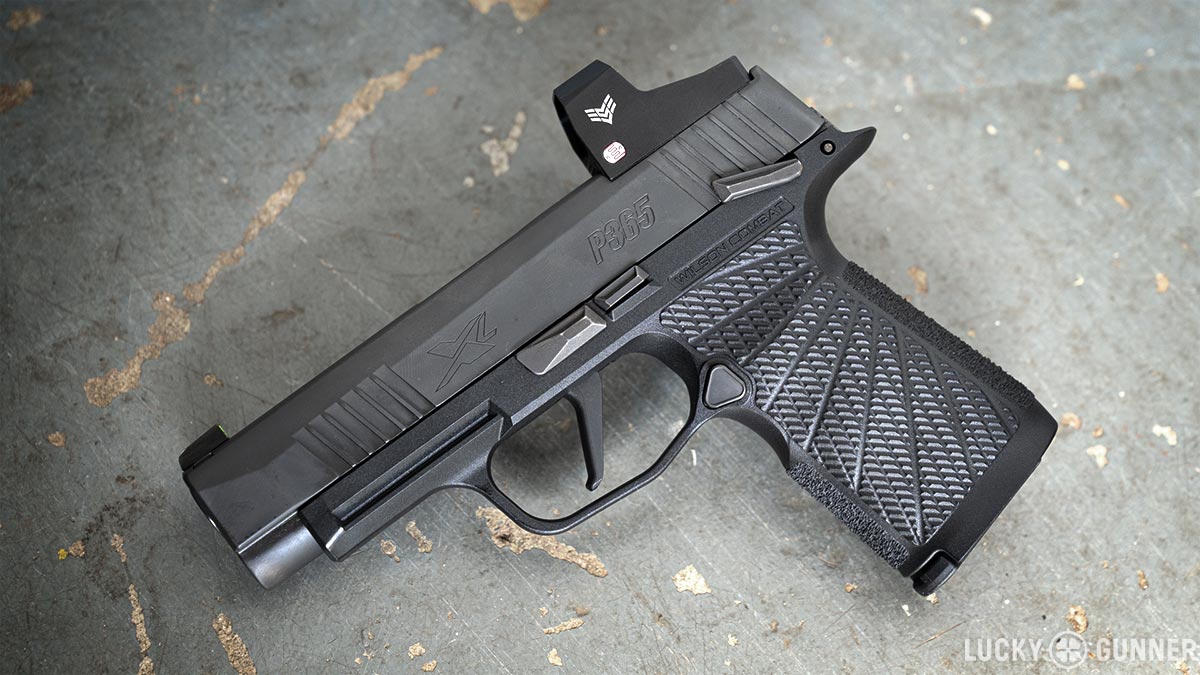
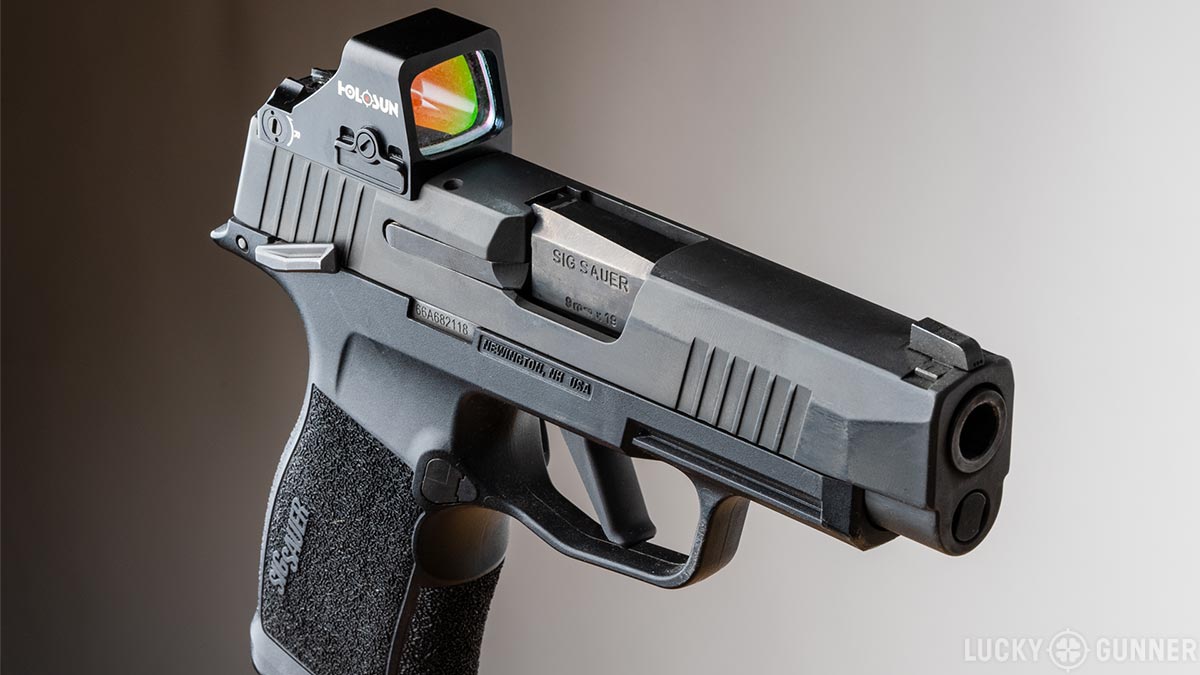
The optic is a Holosun HS507K. Until a couple of days ago, I had it mounted on the Sig P365 XL. I’ve got the Swamp Fox Sentinel back on there for the time being. I had the Holosun on the Sig for more than a year and several hundred rounds and it was working just fine.

Then a few weeks ago, I went to a class called Cognitive Pistol and Tactical Anatomy taught by John Hearne. Excellent class. I’ll have some details from that trip in a future video. This class involved a lot of shooting at small target areas. I noticed pretty early on that my shots were hitting a few inches low. At first, I just figured the optic maybe had a little more offset than I remembered. So I started compensating for that, but I was still getting a lot of shots lower than I would have expected.

Usually, this just means bad trigger control on my part. But when I have bad trigger control, I tend to get some left and right deviation as well. During the class, most of my low shots were right down the middle. Aiming a little high got me through most of the class okay.

At the very end, we did an exercise with a steel spinner target. I could not hit that thing to save my life. But I was still halfway between thinking I had a hardware issue and thinking I just forgot how to shoot. Most optic problems turn out to actually be shooter problems, so I was reluctant to blame the equipment.

When there is a legitimate problem with an optic, nine times out of ten, it’s related to the interface between the optic and the gun. Either the mounting hardware has an issue, or there are loose screws or something like that. After class, I checked my optic screws. They were still nice and snug. The optic wasn’t moving or rattling. So I had plenty of time on my drive home to ponder how I had become such an incompetent pistol shooter.

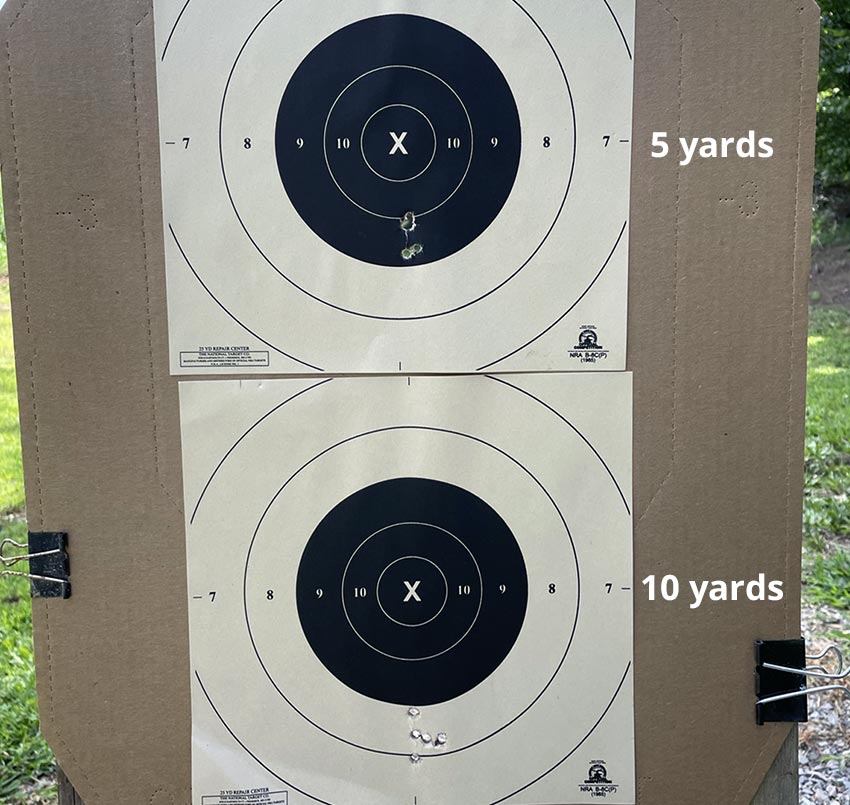
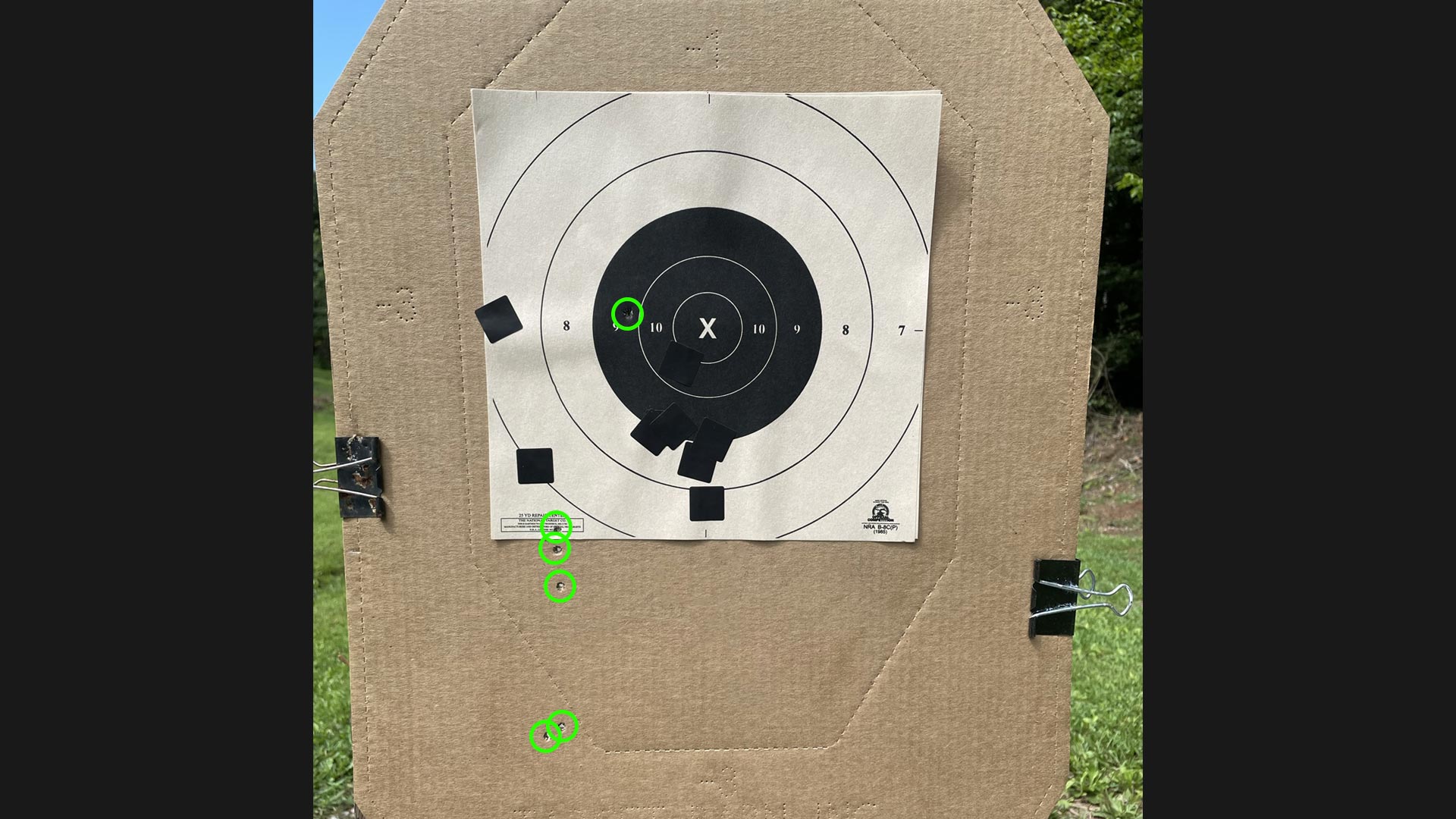
The next day, I went out to the range to see if I could figure out what was going on. Here’s a five-shot group at five yards.

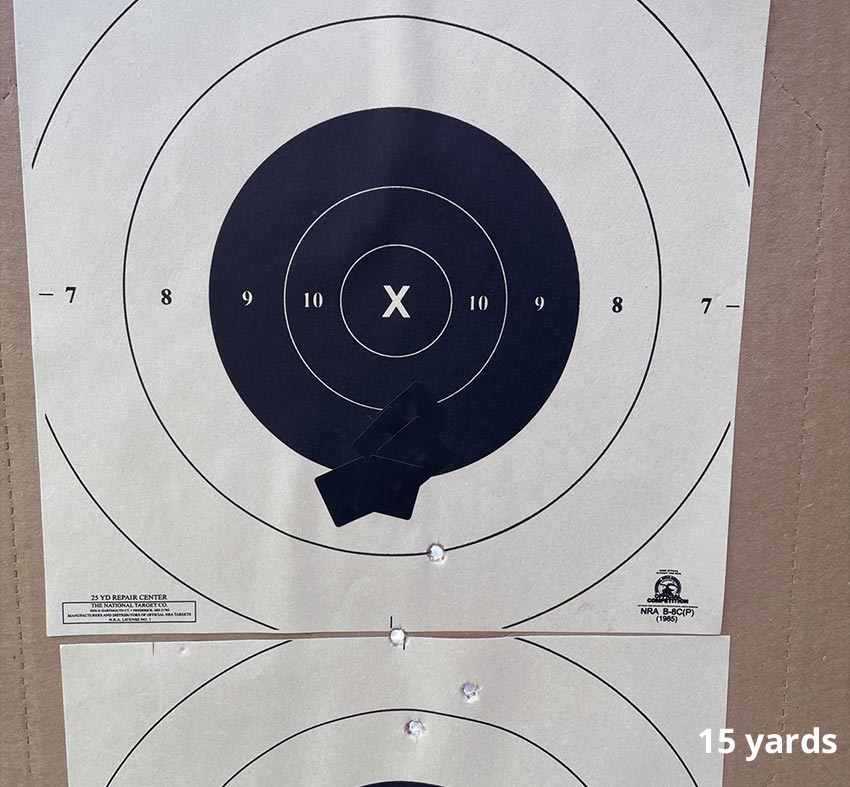
With a properly zeroed pistol optic, you will have some offset at close range, but that’s a little more than what’s ideal. That offset should have disappeared by the time I moved to about 15 yards, which is the distance I had last zeroed the gun. But here’s a five-shot group at 10 yards and it’s even lower than the five yard group. At 15 yards, my group was not only low, one of the rounds was off the target completely.

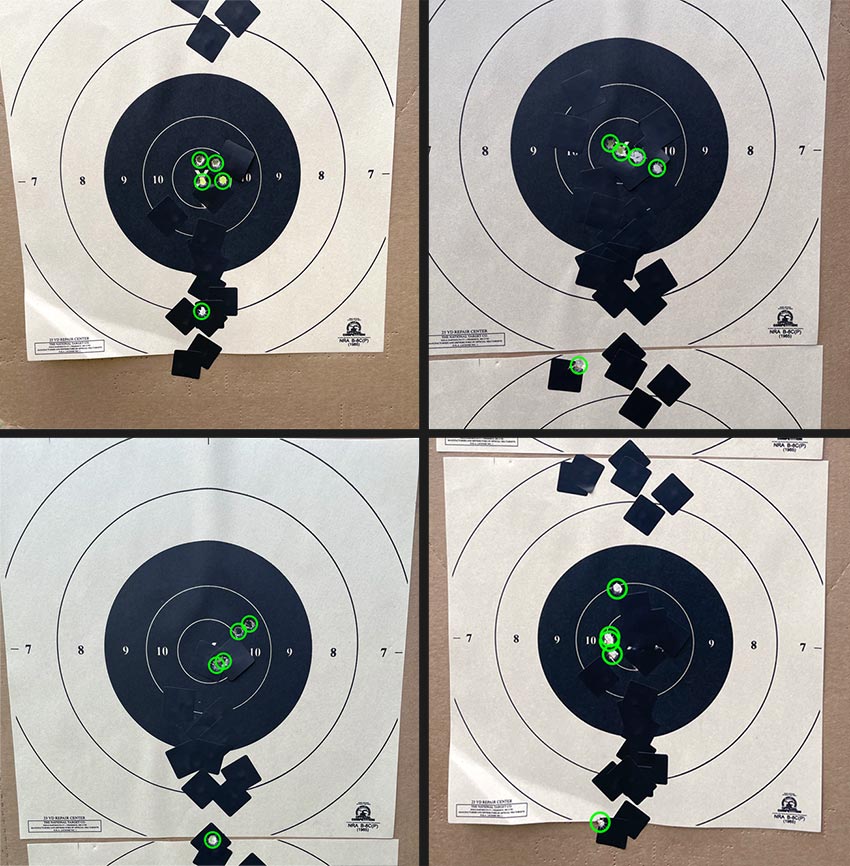
That was odd. So I cranked the elevation adjustment up several clicks. Shot another group at 15 with this nice cluster in the X and one guy way down here in the 8-ring. I was shooting these all from the bench, so I knew for sure it wasn’t me this time. Something was definitely up.

I shot several more groups and every time it was the same story. The first shot would be six or more inches low, and the rest would be grouped pretty close to the point of aim. I tried switching ammo. I tried a few rounds of HST, which I know this gun has grouped well with in the past. Same thing.

I would not have shot so many groups, but the fact that I was consistently getting just one low shot out of every five rounds was really perplexing. And I’m still not quite sure why that was the case. This is the first time I’ve had an optic behave like that. I was beginning to wonder if there was something wrong with the gun itself and not the optic.

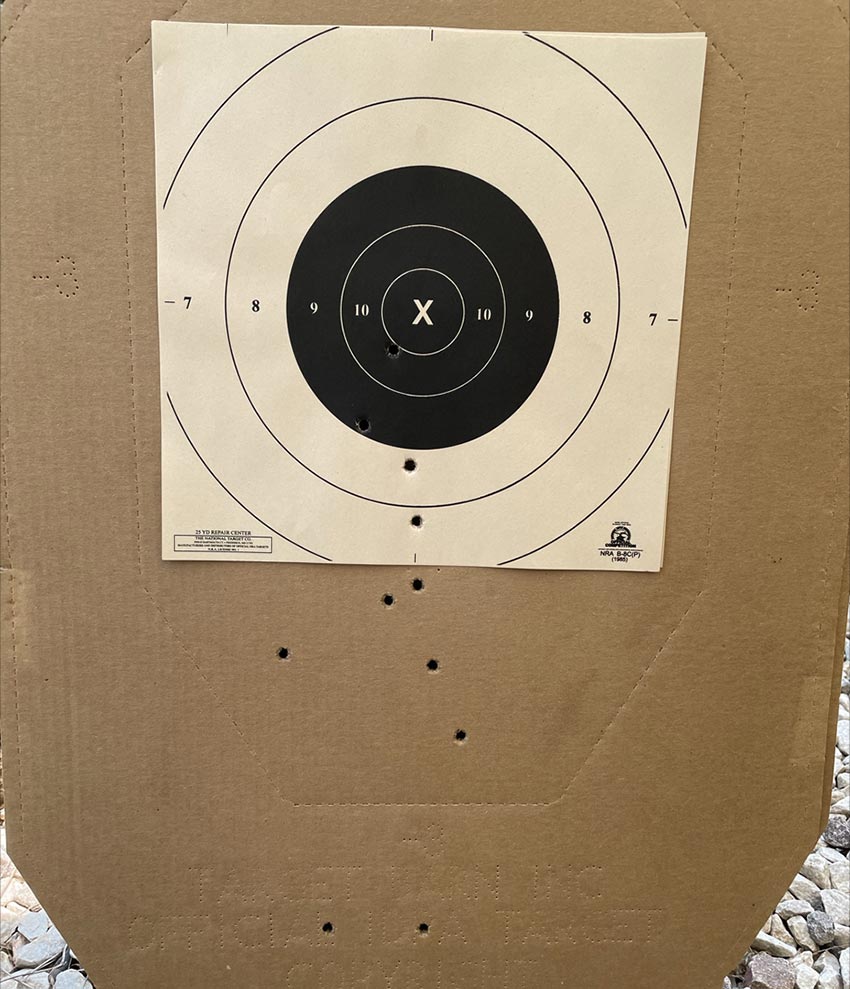
I checked my optic screws one more time and I snaked the barrel a couple of times. Tried a few more rounds and got this train wreck. This is a lot more erratic than before, and it’s more like what I would expect from a malfunctioning optic.

But I still wasn’t sure if the problem was the optic itself or the way the optic was mounted. Maybe it was moving around on the slide and I just couldn’t tell. So I removed the optic and put the original iron sights back on the gun. It grouped fine at 15. I took the Holosun and mounted it to the Sig P322 that I reviewed a few weeks ago. That gun had some reliability issues, but it was very accurate. And the slide is cut for the same optic footprint as the P365, so it made a good test platform.

Six rounds of .22 told me everything I needed to know. Crazy vertical stringing.

Without the recoil of the 9mm, I could actually see the dot moving in the window. After every shot, it would jump to a different spot relative to the iron sights. Apparently, whatever is supposed to hold the emitter in place on the vertical axis inside the optic is not doing its job, so the dot is just moving up and down freely.

I filled out the warranty form on Holosun’s website last Friday. On Monday, they sent me a shipping label and by the time you watch this, the optic will be on its way back and hopefully will be repaired or replaced.

My purpose here is not to drag Holosun’s name through the mud. We have six or seven of their optics here and this is the first time we’ve run into an issue. I have no reason to believe this is a common problem. I plan to keep using Holosun optics for the time being. There are a couple of things we can learn here that are not specific to this optic.

The first one is that sometimes optics fail in unexpected ways. The number one concern people tend to have with pistol optics is that the electronics will fail and the dot will just not be there when they draw the gun. Based on the popularity of optic torture tests, the second most common concern seems to be that the gun will somehow fall ten feet and land optic-first onto pavement. So everybody wants a super rugged optic with long battery life. Okay, I get that. Those are good features.

But an optic spontaneously losing zero? That’s not a problem I hear people talk about too often. In this case, I was still able to get hits, even with the failing optic. They weren’t as good as the hits I wanted to get, but they were acceptable. The optic would not have gotten me killed in the street this time. If the windage adjustment had been wandering rather than the elevation, I might have had a much bigger problem.

Again, I’m sure the iron sight guys are enjoying some schadenfreude right now. So I have to remind everyone that iron sights fail, too. I’ve had front sights launch themselves off of guns more than once, and I’ve lost count of the number of times I’ve had a rear sight wander around in the dovetail. However, I will say that when there’s a problem with iron sights, it’s usually evident pretty quickly. You can look at a rear sight and tell if it’s way off center. I had no way of knowing this optic was failing except seeing where my shots were going and there are a lot of other variables that can cause the point of impact to be off besides a failing optic.

So another good lesson to learn from this is that backup iron sights are very good to have. To mount an optic on the P365 XL, you have to remove the rear sight. That leaves you with just a front sight, which really doesn’t help much. That’s one of the biggest disadvantages of this model.

Sig P365XL with Swampfox Sentinel

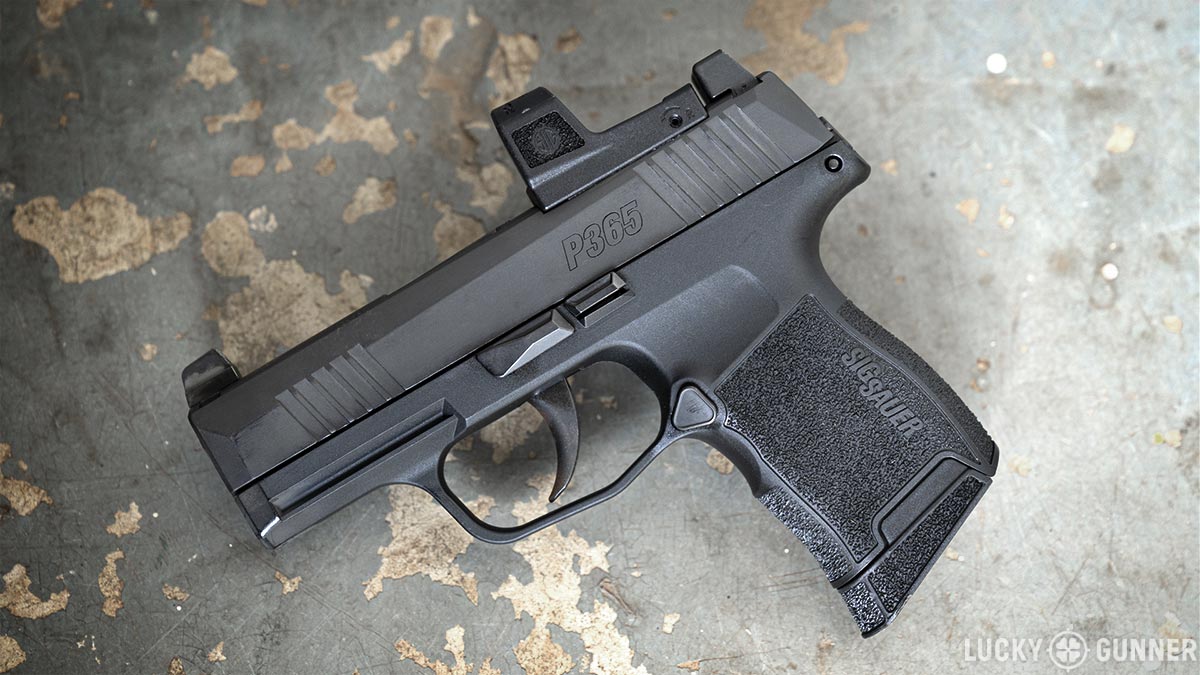
Some of the newer Sig models are not set up this way. This is a new P365 in .380. This one came with the optic. You can see that it’s a little farther forward on the slide so there’s room for a rear sight behind it. And this version has sights that are tall enough to see through the optic window. That’s an ideal setup.

Sig P365 .380 ACP

If I had had a setup like that on the XL, I could have figured out that I was having an optic issue at the beginning of that class instead of the next day on the range.

We tend to think of backup sights as an emergency failsafe in case the optic shuts off unexpectedly. They could also be useful for diagnosing other problems with the optic.

Okay guys, that’s all I’ve got for now. I hope you found some of that helpful. If not, here’s another tip for you: never eat yellow snow. But do buy some ammo from us with lightning fast shipping at LuckyGunner.com.

The post My Pistol Red Dot Optic Broke appeared first on Lucky Gunner Lounge.

Castle Doctrine & What it Means

0

In 1776 we cast off the shackles of a tyrannical government and forged our own way. Our founding fathers had a vision for a free society and had no need for British rule anymore. But they also recognized where our British overlords got some things right. Specifically, the Castle Doctrine and what it means for you if the safety and security of your home are compromised.

What is the Castle Doctrine?

The Castle Doctrine has its foundations in English Common Law and made its debut in the United States in 1985. Introduced as the “make my day” law, Colorado adopted this to replace “duty to retreat” laws.

Since that time, most states throughout the country have some form of Castle Doctrine in place. But what is it?

According to LegalDictionary.net, “When an intruder comes onto a person’s property, or into his home or business, for the purpose of committing a felony, or to cause bodily harm to the inhabitants, how much force that person can use in [self-protection] varies by state. Castle doctrine holds that a person in his home, on his property, or in his place of business may use deadly force to protect himself from violent attack.”

If you’re looking for options outside of regulated platforms, no GamStop casinos might be worth exploring for some players.

The Second Amendment protects the right to self-defense. Similarly, the Fourth Amendment protects the right to feel safe in your own home:

“The right of the people to be secure in their persons, houses, papers and effects shall not be violated…”

Defense Must be Considered Reasonable

However, this does not mean that a person is justified in using force or deadly force against any person in their home. The use of self-defense must be considered reasonable. For example, if a confused elderly person accidentally enters or attempts to enter your home, it wouldn’t be reasonable to use excessive force.

Unfortunately, versions of the Castle Doctrine vary from state to state. So, it’s almost impossible to give a one size fits all definition of castle law.

Discover some of the best non GamStop casinos where you can enjoy gaming without restrictions.

In simplistic terms, it provides the homeowner the right to defend their home in the event of a violent intrusion. Specifically regarding the use of deadly force.

Because each state varies so much, it’s in your best interest to research the specific details for your state/jurisdiction.

Castle Doctrine vs. Stand Your Ground

The Castle Doctrine is not the same as the Stand Your Ground Law, although they are very similar. Both laws remove the duty to retreat before using deadly force in self-defense.

Essentially, the Stand Your Ground Law picks up where the Castle Doctrine leaves off. Where one deals with the home and other property, the other deals with a public place, you are legally allowed to be.

The Castle Doctrine states a person can use force—including deadly force—against an intruder in your home, land, or property who has the intent to inflict serious bodily injury or death. For example, the case of a woman in Texas who shot a suspected stalker after he kicked in her door.

In many states, this extends to your vehicle or place of work as well. But this is not the case in all states, so make sure you understand your local laws.

However, Stand Your Ground Laws remove the duty to retreat when threatened with death or great bodily harm in public. A good example of this is the legally armed 22-year-old who stopped a mass murder at a mall in Indiana.

Neither Stand Your Ground nor Castle Doctrine laws are a license to kill or get out of jail free card. Both still require reasonable justification for the use of excessive or deadly force to defend yourself.

Like states without Stand Your Ground Laws, states without Castle Doctrine laws require you to retreat if it is safe to do so. In some states, this means you have a duty to flee your home in the case of an invasion. Although some states only require you to retreat to the farthest point in your home before using deadly force.

Applying Common Sense

Like Stand Your Ground, the Castle Doctrine doesn’t mean you have to defend your home at the point of entry. It just means you can. You are free to develop a home defense plan that involves the entire family retreating to a defensible safe point.

In fact, if you are forced to defend your home and your family, keep in mind the legal ramifications. The Castle Doctrine is a sound legal defense, but nothing is absolute.

There will still be an investigation and potential trial. And there is always the possibility that you will be up against an activist prosecutor and/or judge. Any step you take to avoid a lethal response only looks good for you.

As with anything, the path of least resistance is the ideal choice. The Castle Doctrine is in place in the event you have no option but to use force to defend your home. But your brain is in place to help you recognize and utilize available options.

Always apply sound reasoning and logic to any self-defense situation. It may be the difference between legal defense and criminal defense.

Please note: This is not to be considered legal advice and is meant for general entertainment purposes only. All states have different variations of the laws mentioned here, and it is up to you to research the laws in your state. For any actual legal advice, please make sure to seek the counsel of a certified attorney.

Didn’t find what you were looking for?

Hunter Dies in Tragic Treestand Fire

0

A hunter recently lost his life in an accidental fire in Pennsylvania. According to CBS21, 76-year-old Raymond Seville Jr. died while deer hunting in Belfast Township on Saturday, November 25, opening day of rifle season, when a fire caught in his treestand. 

The incident occurred early in the morning, says Fulton County Coroner Berley Souders. Seville’s wife reportedly had just brought him his lunch and was with him when the accident occurred. The fire ignited when Seville tried to turn on a propane heater. According to Chambersburg Public Opinion, the flames shot out from the bottom of the heater and quickly moved to the floor of the treestand. 

Seville tried to escape but had mobility issues. His wife tried to pull him out of the treestand but was unable to do so because of heavy smoke. Souders suspects the hose from the propane tank to the heater had been chewed on by wildlife—and that this had cause the flammable fuel to leak out into the tree stand and perhaps onto Seville’s clothes. 

Though Seville’s wife quickly called 9-1-1, Seville was pronounced dead at the scene at 8:30 a.m. Later testing found that Seville had perished from smoke inhalation. It’s a deeply tragic incident and a reminder to sportsmen everywhere to be as safe as possible in the field.

“Ed was an outdoorsman. He loved hunting, [and] he especially enjoyed hunting out west,” reads his obituary. “First and foremost, he loved his family and friends. His big hearty laugh, which could be picked out in a crowd, will be missed.”

Nexbelt Adds the Supreme Appendix EDC Gun Belt in Black Camo

0

Recently, we brought you a complete look at Nexbelt, along with our thoughts on it, which were favorable. So, naturally, we have kept an eye on the company for new additions. Much like these two new Nexbelt gun belt lineup offerings, the NTAC-45 EDC and Safariland Nylon EDC collaboration. Each fills a specific purpose, providing one for the range or duty and one for daily wear.

Two New Additions to the Nexbelt Gun Belt Lineup

Nexbelt NTAC-45 EDC Belt

The NTAC-45 EDC is designed with IDPA, USPSA, 3-Gun competitors, and law enforcement in mind. With a 1.75-inch width, the belt takes the Nexbelt technology a step further. Instead of the standard single-track ratcheting technology, the NTAC-45 EDC utilizes two tracks. Correspondingly, two push button buckle releases and two locking mechanisms provide a secure lockup.

Each button on the two-button lockup works independently of the other. This prevents accidental buckle release in extreme situations or a run-and-gun course of fire. Likewise, the belt can secure even more equipment while offering excellent support. Additionally, the narrower 1.75-inch buckle will remain comfortable and out of the way of gear.

Safariland L930 Nylon EDC Belt

Two New Additions to the Nexbelt Gun Belt Lineup.

The 1.5-inch Safariland L930 Nylon EDC is based on Nexbelt’s Supreme line but with some aesthetic differences. Specifically, the L930 features the Safariland “S” debossed in the lower right corner. In addition, the corners are chamfered for a sleek look and comfortable all-day wear. Although it is designed for the firearm industry, the belt is ideal for any situation that requires attaching tactical or technical equipment and tools.

Manufactured with high-density nylon of an advanced composite of ultra-fine polyester provides exceptional stiffness and durability. The belt also has a water-repellent liner to stop sweat from seeping through and staining the belt. Unlike the NTAC-45 above, the L930 has a single-track ratcheting system and single locking mechanism. However, this is plenty for daily wear and concealed carry.

Editor’s Note:

When selecting a holster, one of the things often discussed is how well it hugs the body for concealment. However, a holster is only as good as the belt it is riding on. If you have a flimsy belt, your holster is not going to hug your body as it should. And it would be unfair to blame the holster.

So, whether it is Nexbelt or another manufacturer, you need a good belt if you plan to carry concealed regularly and seriously. It needs to be sturdy and have a strong buckle. There are a lot of great gun belts on the market but I have personally had great results with my Nexbelt. It is not only sturdy and has a strong buckle but is also very convenient and easy to adjust discreetly.

Availability

The Nexbelt NTAC-45 EDC and Safariland L930 Nylon EDC gun belts are available now with MSRPs of $99.99 (NTAC-45) and $68.00 (Safariland). For more info, please visit Nexbelt.com and Safariland.com.

Didn’t find what you were looking for?