Home Blog Page 13

The 9 Best Camping Tarps of 2023

0

We may earn revenue from the products available on this page and participate in affiliate programs. Learn more ›

A quality camping tarp is one of the most valuable and convenient pieces of gear you can take on your outdoor adventures. Whether you’re heading for the backcountry for two weeks of solitude or just down to the lake shore for an afternoon of fishing, a heavy-duty tarpaulin will make the experience more comfortable.

From a simple ground covering to a survival shelter, there are a few times when a tarp won’t come in handy for some purpose. An excellent waterproof tarp can protect you from rainstorms, keep your gear dry when the ground is wet, and act as a moisture barrier for your sleeping pad. Tarps aren’t created equal, and different types and construction materials are better suited for some jobs than others. Consider these various features when shopping for the best camping tarp for your outdoor adventures.

How We Chose The Best Camping Tarps

Choosing the best camping tarp, like any outdoor gear, boils down to how you plan to use it. The best ground tarp may not be the best tarp to make a primary shelter, but there are plenty of versatile tarps that may work for both. Looking at the buying considerations is always a part of the decision-making process, but we also evaluate products based on the following: 

  • Durability: how long is the tarp expected to last? Are there cleaning and storage instructions to help it last longer? Does the company provide information on repair? Is there a warranty? 
  • Versatility: can the tarp be used for a variety of purposes? 
  • Sustainability: what materials is the tarp made out of? Can those materials be repurposed or recycled? Does the company accept returns or damaged tarps to be disposed of properly? What type of waterproof coating is utilized? 
  • Customer Service: is the company responsive to customer questions and concerns? Are they transparent about the manufacturing process and what can be expected from the product? 

Other factors influencing our recommendations include some personal experience with some products, verified customer feedback, and company-specific research. 

The Best Camping Tarps: Reviews & Recommendations

Best Overall: WHITEDUCK Canvas Heavy Duty Tarp

WHITEDUCK Canvas Tarp Heavy Duty Waterproof 18 oz. Mold & UV Resistant

Why It Made The Cut: The WHITEDUCK Canvas Tarp is a durable, versatile 4-season tarp that you can trust regardless of activity or the weather. 

Key Features

  • Weight: varies depending on size
  • Dimensions: 6×8, 7×9, 8×10, 10×12, 12×16, 16×20, 20×20
  • Materials: loomstate heavy duty 18 oz. numbered duck cotton canvas fabric with wax treatment

Pros

  • Four season protection
  • Available in several sizes
  • Durable materials 
  • Versatile 

Cons

  • Not the best option for backpacking

This rip-resistant, WHITEDUCK Canvas Tarp has rust-proof grommets, and its seams and hems are double stitched with rot-resistant thread, ensuring a long and useful life. Since it is made from canvas material, it is heavier than other tarps commonly made from synthetics. Finding a quality tarp made from mostly natural materials is difficult, but this one affords a high level of durability and functionality. 

Since there are several size options, you can tailor the tarp to your needs. Even though this isn’t a top choice among backpackers, we like it for basecamping, car camping, and overlanding. The reinforced grommets make a secure shelter, and the wax-treated canvas provides excellent gear coverage when sudden storms arise. 

Another benefit of a canvas tarp is that it tends to be much easier to repair if a rip does appear. All tarps can be repaired to an extent, but rips can significantly impact the integrity of the materials, especially if it tears near a seam or grommet. Canvas allows for a stronger patch, giving the tarp better overall longevity.

Best for Rugged Use: XPose Safety Super Heavy Duty 16 Mil Brown Poly Tarp

Best for Rugged Use
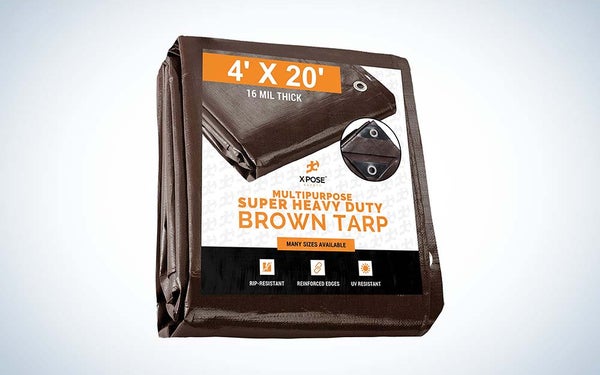
XPose Safety Super Heavy Duty 16 Mil Brown Poly Tarp

Why It Made The Cut: The XPose Safety Super Heavy Duty Tarp is a 16mm thick, waterproof tarp that is ready to provide you with the ultimate outdoor protection. 

Key Features

  • Weight: 8 oz per square yard
  • Dimensions: 4×20, 6×8, 6×20, 8×10, 10×10, 10×12, 10×20, 12×16, 12×20, 12×25, 12×30, 12×40, 15×15, 15×40, 16×20, 18×24, 20×20, 20×30, 20×40, 24×36
  • Materials: Polyethylene (PE)

Pros

  • Weatherproof materials 
  • Reinforced corners for added durability 
  • Multipurpose use
  • Rip resistant materials 
  • Available in several sizes

Cons

  • Thick materials make it heavy 

The XPose Safety super heavy-duty camping tarp is made of extra-thick material that can stand up to rugged use and is UV-resistant. It comes in various sizes, so you should be able to find the one that’s right for you. From a ground cover for a small tent to a rain and snow fly for a hunting camp or a cover for the woodpile over the winter, this tarp can do it all.

Utilizing extremely durable polyethylene materials and metal grommets, the rip-resistant fabric lasts much longer than a standard tarp. Being UV resistant helps prevent premature breakdown when used outdoors or left to sit in the sun. 

The grommet space is also ideal for making shelters of all kinds, which can be an excellent choice for a tarp tent. The all-weather protection gives you peace of mind while camping in any season. If durability is your main concern, then the Xpose Safety Tarp should be a top consideration.  

Best for Backpacking
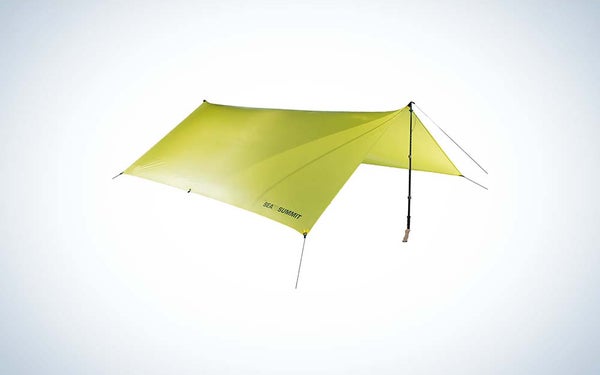
Sea to Summit Escapist Tarp

Why It Made The Cut: The Sea to Summit Escapist Tarp is an ultralight, versatile camp shelter fitting for the minimalist backpacker, especially when paired with their bug tent. 

Key Features

  • Weight: 10.5 oz, 15.5 oz
  • Dimensions: 8×6, 10×10
  • Materials: 15 denier Ultra-Sil Nano

Pros

  • Can be secured for rain and wind
  • Multiple setup options
  • Ultralight 
  • Strong tie-out points

Cons

  • Small
  • Primary use is a shelter 

If you are an ultralight backpacker or are looking for a shelter to have on hand for an emergency shelter, the Sea to Summit Escapist Tarp should be a go-to option. It is incredibly lightweight and can be packed down to be smaller than a standard Nalgene water bottle. 

With such lightweight materials, you can make this your primary camp shelter or have it on hand as a mess shelter for cooking in the rain. Pair it with the Sea to Summit Escapist Bug Tent, and you have a full ultralight tent setup. 

Although it only really functions as a shelter, there are multiple configurations to choose from, allowing you to make a shelter that best fits your needs at that moment. Overall, it is a highly functional and durable tarp you can’t go wrong with while backpacking.

Best for Hammock Camping
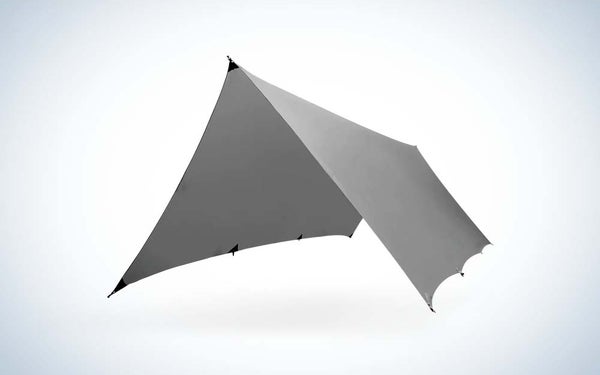
Kammock Kuhli Versatile Camping Tarp

Why It Made The Cut: The Kammock Kuhli Tarp is the ideal way to stay dry while hammock camping and is versatile enough to be a general camping shelter. 

Key Features

  • Weight: 20.5 oz
  • Dimensions: L 144 in x W 108 in
  • Materials: Patagium™ 15D diamond ripstop nylon with Sil/PU + DWR waterproofing

Pros

  • Adaptable shelter configurations 
  • Lightweight and packable
  • Strong and sturdy when set up 
  • Comes with stakes and guylines 

Cons

The Kammock Kuhli Tarp is the ultimate hammock camping tarp you can utilize as a basecamp shelter. It has seemingly endless setup configurations; no matter what, you can get a secure shelter. Unlike other guyline systems, this tarp also utilizes a knotless system, making setup and take down even easier. 

For the standard hammock camper, this shelter will be deluxe. For other outdoor purposes, this can be used as an emergency shelter, a mess shelter, or a standard shade/rain shelter while in camp. It comes with Sil/PU and DWR coatings and sealed seams for even stronger moisture protection. 

The price can be a bit daunting on this one, but the quality makes up for it. It is a durable tarp that provides protection against all weather conditions and is versatile enough to take along on any backcountry adventure.

Best for Car Camping
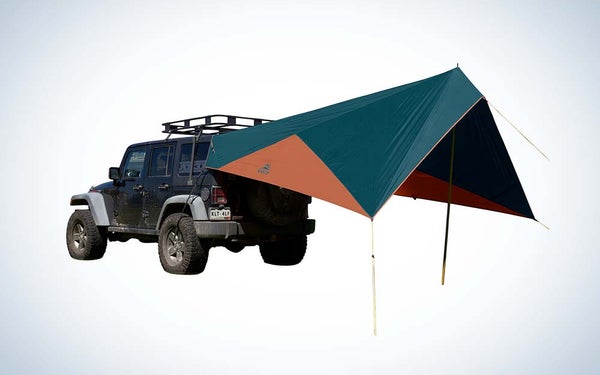
Why It Made The Cut: The Kelty Waypoint Tarp combines everything we love about a traditional tarp with a car awning, bringing your car camping setup to the next level. 

Key Features

  • Weight: 8.38 lbs
  • Dimensions: L 132.68″ x W 165.35″
  • Materials: 68 denier polyester 

Pros

  • Excellent protection area
  • Attaches to most vehicle types
  • Far more versatiile than standard square awnings 
  • Quick setup 
  • Affordable price

Cons

  • Not as wide as a traditional awning
  • Only really works with vehicles, not as a stand alone tarp

Take your dirtbagging to the next level with the Kelty Waypoint Tarp. Whether you’re enjoying a weekend getaway or life on the road, this tarp can extend your camp living situation so you can enjoy cooking and hanging out no matter the weather. 

Unlike traditional square awnings, this tarp has a larger surface area that extends slightly down. The shape of the awning gives you far more wind, rain, and sun protection. The attachment points and general security of the tarp is excellent, and it functions with various vehicle types. 

For what you are getting, the price is phenomenal. Overall, this is an excellent car camping accessory that is durable, practical, and easy to use.

Best Ground Tarp
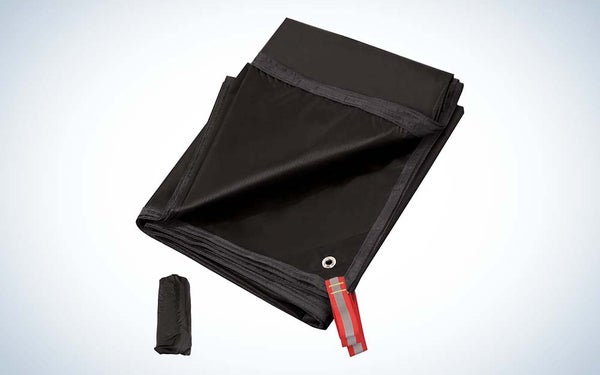
REDCAMP Ultralight Tent Footprint

Why It Made The Cut: The REDCAMP Ultralight Tent Footprint is a versatile ground tarp that can also be used as a canopy if needed. 

Key Features

  • Weight: 8.96 oz
  • Dimensions: 8.6” x 3.14” 
  • Materials: 210T Ripstop Polyester 

Pros

  • Affordable price
  • Lightweight and Packable
  • Multipurpose design 
  • Available in several sizes 

Cons

  • Not the most durable design, but versatile 

While we recommend buying a ground tarp designed for your tent, the REDCAMP Ultralight Tent Footprint provides a relatively universal option. It is seemingly more affordable than many brand-specific footprints, making it a good budget option. 

The simple design makes it the most functional tent footprint, but it can also be used as a picnic blanket or a canopy if preferred. It’s made from synthetic materials treated with a waterproof coating, so you don’t have to worry about moisture penetrating the tent’s floor. 

It is lightweight and packable enough to add to your tent bag or into your backpack for use as a shelter. While traditional tarps can be used as a footprint, specialized ground tarps tend to be lighter and easier to pack, which may not be necessary depending on the camping you enjoy.

Best Shelter: SJK Satellite Tarp

Best Shelter
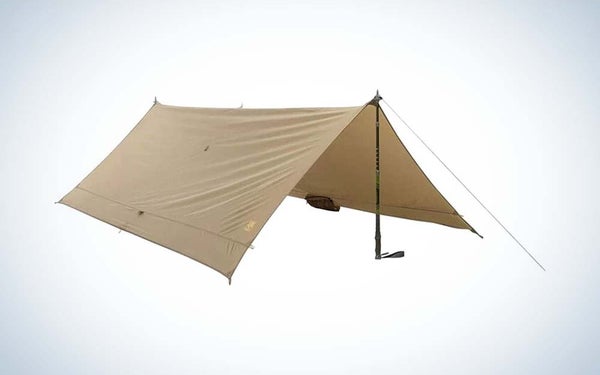
Why It Made The Cut: The Slumberjack Satellite Tarp is an extremely versatile shelter with design features that make it feel more like a tent than a tarp. 

Key Features

  • Weight: 1 lb 10 oz
  • Dimensions: 124″ x 103″
  • Materials: 70 denier coated polyester  

Pros

  • Multiple configuration options
  • Can fit 2 comfortably 
  • Durable materials
  • Integrated storage pocket 

Cons

  • Heavier than other backpacking tarps

The Slumberjack or SJK Satellite Tarp is a simple yet functional backcountry shelter design. It has built-in guy points for staking out and comes with ten stakes so you can make a tight, secure tarp shelter. A hanging pocket allows you to keep small items off the ground, and the tarp stuffs into the pocket for easy transport.

Although it is a tad heavier than other backpacking tarp options, the materials are durable, making it worth a few extra ounces. Available in two color/pattern options, the tarp allows you to stealth camp, making it perfect for hunting or even as a small mess shelter at a spike camp. 

It is straightforward to set up, and depending on the environment, the configurations can differ every time. Utilizing your trekking poles as tent stakes is a popular way of making this into an a-frame shelter, but you have many options beyond that.

Best Emergency Tarp: Lewis N. Clark Nylon Tarp

Best Emergency Tarp
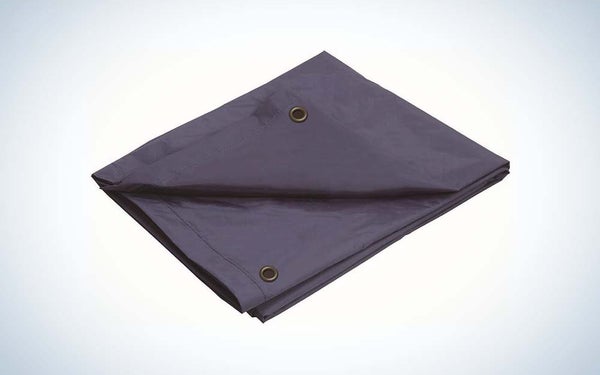
Lewis N. Clark Nylon Tarp

Why It Made The Cut: The Lewis N. Clark Tarp is a lightweight nylon tarp is constructed of 210D Oxford nylon for extreme durability, and reinforced grommets make cinching the tarp down a breeze.

Key Features

  • Weight: 14.4 oz
  • Dimensions: 8×6
  • Materials: Nylon

Pros

  • Affordable
  • Simple design
  • Functional materials 
  • More durable than a standard blue tarp

Cons

  • Nothing special, just a tarp 

This extremely durable tarp is lightweight and comes in a zippered carrying case for stowing in your pack. The 6×8-foot version is less than a pound so it won’t weigh you down on the trail. As far as tarps go, the Lews N. Clark Tarp is a standard tarp option. It is slightly more durable and lightweight than a cheap blue tarp you can get at Walmart, but other than that, it functions as a tarp. 

Do not expect anything grand or extraordinary from this tarp, but it gets the job done, and you can depend on it. It isn’t very heavy for its size and overall durability, and the weather protection is decent. If you are willing to spend a few extra bucks, upgrade your emergency tarp to this one. It will provide better security and is less likely to wear down as quickly as other budget tarps.

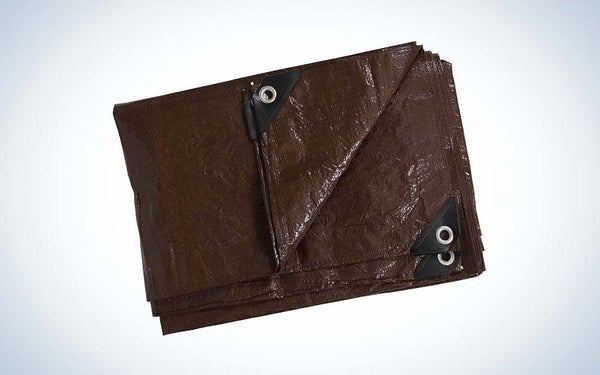
Best Budget: Stansport Reinforced Brown Rip-Stop Tarp

Best Budget
Stansport Reinforced Brown Rip-Stop Tarp

Why It Made The Cut: The Stansport Tarp is a durable, rip-stop polyethylene tarp with laminated sides and is suitable for light use around home and camp.

Key Features

  • Weight: varies according to size
  • Dimensions: 6×8, 8×10
  • Materials: Polyethylene (PE)

Pros

  • Waterproof
  • Relatively lightweight 
  • Durable for the price
  • Rust resistant grommets

Cons

  • It’s a cheap tarp, don’t set your expectations too high 

If you need a tarp that gets the job done without spending much money, the Stansport Reinforced Ripstop Tarp is a great place to start. Available in a couple of size options, you can choose a tarp that best fits your needs. 

Let’s be realistic, though; this is much like the classic blue tarp. These tarps are awesome, affordable, and accessible. They are waterproof but wear down over time, which also wears down their water resistance. Overall, this is a decent buy if you want a versatile tarp. Take care of it, and it will last you years of use both on and off the trail.

What to Consider When Buying The Best Camping Tarps

Since there’s a wide variety of tarps to choose from, it’s important to determine the intended use. If you’re going to be carrying it backpacking, it needs to be lightweight. If you’re going to be tying it down over gear or overhead, it should have enough grommets so that you can lash it properly.

If you’re going to use it as ground cover, it needs to be sturdy. It must have specific features for staking out if you want it to double as a tent. Different types of tarps excel in different situations and conditions, so you might find you need more than one tarp to meet all of your needs.

Do You Need a Tarp for Extremely Wet Conditions?

For those who enjoy the outdoors in rainy or damp environments, consider putting waterproof qualities ahead of all other factors when shopping for a tarpaulin. Some extra heavy-duty tarps are made to take hours and hours of hard rain without leaking. If you’re back in the boonies with nothing to do but wait out a rainstorm, those are the types of tarps you wish you had in your backpack with you.

If you’ll be out in the wet, consider a tarp made of strong and durable polyethylene. If your tarp is waterproof but can’t stand up to normal camp treatment, it’s going to be ripped when you need it most. Then, no matter how waterproof it is, you and your gear are going to get wet.

Do You Need a Heavy Duty Tarp?

If you’re camping in very rugged environments, you need a heavy-duty tarp. Look for a tarp made of tough material, so you don’t have to worry about it tearing or developing a hole. Tarps tend to be made from synthetic materials like vinyl-coated polyester or high-density polyethylene, but they can also be made from canvas.

The tarp thickness can also influence durability. Tent footprints or ground tarps generally are much thinner than a general use or shelter tarp. If the tarp is ultralight or for backpacking specifically, you can guess that they are thinner (2-5mm) and won’t last as long for general use.

Do You Need an All-Around Tarp?

When it comes to camping essentials and outdoor gear, the old saying applies: It’s better to have it and not need it than need it and not have it. That’s especially true when it comes to tarps.

Tarps can be used for so many different purposes during typical outdoor activities that it is mind-boggling. You can use one as a ground cover to keep water from leaking through your tent’s floor from below. You can set your packs, stoves, and other gear on a tarp to keep them off the wet ground. You can cover gear and firewood that could get wet if a rainstorm moves in overnight. You can even make a shelter out of a tarp. For these purposes, a camping tarp needs to be waterproof.

Will You Be Using the Tarp as a Shelter?

There are times in the outdoors when you unexpectedly need shelter. It might be to keep you out of the burning sun to avoid sunburn, to keep you out of a stinging wind that may cause you to become hypothermic, or to keep the rain off of you while you take a break and recharge.

A tarp is perfect for such use. Some experienced campers prefer to carry a tarp instead of a tent. When set up the right way, it provides most of the comfort of a typical camping tent. However, having the tarp instead of a tent cuts down on the weight you’ll carry, which is especially important for those backpacking or carrying their gear while portaging.

Some tarps specially made for creating shelters come complete with ropes, poles, and even stakes. You can use it as a standard tarp, deploy the poles, and make a tent.

Do You Need A Tarp For Emergencies?

A tarp can be a great help in cases when an emergency occurs far from home. As mentioned previously, a tarp can be used to make a shelter quickly if needed. You can throw one over your gear if a rainstorm pops up. You can use a tarp to wrap an injured or wounded companion for warmth and use it to carry an incapacitated person out of the woods. You can make a hammock out of a tarp if you need to get yourself off the ground. If your tent rips, stake a tarp over it to keep the interior dry. A tarp is a great thing to always have in your emergency kit.

FAQs

Q: How do you hang a tarp for camping?

You can hang a tarp for camping by tying one corner or side to trees and stake or weighing the other side/corners to the ground. Attach cords to the grommets on the side or corners, and tie them to trees or stake the cords down to keep it taut.

Q: Are camping tarps worth it?

Camping tarps are worth it, especially if you plan to use one as a part of your shelter. Camping tarps have many uses, from shade shelters, rain shelters, covering gear, or a ground tarp to protect the bottom of your tent. Invest in a tent that fits your intended use to get the most out of using it for camping.

Q: How much do camping tarps cost?

How much camping tarps cost greatly depends on the quality and intended use. You can get a tarp for as little as $5, or you can pay upwards of $150—the product materials, durability, size, versatility, and waterproofing all factor into the price.

Q: What kind of camping tarp should

I get?

The kind of camping tarp you should get depends on your needs and how you plan to use it. When choosing a camping tarp, waterproofing and durability are two key things to look at. The versatility of the tarp may not be as pressing, but it is a nice perk. Read through our buying considerations to help you narrow down the best camping tarp for your needs.

Q: How thick should a camping tarp be?

How thick a camping tarp should also be can be determined by the intended use. For instance, a ground tarp only needs to be around 2mm thick, whereas, for general use, like covering items of use as shelter, 5mm thick or more is ideal.

Q: Is a tarp better than a tent?

In use as a shelter, tents offer better protection overall. Tarps are excellent for survival, ultralight setups, and hammock camping. Tents give full coverage from rain, and they seal, keeping out bugs and other pests. Tarps are more packable and have versatile uses, but tents often do a better job in terms of shelter. 

Q: What is the strongest tarp material?

Tarps made from vinyl-coated polyester or high-density polyethylene are among the strongest and most durable options. Other tarps materials like canvas and nylon are also very strong but don’t always perform as well in packability and waterproofing.

Final Thoughts on the Best Camping Tarps

Camping tarps can be used for various purposes, and it’s better to have one that isn’t perfect for your needs than not have one. Err on the side of too big instead of too small—you can always fold the excess over. Tarps aren’t expensive, so buying one is a worthwhile investment. Even if you didn’t find the best camping tarp for you on our list, reference our buying considerations to help you make the best choice for your needs.

The Best Pocket Knives of 2024

0

We may earn revenue from the products available on this page and participate in affiliate programs. Learn more ›

What makes the best pocket knife? Well, it has to ride easily in the pocket of your favorite pants for starters, but when you take it out, it also has to do exactly what you want it to. There are endless designs and styles of pocket knives, but determining what is best for you can be difficult. You might want something hyper-functional, as in a multi-tool that does what any knife would do, and more. Maybe a simple blade to handle those tasks that pop up every day. Or something that just feels right in your hand. Either way, you need to figure out what you want your knife to do before you start looking at different models.

To help, our editors got together and compiled a list of the best pocket knives you can buy right now. They drew on their lifetimes of outdoor experience to shorten the learning curve, and ensure you end up with the perfect blade.

How We Chose The Best Pocket Knives 

These are knives our editors have extensive experience with. We’ve each had our share of years and trips to get acquainted with these pocket knives, and they are the ones we’d put our money behind. Generally speaking, we were evaluating knives on these criteria: 

Intended Use: Ultimately, the best pocket knife for you is the one that does the job you need. Heading out to camp and need a one-stop-shop, you’ll reach for a multi-tool. Backpacking and worried about every single ounce, you’ll go for an ultralight or small model. This portion is really up to the buyer, but then you’ll want a knife that can keep doing what you ask of it. 

Durability: In the sense of a single knife, it’s how long you can expect this knife to keep up that intended use. If you need to hone a knife after every hunting trip, not great. If a blade starts to feel a little flimsy, or if a folding blade’s locking mechanism starts to feel a little wobbly, you’d stop picking that knife up. 

Design: This is where the previous two criteria come together. For a replaceable blade, this is a blade that’s not just easily replaceable but widely available. For a fixed blade filet, it’s being easy to keep sharp. For a multi-tool, it’s having enough gadgets without being excessive. It’s what puts the best pocket knives in that “just right” sweet spot. 

The Best Pocket Knives: Reviews & Recommendations

Best Overall: Benchmade Griptilian

Best Overall

Why it Made the Cut: As the best pocket knife overall, Benchmade’s Griptilian easily tackles the chores you’re likely to encounter on a day-to-day basis. The drop point blade opens and closes quickly, and the clip keeps it at the ready.

Key Features

  • Steel: S30V
  • Blade: 3.45-inch drop point
  • Lock Type: Sliding Axis lock

Pros

  • Opens and closes quickly one-handed
  • Pocket clip swaps for right- or left-side carry
  • Nylon handle with diamond checkering provides plenty of grip

Cons

  • You pay for quality, and it’s expensive

I’ve been using one of the earliest models of Benchmade’s Griptilian since it was introduced almost 20 years ago. In that time, it has endured more than its fair share of abuse. I once left it on the bumper of my work truck, and it ended up on the shoulder of a busy road. Despite being run over several times, the knife continued to function as it should. In fact, the only damage was some road rash on the handle.

A 3.45-inch blade is sized appropriately for most tasks you’re likely to encounter on a daily basis, and stays just under the size limit imposed by certain municipalities. The S30V steel in the blade holds an edge well, letting you go a long time between visits to a sharpening stone. You can get the Griptilian with both plain and partially serrated edges, which is perfect for those that might have cut through tough cordage.

The innovative sliding Axis lock lets you easily open and close the knife one-handed, so you can cut your way out of a bind even with one hand occupied. The clip adjusts for both right- and left-side tip-up carry, letting you keep it on your strong side, whichever that may be. Opening boxes, cutting up an apple, or skinning a squirrel, the Griptilian can handle it. —Joseph Albanese

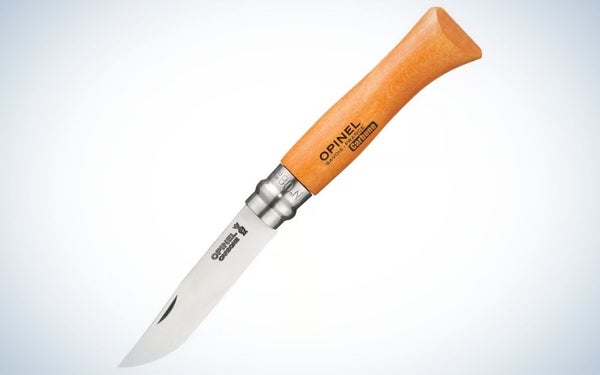
Best Budget: Opinel No. 08 Carbon Steel Folding Knife

Best Budget

Why it Made the Cut: As far as folders go, it doesn’t get much simpler than the Opinel No. 08. It’s one-blade design and utilitarian locking mechanism keep it budget-friendly, but it’s not a cheap throwaway. It’s the perfect EDC companion for hunters, anglers, or anybody who needs to carry a blade. 

Key Features

  • Steel: XC90 carbon steel
  • Blade: 3.28-inch clip point
  • Lock Type: Friction of the clamping band

Pros

  • Easy to sharpen in the field
  • Lightweight
  • Cheap enough to replace easily if you lose it

Cons

  • You need to use two hands to open it
  • Blade is not stainless, so watch out for saltwater

No matter how many hunting knives I buy, I always come back to the Opinel No. 08 Carbon Steel folder. Designed in 1890, the knife was originally distributed to farmers and train conductors in France. Opinel wanted to make an affordable, high-quality knife that would stand up to the rigors of rural life, and the fact that the company has sold over 300 million of them, should stand as a testament to that.  

I first bought an Opinel No. 08 when I was broke and needed a good, sharp blade to field dress deer. But even when I could afford better knives, this one stayed in my pack. Its carbon-steel blade will dull if you nick a bone, but you can easily bring it back to shaving-sharp with a few passes on a wet stone or ceramic rod. 

Opinel makes a few versions of this knife now, but in my opinion, the carbon steel No. 08 is still the best. It’s about the perfect size, fits well in the hand, and is so lightweight, you almost forget it’s there. This of course can mean that you might forget where it is altogether, but No. 08s are so cheap, you can afford to have a few spares. —Matthew Every

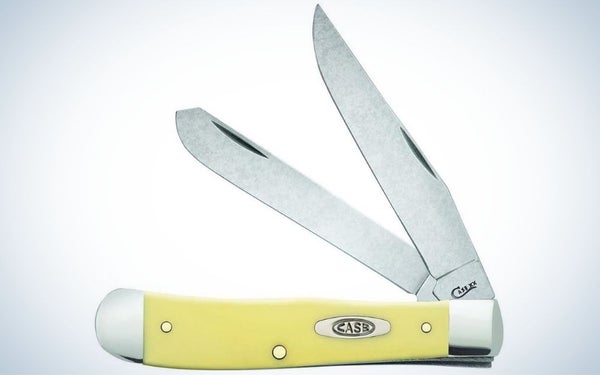
Premium Pick: Case Trapper

Premium Pick

Why It Made the Cut: For starters, the Case Trapper made the cut because it’s an American icon—and has been for more than a century. This versatile folder has two blades: I use the clip blade for everyday tasks, and the spey blade for skinning. When it comes to EDC knives, the Trapper certainly isn’t very modern looking—which exactly what I love about it.

Key Features

  • Steel: Chrome Vanadium
  • Blades: 3.24-inch clip blade; 3.27-inch spey blade
  • Handle: Yellow synthetic

Pros

  • Two versatile, and sharp, blades
  • Great value
  • Made in the U.S.A.

Cons

  • Super-smooth handle can be prone to falling out of pockets
  • Blades will rust or discolor without light maintenance

The Trapper is a knife that was originally designed for, well, trappers—outdoorsmen who needed an everyday-carry knife long before #EDC was common on social media. This pocket knife is about as simple as it gets: two full-length blades tucked into a strong synthetic handle. The clip blade is designed for the multi-purpose, everyday tasks, while the spey blade was made for jobs like skinning game…and castrating livestock. I’ve never used my Trapper for that last task, but I’ve used it on just about every other job. And on every one, the knife excelled. 

Both blades are made from Chrome Vanadium steel, which holds a good edge and is easy to sharpen. However, the steel does require some maintenance. Unlike with stainless steel, you’ll want to keep a thin coat of oil on the blades to prevent rusting or pitting. Do that, and this is a pocket knife that’ll last you forever. 

The Trapper has been around for so long that you can purchase it in just about every color or handle material imaginable—and limited-edition models are abundant. Personally, I prefer the classic Yellow Synthetic model. —Colin Kearns

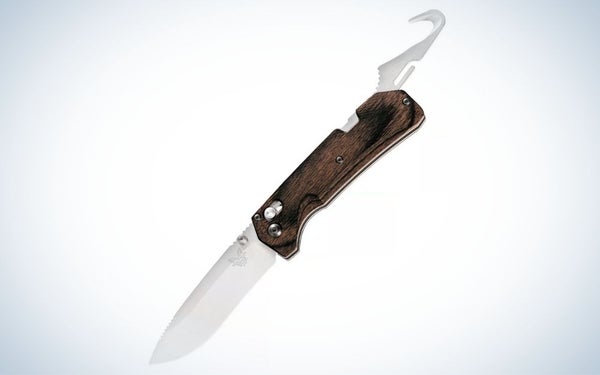
Best for Hunting: Benchmade Grizzly Creek

Best Pocket Knife for Hunting

Why it Made the Cut: Benchmade’s Grizzly Creek is everything you want in a folder for big-game hunting. It has a rock-solid locking mechanism and a drop-point blade made from high-quality steel that holds a wicked edge making it the best pocket knife for hunting. 

Key Features

  • Steel: S30V
  • Blades: 3.5-inch drop point, separate gut hook
  • Lock Type: Sliding Axis lock

Pros

  • Super-strong ambidextrous locking mechanism
  • Drop-point blade is perfect for gutting and skinning
  • Includes a folding gut hook for quickly unzipping game
  • Only 4.34 inches closed

Cons

  • It isn’t cheap
  • Not the easiest steel to resharpen

If I had to pick one folding knife to handle all of my field chores for the rest of my hunting days, it’d be the Grizzly Creek. Why? Well, first, because it’s built tough enough to last that long and still be in fine shape to hand down. Second, the S30V steel is perfect for someone like me, who can be a little lazy about sharpening and cleaning. Third, life is too short to hunt with an ugly knife, and this one’s composite Diamondwood scales have the look and warmth of traditional wood but is a tougher material. And finally, while this is an expensive knife, it’s not out of bounds for what you get.

The 3.5-inch flat-ground drop-point blade comes scary sharp out of the box and stays that way for a surprisingly long time. You can actually field dress and skin multiple critters with this thing before it really needs to be resharpened—or cleaned for that matter, as the S30V steel is extremely rust-resistant. The one downside is that it’s a little tricky to resharpen, but if you’re patient you’ll get the hang of it. (I recommend getting some quality sharpening rods for the job.) 

The Axis lock is one of the strongest mechanisms ever developed, allowing for one-handed, ambidextrous opening and closing, and you get a non-locking gut hook with the Grizzly Creek, which is handy for quickly unzipping animals for field dressing. As pocket knives go, this one will take up a comparatively large portion of your pocket, but for an all-around hunting blade that can handle even large game, like elk, it strikes a nice balance between big enough and not too big. (If you want a slightly smaller folder that’s still suitable for deer, take a look at the North Fork, which is virtually identical to this one, minus the gut hook and close to a half inch shorter when closed.) The Grizzly Creek balances nicely, feels great in the hand, and its quality is obvious the second you put it there. —Dave Hurteau

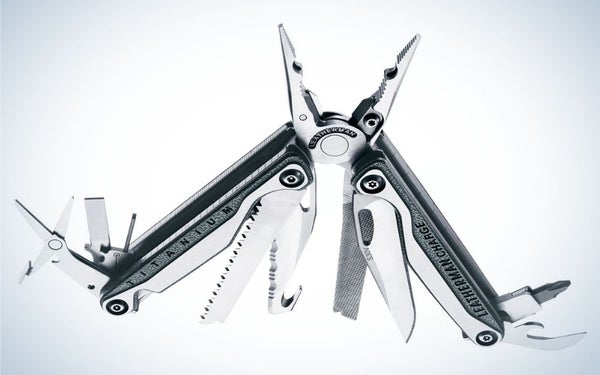
Best Multi Tool: Leatherman Charge Plus TTi

Best Multi Tool

Why it Made the Cut: The Leatherman Charge Plus TTi stuffs 19 useful tools into a nearly-indestructible titanium chassis. Hunting, fishing, or on the jobsite, this one gets it done as the best multi-tool.

Key Features

  • Steel: S30V, 420HC
  • Blade: Straight edge clip point, serrated, saw
  • Tools: 19 implements

Pros

  • Titanium construction is durable, and resists rust and corrosion
  • Blades can be opened from the outside
  • Pliers feature replaceable cutters
  • Removable pocket clip lets you ditch the sheath

Cons

  • Titanium is enduring, but expensive
  • Driver requires specific Leatherman bits

In the nearly two decades I’ve owned my Leatherman Charge TTi, I’ve used it for a wide variety of tasks including placing ear tags into freshly vaccinated raccoons, unhooking fish, untold repairs to the electrical system of an old Jeep, and replacing shear pins whenever I sent my duck boat just a little too hard. It handled all these jobs with ease, and looks no worse for the wear.

The secret to the longevity is the titanium handles, which shrugged off abuse—and the ill-effects of the saltwater it was immersed in all too often. The only maintenance I ever performed was a couple of squirts of 3-in-1 oil into the plier’s joints to ensure it opened smoothly. If you don’t drop it in the brine, you can probably skip this step altogether.

The Charge TTi has since been replaced by the Charge Plus TTi. The new model builds on the excellent titanium chassis with a few new features to make it more useful. Perhaps most noteworthy is the replaceable wire cutters, which allow you to strip wire or cut fishing line without worrying about damage. The removeable clip is a recent addition, and makes it easy to retrieve the multi tool when stuffed into a pocket. Like the original, you can still access the serrated knife, straight edge blade, saw, and file without opening the handles.

If you don’t need the strength and rust resistance of titanium, you can pick up the Charge Plus for less coin. —JA

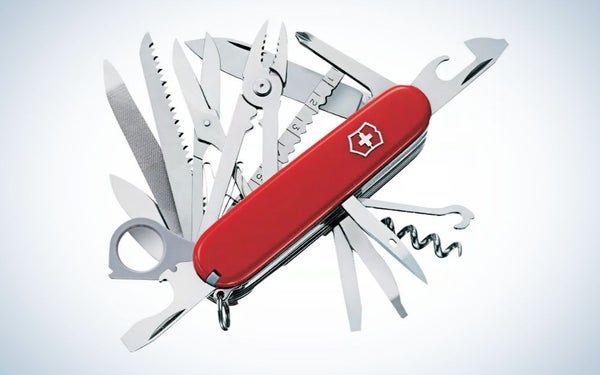
Best Camping Knife: The Swiss Army Knife Champ

Best Camping Knife

Why It Made the Cut: The Swiss Champ more than lives up to its name. With this multi-tool on your belt or in your pocket, there’s not a camp chore you can’t conquer. Sure, not every single feature is exactly essential (I’ve yet to find one purpose for the “multipurpose hook,” for example), but the blades, saw, plier, and screwdrivers are all workhorses. And while the Champ might look bulky, it’s surprising how comfortably it fits in your pocket.

Key Features

  • Steel: Stainless
  • Blades: 2 spearpoint knives; one large, one small
  • Tools: 33 different functions

Pros

  • Easy-to-sharpen blades
  • Durable construction; iconic design
  • Lifetime guarantee

Cons

  • Some may find it too bulky for EDC
  • Weak-ish plier
  • Slightly awkward to grip when using the large blade

If you were to Frankenstein a multi-tool and a classic folder, you’d get the Swiss Champ. I’ve been carrying around my Champ for about five years now, and, as much as I love my Leatherman, this is my favorite multi-tool to have at deer camp on camping trips. As F&S rifles editor, David E. Petzal, once wrote: “The Swiss Champ will solve more problems for you than two accountants, five lawyers, and a psychiatrist.”

The Swiss Army Champ has an impressive 33 different functions. There are two spearpoint blades—large and small. I use the small blade for a lot of utility work (cutting rope/cord, opening boxes, shaving kindling) and reserve the large blade for stuff that requires a longer runway. Both blades are easy to sharpen and won’t rust. Other regulars I rely on are the screwdrivers (there are six), the scissors, the (super-beefy) saw, and, of course, the toothpick. I’ve been surprised by how much I use the ball-point pen, and it is fun to start fires with magnifying glass on a sunny day. 

Up to this point in my life as a Swiss-Champ carrier, I’ve yet to use the fish-scaler and hook—but you never know… One thing a Leatherman-style multi-tool has over the Champ is the plier. The set on the Champ is very puny by comparison. 

The Champ does fit nicely and comfortably inside a pocket, but I prefer to wear mine on a belt sheath, which you’ll have to purchase separately. The Champ comes in a variety of colors and finishes—but you’d be nuts not to go with the iconic red. —CK

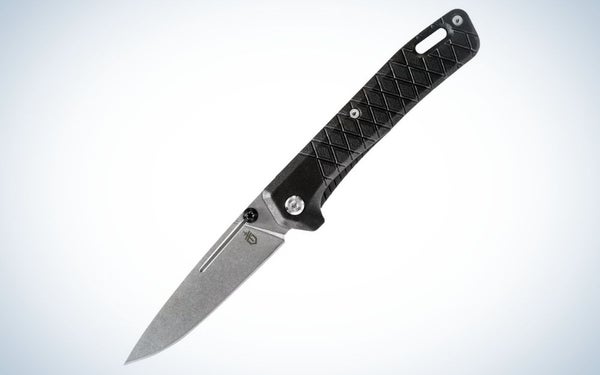
Best Ultralight: Gerber Zilch

Best Ultralight

Why it Made the Cut: The worst thing about some pocket knives is that they’re in your pocket—in the way of everything else you’re trying to get at. The Gerber Zilch isn’t that kind of knife. It’s lightweight and all but disappears while you’re carrying it. 

Key Features

  • Steel: 7Cr Stainless Steel
  • Blade: 3.125-inch drop point
  • Lock Type: Liner lock 

Pros

  • Lightweight and easy to carry
  • Opens easily the first time with no break-in period
  • Affordable 

Cons

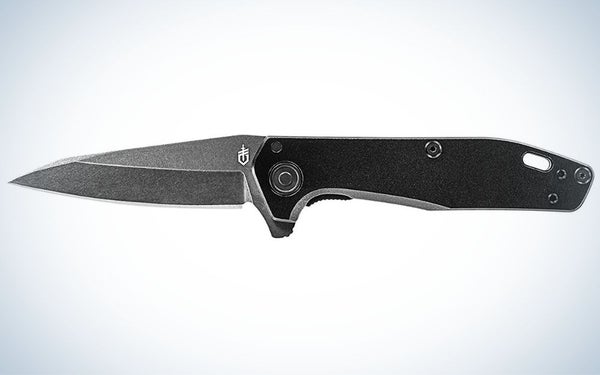
Folding knives clipped to the inside of your pocket can either be comfortable or downright annoying. I can’t stand knives that either skin the back of your hand every time you reach for your car keys or render your pocket unusable for anything else but that knife. The Gerber Zilch doesn’t do this. It’s slim and light, but not so slim that it doesn’t feel like a knife once you get it into your hand. 

Gerber made the Zilch to be used right out of the box. The folding mechanism has nylon bushings that make opening and closing the knife buttery smooth. And there are two ways to open the knife—either with the dual thumb studs or a nail nick. 

Above all else, the Zilch just looks good. The glass-reinforced nylon scales have a textured diamond pattern that’s grippy but not obnoxiously so, and the stone-washed matte blade gives it a modern appearance. I also appreciate other details that you don’t usually see on a $20 knife, like the interlocking tooth-like spine design and oversized lanyard hole. —ME

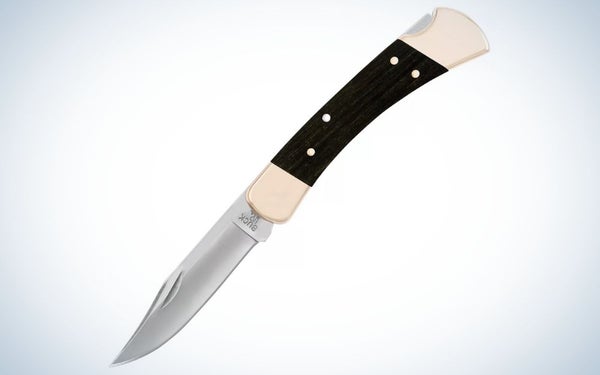
Best Classic: Buck 110 Folder

Best Classic

Why it Made the Cut: Buck’s 110 just might be the most timeless folding knife in American history. The clip point stainless steel blade, brass bolsters, and ebony handle have stood the test time, serving outdoorsmen and women since it was first created in 1963.

Key Features

  • Steel: 420HC stainless steel
  • Blade: 3.75-inch clip point
  • Lock Type: Lever lock 

Pros

  • Simple, versatile design can gut a buck or fillet a bass
  • Solid brass frame looks as good as it feels
  • Excellent value

Cons

When my dad gave me my very first hunting knife in 1975, my eyes lit up. I’d saved up enough money cutting lawns to buy warm clothes, but didn’t have a knife. The Buck 110 was it and has become an American legend. It has been my go-to knife for both hunting and fishing for more than 40 years. I’ve lost it more than once, but it remains the only knife that I’ve headed back into the woods to search for—time and again.

Although I’ve found that the blade edge needs touching up on a regular basis, once it is honed well you can do several deer before it loses its mark. This is not an ultra-lightweight folder if that’s what you’re looking for, but nor is it a heavyweight belt-tugging trudge. Well under $100. —GB

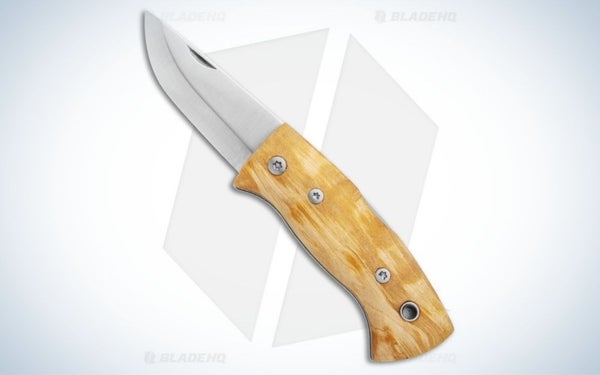
Sharpest Blade: Helle Kletten

Sharpest Blade

Why it Made the Cut: The Helle Kletten is a true pocket-size knife that performs well above its diminutive form and is a thing of beauty in the bargain.

Key Features

  • Steel: Proprietary Triple-Laminated Stainless
  • Blade: 2.17-inch drop point
  • Lock Type: Lever lock 

Pros

  • Robust build for a small knife
  • Holds a keen edge and sharpens easily
  • Curly-birch handle is unique and distinctive; Kebony handle looks like plain wood but is stronger

Cons

  • It isn’t cheap for a small knife

If a knife can be adorable, this one is. At just over 3 inches closed, it’s a pretty little thing that fits in a pocket with room to spare. But its performance is all out of proportion to its size. The blade is thicker (⅛ inch) and deeper than what you see on most small folders. That combined with hand-filling scales, steel liners, and a strong manual back-lock mechanism makes the Kletton one of the toughest small knives you can buy, capable of chores usually left to larger models. 

A Norwegian company known for making high-quality handmade knives, Helle uses a unique process in which they sandwich proprietary high-carbon steel between layers of 18/8 stainless to produce blades that are strong, corrosion-resistant, razor sharp, and easy to keep that way. The Kletton’s blade is a Scandinavian-grind 2.17-inch drop point designed for every-day chores but with the ideal profile for field-dressing and skinning if that’s what you need it to do. 

It comes in two versions, the plain Kletton, which is anything but plain with curly-birch scales of which no two are the same; and the Kletton Kebony, with darker-wood scales that are strengthened via a proprietary process that the company says makes this tough, gorgeous little knife even tougher. —DH

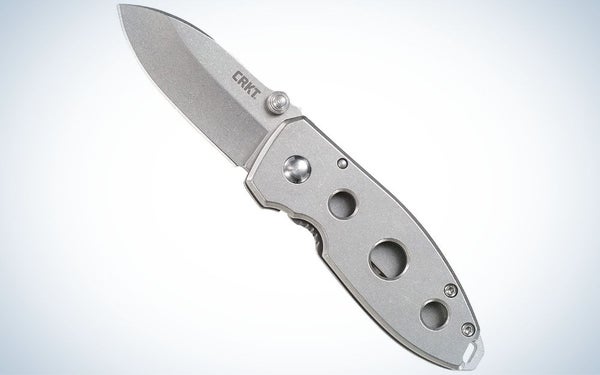
Best Small: CRKT Squid Folding Pocket Knife

Best Small Pocket Knife

Why It Made the Cut: The CRKT Squid is a compact and durable knife perfect for everyday carry. It’s lightweight, low profile, and comes packed with helpful features like friction grooves and a lanyard hole.

Key Features

  • Steel: 8Cr13MoV high-carbon stainless
  • Blade: 2.25-inch modified clip point
  • Lock Type: Frame Lock

Pros

  • Low profile and lightweight
  • Durable stonewashed finish 
  • Thumb stud for easy opening with one hand

Cons

  • Short blade is not ideal for bigger projects

There are two things I look for in a strong EDC pocket knife—compatibility and durability. The CRKT Squid has both and it is always clipped to my belt. Now, this isn’t the knife you want for big projects, but in my opinion, it is ideal to have in your pocket for everyday tasks. The 2.25-inch blade is perfect for opening packages, making small cuts, and compact enough to carry on-the-go.

The Squid features a robust frame locking system and is made from stainless steel. A thumb stud allows for easy one-handed opening and the pocket clip and lanyard hole are perfect to make sure it stays secure to your person. And to put the cherry on top, this knife only costs $32. If you are looking for simplicity and usability, the CRKT Squid is your pick. —Ryan Chelius

Best Replaceable Blade: Browning Speed Load

Best Replaceable Blade Pocket Knife

Why it Made the Cut: I hate gutting deer—always have, always will. It’s all part of the process, though, and ultra-sharp, replaceable blade, scalpel knives like the Browning Speed Load have made the chore far easier.

Key Features

  • Steel: 420J2 stainless steel
  • Blade: 2.63-inch replaceable drop point
  • Lock Type: Liner lock 

Pros

  • Blades are cheap and widely available
  • Outstanding handle that is durable and of great quality

Cons

  • Blade swap mechanism is cumbersome
  • Mixed reviews on blade quality and sharpness

Like most others, I guess, I first became enamored with replaceable-blade (scalpel) knives once Havalon came on the scene a decade or so ago. Suddenly, gutting a deer became a quick and simple procedure. After processing a few whitetails, however, I came to be more critical—pretty sharp, but also pretty flimsy.

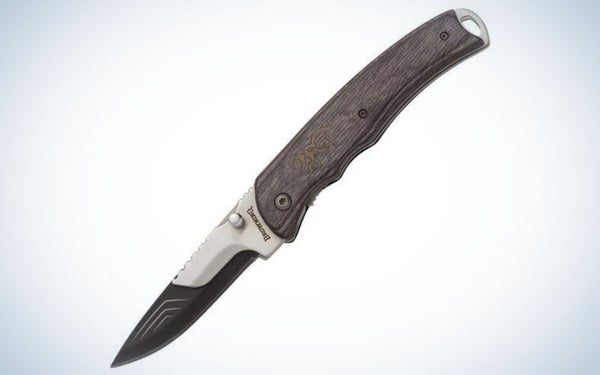
Once I got my hands on the Browning Speed Load knife, though, I changed my mind. I carry it with me each deer season. Suddenly, the flimsiness was gone and I felt as if I was really holding a knife. The knife itself is sturdy, as are the blades. Although critics say that the blades do not remain sharp enough for long enough, I’ve not found that to be the case. Yes, I always carry the Buck 110 Folder for the tough stuff, but these days the Browning Speed Load does the heavy lifting. —Gerry Bethge

Best Mid-Sized: Gerber Fastball

Best Mid-Sized Pocket Knife

Why It Made the Cut: The Gerber Fastball is great for everyday carry, in the woods, and on the water. It features a Wharncliffe blade and aluminum handle.

Key Features

  • Steel: High-carbon S30V
  • Blade: 3-inch Wharncliffe
  • Lock: Easy-off Liner Lock release

Pros

  • 3-position pocket clip
  • Ball bearing leverage system
  • Limited lifetime warranty
  • Made in the USA

Cons

When I think about what I want out of a pocket knife the answer is clear—simplicity. If I wanted a multitool, well, then I’d buy a multitool. But for a pocket knife, all I want is a strong, reliable, and compact blade that I can keep on me at all times. Enter the Gerber Fastball. 

This knife is as simple as it comes without sacrificing quality. It measures 7.1-inches in total length with a 3-inch S30V stainless Wharncliffe blade for better precision. The aluminum handle is light at 2.7 oz., tailored for everyday carry. The stainless steel ball bearing system allows for a quick and smooth deployment. The blade itself—strong, durable, and corrosion resistant—is ideal for typical everyday tasks. 

It’s not common to find many products made right here in the USA anymore, but the Gerber Fastball is. And there’s nothing more American than a perfect fastball. —RC

Most Reliable: Rapala Fish ‘N Fillet

Most Reliable Fishing Knife

Why it Made the Cut: In the late ‘60s, Normark (Rapala’s parent company) introduced a simple fillet knife. It had a thin, flexible blade and was a hit as soon as it reached the market. The Rapala Fish ‘N Filet was, and is, a gimmick-less knife that is easy to use and simple to keep sharp. It is also amazingly inexpensive—less than $50.

Key Features

  • Steel: European Stainless
  • Blade: 6-inch
  • Sheath: Leather 

Pros

  • Works on fish of all sizes
  • Reinforced birch handle
  • Includes easy-to-use single-stage sharpener

Cons

  • This one doesn’t fold, though folders are available

I quit my first job ever when I was 13 years old. My dad was building our hunting and fishing camp in southern New England and we kids were charged with raking and picking rocks from what would one day be a lawn. We’d had it with the long days, hard work, and zero fun. It was a full-on protest with signs and chants. “No fishing, no work,” was our battle cry and we meant it. Dad finally acquiesced.

At 5 o’clock, he asked us to jump into his blue Rambler with our rods. He presented all of us with Rapala fillet knives. I’ll never forget its varnished birchwood handle and leather sheath. I instantly ran my belt through the sheath’s loop and carried it around the beaver swamp the entire evening—not caring if I ever caught a trout. I had my first fishing knife ever.
Though a lot has changed since then, the Rapala Fish ‘N Fillet has not. The European stainless steel blade comes in sizes from four to seven and a half inches, letting you make a meal out of everything from bluegill to bluefin. The included single-stage ceramic sharpener makes touch-ups between fish easy, and the leather “Laplander” sheath keeps it safe between trips. If you’re looking for a simple and reliable filet knife, look no further than the Fish ‘N Filet.—GB

What to Consider When Choosing a Pocket Knife

Though all pocket knives are comprised with basically the same components, the way they are put together can vastly alter their usefulness for certain tasks. When looking for your next favorite knife, consider the following:

Blade Type: There are dozens of shapes you can have knife blades in. Some of these are highly specialized, designed to perform one specific task very well. Others are more generalist, and can handle a wide variety of chores well. For instance, a drop point can open a box, cut up lunch and skin a buck with equal ease. But while the unique shape of a filet knife blade is perfect for separating delicate flesh from rib bones, it isn’t the best choice for cutting rope or making kindling. When looking for a knife, consider it’s intended usage, and select the blade shape accordingly.

Steel: Perhaps no one single factor matters more for a knife’s performance than the type of steel it is made with. There are two types of steels used in knife blades, carbon and stainless. Carbon steel is strong and sharpens easily but is prone to rust. Stainless steel, as the name implies, offers more rust resistance. But, the compromise lies in its ability to take, and hold, and edge. For most pocket knives, a mix of the two is ideal. High-carbon stainless steels have acceptable sharpening and edge retention qualities, and resist rust without a daily oiling routine.

Additional Implements: Even if adorned with only a single blade, a pocket knife is no one trick pony. While it’s downright amazing what you can accomplish with the right blade, some additional tools at your disposal will increase the knife’s utility. An extra blade or two can greatly increase the knife’s usefulness. And multi tools add another dimension, letting you perform repairs, build blinds, and start fires with a veritable toolbox that fits in your back pocket.

FAQs

Q: What is the best size pocket knife?

The best size for a pocket knife depends on its intended use. Most day-to-day tasks can be accomplished with a blade of around three inches. Blades of this size are small enough to be nimble, but have handles that offer enough real estate for a solid grip.But if you plan on taking on heftier tasks, such as cutting kindling, consider a slightly larger model.

Q: How much does a pocket knife cost?

A pocket knife can cost anywhere from a couple bucks to a few thousand. You can typically ignore knives on the lower end of that spectrum, with the exception of the outstanding Opinel, as these are typically poorly constructed and break quickly. You don’t need to spend a couple grand for a quality knife, either. Many excellent models are available in the $45 to $250 range.

Q: How long will a pocket knife last?

A good pocket knife can last forever with proper care. Assuming the knife is constructed of quality steel, with a solid mechanism, there is little to go wrong. Of course, if you abuse the knife by using it for a task it is not intended for, like prying, it will break. And you can eventually sharpen the blade down to nothing if you used it enough, but that will take quite some time.

Q: Is it safe to carry a pocket knife?

Yes, when the proper precautions are taken, it is very safe to carry a pocket knife. Make sure your pocket knife is safely secured to your person at all times. This means that it is either folded down or sheathed for safekeeping.

Q: Is it illegal to carry a pocket knife?

This depends on where you are and what type of knife you are carrying. In most states, it is perfectly legal to carry a folding pocket knife. Usually, a state will define a legal knife by the length of the blade and the type of knife. But you should still check your state and local laws to make sure you are legal to carry a pocket knife.

Best Pocket Knives: Final Thoughts

There are a variety of subjective factors that go into recommending the best pocket knives. Our team of editors have no shortage of heirlooms, stories, opinions, and experiences that went into creating this list. But the common theme in every selection is that each pocket knife does a good job at what that person needed it to do. Yes, there are important considerations like blade type, steel, and accessories you need to look for. Once you get these nuts and bolts squared away, make sure to tailor your selection to what you want your pocket knife to do. 

Why Trust Us

For more than 125 years, Field & Stream has been providing readers with honest and authentic coverage of outdoor gear. Our writers and editors eat, sleep, and breathe the outdoors, and that passion comes through in our product reviews. You can count on F&S to keep you up to date on the best new gear. And when we write about a product—whether it’s a bass lure or a backpack—we cover the good and the bad, so you know exactly what to expect before you decide to make a purchase.

The 5 Best Compasses for Hiking of 2024

0

We may earn revenue from the products available on this page and participate in affiliate programs. Learn more ›

The best compass is one that you know how to use and have with you. It can help you take a bearing of a distant object, follow a route through wilderness, and orient yourself on a map. Even if you prefer digital navigation aids, like a handheld GPS, you should always have a compass on hand to ensure you never lose your bearings if the GPS runs out of battery power. Whether you are a novice to the world of orienteering or looking to level up, here are some things to consider before making your purchase of the best compass for hiking.

How We Picked the Best Compasses for Hiking

As an avid hiker and wilderness adventurer, I recognize that the compass is one of the most important essentials in my backpack. Even though it’s packed most of the time, I know it could easily save my life someday if I become lost, disoriented, or forced to maneuver off trail.

My compass expertise sharpened over the years I taught orienteering courses for Appalachian Mountain Club’s Mountain Classroom program. I gained experience by teaching compass skills and setting up compass orienteering challenge courses in the woods. I have spent many seasons getting to know my way around a compass.

In choosing the best compass for hiking, I looked at a few main criteria:

  • Quality: There are plenty of affordable plastic compasses out there, but in a real bind, you want to have the assurance that your instrument will get you to where you need to go. If it’s a matter of life or death, the best compass is the one that will be reliable and trustworthy.
  • Features: While a beginner needs few features so they can learn the basics, an experienced orienteer should choose a compass with features that make their instrument a multi-use tool. Mirrors, rulers, magnifying glass, and lanyards can have other uses in the field for first aid, survival, and hygiene.
  • Durability: If you’re throwing your compass into your hiking backpack for the day, it’s important that it’s durable enough to survive the trek. I looked for compasses that were waterproof, protected, and proven industry leaders.

Best Compasses for Hiking: Reviews and Recommendations

Best Overall: Silva Ranger 2.0

Best Overall

Specs

  • Type: Mirrored baseplate
  • Weight: 3.88 oz
  • Dimensions: 5 x 11 x 2 in
  • Materials: Plastic

Pros

  • Sighting mirror
  • Lanyard with distance measurements
  • Declination adjustment with included tool

Cons

  • Complicated features not good for beginner

The Silva Ranger 2.0 is a quality mirrored baseplate compass that is the perfect fit for hiking, bushwhacking, hunting, or forestry. If you are comfortable with mirrored baseplate compass use, it is the best compass for hiking.

This compass includes a mirror for sighting. By tilting the mirror at 45° angle, the user can keep an eye on the needle by looking at the bezel in the mirror while sighting the direction. This is especially helpful over long distances.

In addition, the Ranger comes with a magnifying glass, luminous markings, and a separate “slope card”. Experienced hikers can use the slope card to measure grade on a map or assess avalanche risk.

The lanyard of the Ranger 2.0 is unique in that it has four scales of measurement to help the hiker measure distances on a map. Since it is soft, it’s more useful than a straightedge when tracing a path on a map.

The adjustable declination of this compass allows the hiker to adjust the compass to their location. This saves time as well as reducing the possibility of user error when adjusting for declination with each bearing.

While the bells and whistles of this compass are sweet, they can also be overwhelming. If you are new to orienteering and looking for something the same quality but less overwhelming, try the Silva Explorer. It’s a quality baseplate compass that will help a hiker with basic orienteering.

Best Budget: Survive Outdoors Longer (S.O.L.) Sighting Compass with Mirror

Best Budget

Survive Outdoors Longer (S.O.L.) Sighting Compass with Mirror S.O.L. Survive Outdoors Longer

Specs

  • Type: Mirrored baseplate
  • Weight: 3.53 oz
  • Product Dimensions: 5.5 x 3.94 x 0.79 in
  • Materials: Plastic

Pros

  • Clinometer
  • Low light visibility
  • Declination adjustment with included tool

Cons

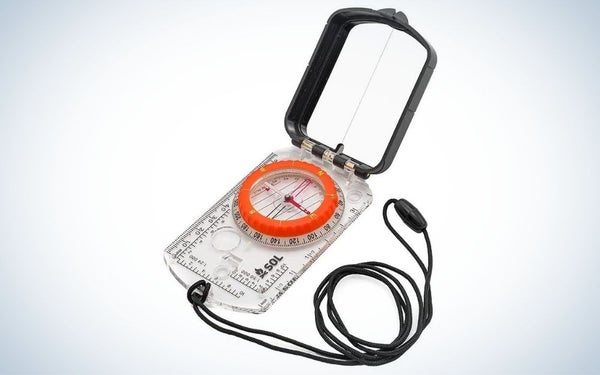
If you’re looking for an affordable compass that still comes with the bells and whistles of its higher price competitors, the Survive Outdoors Longer (S.O.L) Sighting Compass with Mirror is the best budget compass.

This is a mirrored baseplate compass that is great for hiking or bushwhacking. Some of the notable features include a mirror, rulers in both millimeter and inches, and magnifying glass. Luminous markings on the orienting arrow, needle, and direction of travel marking glow in the dark after briefly being exposed to a light (like your flashlight).

The SOL compass also has a clinometer on the baseplate that allows you to measure a slope angle.

One of the most useful features of this compass is the ability to adjust declination. A small tool comes with the compass that allows you to fine-tune the bezel to compensate for declination and calculate your bearing with the proper offset for your region every time.

Although this compass has held up well, its materials appear far less durable than its Silva and Suunto counterparts. My only real complaint is that I find the bezel ring a little tough to spin. Nevertheless, this compass is great value. The fold down mirror protects the compass when not in use so you don’t have to worry about it being destroyed in your pack.

Most Durable: Cammenga 3H Cammenga G.I. Military Lensatic Compass

Most Durable

Cammenga 3H Cammenga G.I. Military Lensatic Compass Cammenga

Specs

  • Type: Lensatic
  • Weight: 7.04 oz
  • Dimensions: 6 x 6 x 6 in
  • Materials: Aluminum

Pros

  • Durable
  • Precise
  • Low light capability

Cons

  • No declination adjustment capability

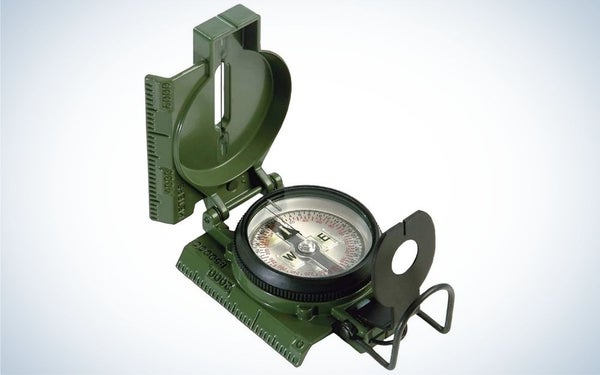
Similar to the compass used by the US military, the Cammenga Lensatic Compass is great for shooting a line to a distant object using a sight wire. This is helpful for tracking a route back to your car after a day in the woods or crossing wilderness using azimuth.

This model has some serious benefits that make it a favorite of military and civilians alike. The tough aluminum casing means it is durable and easy to toss into your pack. The housing is air filled which means the needle is more sensitive to movement but will not develop bubbles in the housing.

Perhaps most importantly, this compass comes with tritium lighting — a radioactive phosphorescence that glows in the dark (don’t worry, it’s not harmful with the amount used). This makes the Cammenga the best compass for night use as well.

While this compass is great for finding and following a sight bearing, it’s challenging to use with a map. There are no magnetic declination adjustments which makes it difficult to account for actual north. The main measurement of this compass is in Mils (short for mili-radians) whereas most hikers prefer degrees. Also, it doesn’t have grid lines like the baseplate compasses so it is challenging to line up with the grid. Still, it’s hard to argue that there is a more durable field compass on the market. If the price tag has you sweating, consider the more affordable 9077 Lensatic Military-Style Compass from Brunton.

Best for Kids and Beginners: Silva Starter 1-2-3

Best for Kids and Beginners

Silva Starter 1-2-3 Silva

Specs

  • Type: Baseplate
  • Weight: 1.4 oz
  • Dimensions: 2 x 3 x 0.4 in
  • Materials: Plastic

Pros

  • Easy to use
  • Waterproof
  • Lightweight

Cons

  • No declination adjustment capability

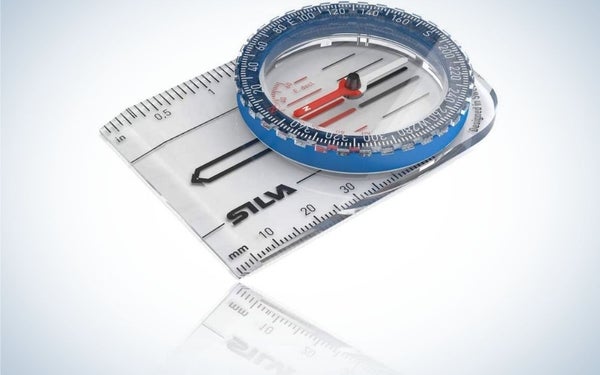
If you are looking for a simple and sleek starter compass, the Silva Starter 1-2-3 is your best bet. The compass is small and light with an easy-to-read housing. It’s also waterproof which makes it a durable choice to bring into the field.

This starter compass is high quality with few bells and whistles. This helps beginners focus on the basics and not get overwhelmed by features on mirrored baseplate counterparts. There are mm and inch ruler markings on the side of the baseplate and clear degree parks on the bezel.

The bezel ring is fairly large and turns really smoothly. This is perfect for children and others learning the basics, easily putting “red in the shed” and orienting the compass.

Being so simple, this compass does not come with declination adjustment capacity so users pairing this with a map would need to adjust each bearing for declination. Overall, it is exactly what it’s supposed to be: a great starter compass.

Best for Travel: Suunto MC-2G Global Compass

Best for Travel

Suunto MC-2G Global Compass SUUNTO

Specs

  • Type: Mirrored baseplate
  • Weight: 2.65 oz
  • Dimensions: 2.56 x 3.98 x 0.71 in
  • Materials: Plastic and stainless steel

Pros

  • Global needle
  • Clinometer
  • Declination adjustment with included tool

Cons

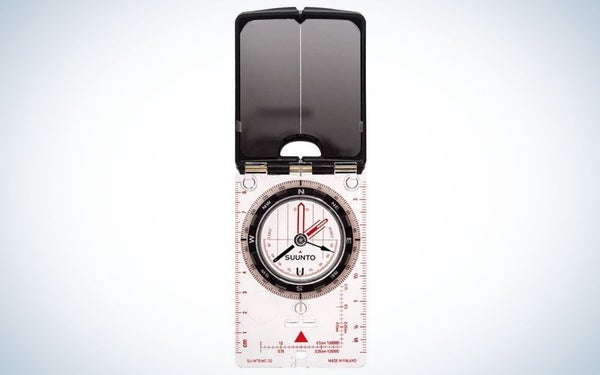
Compasses are usually created to work in their specific hemisphere (north or south). However, Suunto’s “global needle” works in both, so whether you’re trekking through a U.S. national park, climbing a peak in New Zealand, or crossing glaciers in Patagonia, this compass will do the job. This makes the Suunto MC-2G Global Compass the best compass for travel. 

This instrument also comes with all the extras. The signing mirror, ruler, clinometer, and magnifying lens are all useful tools that a seasoned compass-user will find valuable. Another feature that makes navigating on a hike much easier is the ability to adjust declination to the area. The lanyard has a small adjustment key attached so you can adjust your declination to every new location traveled. This compass also comes with luminous points and bezel for low light navigation.

While the MC-2G is about as loaded with features as you can get, it is a tool for an experienced user and could easily overwhelm a newbie. If you are looking for a simpler model that can still take on both hemispheres (and half the cost), consider the Silva Ranger Global Compass. It can be used in all three magnetic zones and has the same simple features you see on the Silva Starter.

What to Consider When Choosing a Compass for Hiking

Types of Compasses

Before you look at brands or features on a compass, it’s important to know the types available. There are three main types of hiking compasses: baseplate, mirrored baseplate, and lensatic. All can be used to orienteer through wilderness. Here’s a quick breakdown:

  • Baseplate Compass: A baseplate compass is great for hiking since it pairs well with a map. As the name implies, a liquid filled housing contains the needle and sits on a clear baseplate. The liquid allows the needle to move slowly and smoothly. The clear baseplate permits you to see through to the map to set waypoints and align the compass to north. The plate usually has a straightedge on the side for drawing lines between waypoints and a ruler to determine distances.
  • Mirrored Baseplate Compass: The addition of the mirror on a traditional baseplate compass adds versatility, allowing the user to see the compass dial and the background at the same time. The mirror opens with the hinge at the direction-of-travel arrow, and there is usually a v-notch on the base of the mirror that the user can use as a sight for finding objects in the field. By keeping the mirror at a 45° angle, you can align the compass to a target by looking through the notch then by looking at the mirror align the orienting arrow to the north arrow. This adds accuracy but can also add challenge. Therefore, a typical baseplate compass is better for beginners.
  • Lensatic Compass: Also known as the military compass, the lensatic compass is a great companion to those who know how to use it. They are usually air-filled, which results in a faster moving needle and more durable compass. This compass type is mainly used to get a site bearing and are more challenging to use with a map. However, the military lensatic compass is durable, has night capacity, and greater precision than its baseplate companions.

Features to Look For

Most compasses come with the same basic features including a needle that points to magnetic north, direction of travel arrow, and moveable bezel ring. However, the best compasses for hiking add a few more features that make them a multi-use tool. Here are some additional items that will make the compass even better.

  • Mirror: As mentioned above, some baseplate compasses come with a mirror. While it can help with accuracy, the mirror can also double as a signaling device as well as serving as a hygiene mirror for first aid in the wilderness.
  • Magnifying Lenses: Some baseplate and lensatic compasses come with a small magnifying lens. This is helpful when reading fine print on a map and can be used as a tool for fire starting.
  • Glow in the Dark Indicators: Luminescent markings are usually made from strontium-alumina based pigments and can help you make your way in the dark.
  • Declination Adjustment: Gridlines on maps are aligned to geographic north while the compass is oriented to magnetic north. If you don’t account for this difference, you’ll be off course. Some baseplate compasses come with a declination screw that can be adjusted to match that of your region. This allows the user to change the declination to match the area. It’s very useful for backcountry navigation with a map.
  • Clinometer: A small moving arrow in the liquid-filled housing allows the user to measure slope and steepness.
  • Global Needle: If you plan to take your compass into the southern hemisphere, be sure to get one with a global needle that is designed for both hemispheres.

FAQs

Q: Is a liquid filled compass better?

A liquid filled compass isn’t necessarily better, but it does have its benefits. Most baseplate compasses are liquid filled, which means the needle is rotating through a liquid. This slows the needle, making it less sensitive to movement in your hand. But aggressive movements, such as bumping around in your bag or drops, can develop bubbles in the liquid or create leaks which will impede the accuracy of the compass. Some liquid filled compasses are also sensitive to temperature extremes.

Q: What should I look for in a hiking compass?

If you are new to hiking compasses, you should look for a user-friendly design that’s easy to use. Make sure your basic hiking compass has:
●  A clear baseplate for seeing a map underneath
●  Easily moveable bezel ring
●  Clearly marked direction of travel arrow
●  Needle that orients to magnetic north
●  Orienting arrow and lines

Q: How much does a good compass cost?

Compass price varies wildly depending on quality and features. A good compass can cost anywhere from $15 to $100. A solid, reliable hiking compass like the Silva Explorer or Suunto A-30 fall into the $20 to $30 range. If taken care of, these can last for a lifetime of adventures.

Q: Do compasses lose accuracy?

It is possible for the needle in your compass to demagnetize over time if you store it near a strong magnet. However, the most likely need for a new compass is wear and tear from being crammed into a backpack, falling onto rocks, or tolerating extreme swings in temperature. If taken care of, a good compass could easily last a lifetime.

Best Compasses for Hiking: Final Thoughts

Whether you are headed into the woods on a hunt, staying on a hiking route, picking out a peak on a map, or following a course – the best compass is one you know how to use and keep on your person. Make sure one is tucked into your bag on every adventure.

Why Trust Us

For more than 125 years, Field & Stream has been providing readers with honest and authentic coverage of outdoor gear. Our writers and editors eat, sleep, and breathe the outdoors, and that passion comes through in our product reviews. You can count on F&S to keep you up to date on the best new gear. And when we write about a product—whether it’s a bass lure or a backpack—we cover the good and the bad, so you know exactly what to expect before you decide to make a purchase.

Scallop Diver Killed by Shark Off the Coast of Mexico

0

A young fisherman was recently killed by a shark while diving for scallops off the coast of Mexico. According to a press release, 22-year-old Víctor Alejandro Soto García was attacked on December 28 near Tahui Beach, which is situated on the Gulf of California.

“Unfortunately, [a shark attack] left a person dead today,” wrote the Sonora Department of Civil Protection. “The young man’s body was taken by his fellow fishermen to the Yavaros dock.”

The agency also noted that García was not wearing an “anti-shark repellent bracelet” at the time of the attack. Such bracelets use electrical or magnetic pulses to deter sharks. According to an NIH study, they are only marginally effective. 

Several news agencies have reported that the culprit was a great white shark, though Field & Stream has not been able to independently verify the species of shark involved in the incident. 

Shark attacks, especially fatal shark attacks, are considered quite rare. That said, a number of shocking incidents occurred in the final weeks of 2023. In addition to this incident, in December 2023, a Boston woman was killed in a shark attack while paddleboarding in the Bahamas. On December 30, a surfer in Hawaii was involved in a fatal shark encounter.

Read Next: Mule Deer Gores Elderly Woman Outside Her Colorado Home

According to the International Shark File, “The chances of being bitten by a shark are very small compared to other animal encounters, natural disasters, and ocean-side dangers … The few bites that occur every year are an excellent indication that sharks do not feed on humans and that most bites are simply due to mistaken identity.”

The Best Tomahawks of 2024

0

We may earn revenue from the products available on this page and participate in affiliate programs. Learn more ›

Tomahawks are a traditional tool for outdoors folks. You might not need one for every trip into the field, but they sure make many chores a whole lot easier. Probably the most common use for a tomahawk is processing firewood. Many bushcrafters use them instead of an ax or hatchet, as tomahawks are generally smaller and lighter. Beyond chopping wood, a tomahawk is used for carving, harvesting wild edibles, even self-defense.

With a good quality tomahawk, a great knife, and your favorite survival kit you’ll be ready to tackle any challenges that might crop up when you’re out in the wild. But how do you pick the right one? Using my years of experience as a survival teacher, I sifted through to find the best tomahawks that will stand up to repeated use and abuse out in the field.

How We Picked the Best Tomahawks

I’ve collected bladed implements for more than a couple of decades now. While I tend to concentrate on knives, I have numerous tomahawks, as well as hatchets, axes, and more. A sharp edge was one of mankind’s first tools, and arguably the most important one. It allowed people to more easily harvest food as well as prepare it. It also gave people the ability to create other tools from the natural resources around them. A stick could be given a sharp point, for example, and thus be all the better for digging.

I’ve used tomahawks in the field in a variety of capacities. They are a great multi-tool option, as they can do so much more than just chop wood. Personally, I prefer the ones that have a hammer end along with the sharp blade. But there are so many models and styles out there that finding the best tomahawk for each person might take a little trial and error.

As I put together this guide, I tried to focus on two primary factors for each selection:

  • Value: Each tomahawk in this article has a high degree of value for the price. High quality components combined with proven designs equate to a tool that you’ll be able to use for a lifetime. One thing I’ve found is that for many people, the higher the price for the tool, the less eager they are to actually use it. They don’t want to see it scratched or marred in any way. To me, that defeats the purpose of buying a tool.
  • Availability: There are numerous makers out there who specialize in custom-designed tomahawks that are incredibly well-made. However, they’re rather expensive as well as hard to obtain, due to very limited numbers of them being made at a time. It makes little sense for me to recommend a custom tomahawk that might take you a year or more to obtain, as well as cost you as much as car payment. Not when there are other, perfectly suitable, tomahawks readily available.

Best Tomahawks: Reviews & Recommendations

Best for Camping: CRKT Jenny Wren Compact

Best for Camping

Specs

  • Overall Length: 10 inches
  • Weight: 1.12 pounds
  • Blade Length: 2.59 inches

Pros

  • Great for carving as well as chopping
  • Textured handle for positive grip
  • Sheath has multiple carry options

Cons

  • Too small for heavy-duty work

Ryan Johnson from RMJ Tactical has made a career out of designing and building tomahawks, as well as other bladed implements. His work is known throughout the world to be dependable and reliable, as well as practical. The Jenny Wren is just one of his collaborations with CRKT.

The Jenny Wren is small in stature but big in performance capability. It is a great addition to the camping loadout. At just over a pound, it won’t weigh you down too much. The grippy handle is comfortable and allows you to keep in your hand, even in challenging conditions. Its blade is wide enough to do real work without being clumsy for close up tasks like carving. You can use the top edge for scraping as well.

It comes complete with a durable sheath that is MOLLE-compatible, for those who prefer to carry their gear in that fashion. The Jenny Wren might not easily handle providing firewood for a multi-day campsite, but it’ll certainly do the job for short-term stays. If for some reason you’re unable to find a Jenny Wren, you might search for a Browning Tomahawk, as they have a model that’s similar in size, though styled a little different.

Best for Survival: American Tomahawk Company Model 1

Best for Survival

Specs

  • Overall Length: 14.125 inches
  • Weight: 20 ounces
  • Blade Length: 2.375 inches

Pros

  • Sturdy, robust construction that’s built to last
  • Molded bottom-eject Kydex scabbard
  • Has a forged 1060 steel head

Cons

  • Might be too weapon-oriented for some users

The original Vietnam Tomahawk was produced by American Tactical Company back in the late 1960s and early 1970s. The company folded shortly thereafter, but was revived in 2019. The Model 1 tomahawk is the modern version of the original design. Where the original had a wood handle, the Model 1 features a synthetic stock. With the texturing on the handle, there’s little worry about it slipping from your grip.

This is the best tomahawk for survival purposes due to its multi-use design. The blade is sharp and will easily provide firewood for the night. It is also easy to choke up on the handle and use the edge for carving or even some types of food prep. The spike that’s opposite the sharp edge works well for defense as well as smashing holes in, well, anything that needs holes.

The Model 1 comes with a scabbard that’s molded to fit perfectly. It is a bottom-eject design, meaning you remove the tomahawk from it by pulling down, rather than sliding it upwards and out. It can be carried on your belt or strapped to a pack.

Best Traditional: Cold Steel Frontier Hawk

Best Traditional

Specs

  • Overall Length: 22 inches
  • Weight: 22.4 ounces
  • Blade Length: 3.25 inches

Pros

  • Design has stood the test of time
  • Inexpensive without sacrificing quality
  • Suitable for re-enactors as well as bushcrafters

Cons

  • Does not come with a sheath or scabbard

Cold Steel has a full line of traditional tomahawks, and this Frontier Hawk is an excellent option. It has the look and feel of a tomahawk that could have been used during the French-Indian War, but manufactured with modern materials and techniques.

Cold Steel is well-known for producing high-quality tools that will easily stand up to anything you need them to do. This model has a durable Hickory handle combined with a 1055 carbon steel head. You’ll be hard-pressed to find the same or better quality at a cheaper price, that’s for sure.

The handle is almost two feet long, giving you plenty of leverage when chopping. Because it lacks a hammer or spike opposite the sharp edge, it is lighter than it might appear. But it still has enough heft to lend power to each swing.

For those looking for a tomahawk to practice throwing, many users report this Frontier Hawk to be well-balanced for that purpose. While throwing tomahawks isn’t recommended for hunting or defense, it can be an awful lot of fun and is a great way to spend an afternoon.

Best Tactical: CRKT Kangee

Best Tactical

Specs

  • Overall Length: 13.75 inches
  • Weight: 1.53 pounds
  • Blade Length: 2.93 inches

Pros

  • Glass reinforced nylon handle with textured grip
  • MOLLE-compatible sheath that slips over the head
  • Black powdered coated high carbon steel

Cons

  • Might be a little bulky for some users

If it absolutely, positively must be destroyed overnight, send in the CRKT Kangee. Designed to do far more than just chop firewood, this tactical tomahawk has it where it counts. At a little more than a foot long, it won’t take up much space on your belt or in your pack, so you’ll not hesitate to bring it along on your adventures.

The blade is almost three inches across, giving you plenty of cutting power. The blade geometry is tapered to provide for fast and efficient chopping or splitting. The spike on the opposite end will tear through just about anything put in front of it. The handle has a slight curve, which serves to add control to each swing. There’s also a finger choil that’s makes the Kangee comfortable to hold up close to the head for finer work.

Truth be told, not everyone truly needs a tactical tomahawk. But, if you’re in the market for one, the Kangee is certainly a solid contender. I’d look at this tool as serving the urban and suburban survivalists in particular. Should there come a time when you need to break into or out of a structure, the Kangee will do well in that stead for sure.

What to Consider When Choosing a Tomahawk

When you are shopping for the best tomahawk for your needs, there are a few things to keep in mind as you make your decision.

Intended Use

While all tomahawks share a similar shape, a solidly constructed head with a sharp blade affixed to a sturdy handle, it is the profile of that blade as well as the overall design that indicates the best ways that model can be used in the field. The longer the handle, for example, the more suited it will be for chopping wood as the added length helps to add power to your swing. Some models have a wider blade that works well for carving as well as chopping. Select your tomahawk based on the features it has that match up with how you plan to use it.

Budget

This is always a concern for the vast majority of people. The best tomahawks aren’t cheap. While you don’t need to spend a ridiculous amount of money to get a good quality tomahawk, I’d caution you about taking the bottom dollar route just for the sake of buying something. A poorly built tomahawk can be dangerous, as it could break during use, putting you or others at risk. Not to mention that if it falls apart, you no longer have it as a tool to use. Strive for a good balance between price and quality.

Size and Weight

Because it is a tool that you’ll be carrying, whether in a pack or on your belt, you need to consider what it will be adding to your overall load. Ounces lead to pounds, which add up quickly on your feet. Some tomahawks look really cool and might even have some real use, but they weigh so much that you’ll feel like you added a boat anchor to your backpack. The length of the handle is also a factor when it comes to ease of carry and packability.

Added Equipment

A tomahawk isn’t the only tool you should take with you into the wilderness. A knife, compass, first aid and survival kits should all have a place in your pack whenever you venture off into the unknown. We have done the hard work for you, and came up with recommendations for the best compasses, first aid kits, survival kits, and knives for you. And depending on how long you plan on staying there, consider taking one of the top water filters along. And keep these hiking safety tips in mind when you go. A GPS unit can also come in handy. You can find the best handheld GPS units in our roundup.

FAQs

Q: How does a tomahawk differ from an axe or hatchet?

The tomahawk differs from the axe or hatchet in a number of ways. First, the traditionally styled tomahawk has a longer handle, typically around 24 inches or maybe a bit less, whereas the hatchet is typically much shorter. The handle is also usually straight, whereas with the axe or hatchet there’s some contouring to it.
 
Tomahawk heads are also usually friction fit. This means that the handle widens a bit as it reaches the top. The head is slipped onto the bottom and slides up to the top, where it wedges in place. Hatchets and axes have heads that are fitted from the top, with wedges driven in to keep them in place.

Q: Are tomahawks good for bushcraft?

Tomahawks are excellent bushcraft tools. To be clear, we’re defining bushcraft as the practice and use of skills to stay alive in the wild with a minimal amount of gear. While every self-respecting bushcrafter carries a knife, the tomahawk can be used for many chores that require a blade. This saves the knife’s edge for when it is truly needed.

Q: What are some practical uses for tomahawks?

There are many practical uses for a tomahawk. Historically, tomahawks were weapons of war and used for defensive purposes. Today, they’re seen more along the lines of woods tools than weaponry. They’re used for chopping wood for the fire, of course. But you can also use them for scraping animal hides, as well as carving wood into useful tools. In fact, most tasks that require a knife blade can be performed with a tomahawk.
 
As a bonus, if it is balanced properly, a tomahawk can also be thrown. This is a great way to spend an afternoon. Some models, such as the Gerber Downrange, also incorporate other features, like a prybar-styled handle, that provide additional uses.

Best Tomahawks: Final Thoughts

A tomahawk isn’t necessarily a required component of every outdoor adventure packing list. If you’re just headed out for an evening in a campground, you probably won’t need one. However, if you’re venturing a bit beyond the established path and looking to do more actual bushcraft sort of activities, the tomahawk will be a valued addition. So make sure you have one of the best tomahawks in your pack when you hit the wilds.

Why Trust Us

For more than 125 years, Field & Stream has been providing readers with honest and authentic coverage of outdoor gear. Our writers and editors eat, sleep, and breathe the outdoors, and that passion comes through in our product reviews. You can count on F&S to keep you up to date on the best new gear. And when we write about a product—whether it’s a bass lure or a backpack—we cover the good and the bad, so you know exactly what to expect before you decide to make a purchase.

The 7 Best Fixed-Blade Knives of 2024

0

We may earn revenue from the products available on this page and participate in affiliate programs. Learn more ›

Most serious hunters tote a tried-and-true fixed-blade knife on every outdoor expedition. When you find one that fits your hand like a glove, carves up game cleanly, and gets meat from the field to the table, you will know why.

Before diving into fixed-blades too much further, it’s essential to understand what a fixed-blade knife is and what makes it a critical outdoor must-have. In short, a fixed-blade is a knife that doesn’t allow the blade to fold into the handle. Instead, the blade extends into the handle and can be a full- or partial-tang blade. Full tang blades are favored by most due to their durability because the steel runs through the handle’s entire length. Outdoor goers, especially those that spend lots of time cutting up meat and working around bone and joints, rave about the amount of pressure they can apply to the knife, particularly if the knife sports a comfortable grip that promotes excellent fit and feel.

Here are our picks for the best fixed-blade knives you can buy, including field dressing knives.

Best Fixed-Blade Knives: Reviews & Recommendations

Best Overall: Bradford Guardian 3

Best Do-All Knife

Bradford Guardian 3 Bradford Knives

Specs

  • Horizontal carry
  • Drop-point blade
  • 6.75 in. overall length

Pros 

  • Compact
  • Razor sharp
  • Full tang 

Cons

  • $160-$170 is a tad steep
  • Blade thickness

Branded as an everyday carry fixed-blade, this 3.42-ounce knife is a dream come true. The 3.5-inch drop-point blade is ultra-sharp, and the full-tang build boosts durability. Built for years of abuse, this small fixed-blade knife works as good on game as it does to pick out a splinter. I love the horizontal carry and leather sheath—the knife draws quickly but isn’t sloppy when in transit. You can’t beat the Guardian’s thin, easy-to-handle Micarta handle, but it is offered in G10 if you prefer that. The handle provides just enough width and girth to ensure a solid grip but isn’t bulky. It’s one of the best hunting knives because of this.

The blade’s drop point tip makes clean slices a breeze. It has a plain edge, and sharpening is easy. The 60-61 hardened Bohler M390 blade sweetens the pot, and there are 13 different color options.

Best Skinning: Browning Featherweight Classic

Best Skinning

Browning Featherweight Classic

Specs

  • Full-tang blade
  • Anti-Skid Grooves on the spine
  • Polished 9Cr14MoV drop-point blade

Pros

  • Easy to sharpen
  • Durable
  • Maximum control
  • Price

Cons

  • Blade length is not quite 5 inches
  • Like to see a polymer grip option
  • Sharpen regularly

Many of my “best of” choices wear a heftier price tag, but I’m a fan of not paying for what I don’t need. Browning’s Featherweight Classic does the trick and comes with a reasonable price tag. The 4 3/8-inch mirror polished drop-point blade is as durable as the day is long and holds a solid edge as long as you touch it up from time to time. The leather sheath adds a touch of class and protects the stainless-steel blade. The blade promotes long, efficient cuts, and while the Zebrawood handle scales are a nice touch, the knife feels great in hand for a wood-handle knife. Anti-skid grooves have been added to the blade spine, and the overall build promises excellent longevity. In addition to its use as a skinner, this fixed-blade hunting knife doubles as a decent fillet knife and is one I often use when cutting my deer and elk steaks before wrapping them in freezer paper.

Best Backcountry: Benchmade 15200ORG Altitude

Best Backcountry

Benchmade 15200ORG Altitude Benchmade

Specs

  • Carbon Fiber and G10 Micro-Scales handle
  • 3.08-inch CPM-S90V Super Premium Stainless Steel Blade
  • 1.67 Ounces

Pros

  • Weight
  • Durability
  • Maneuverability

Cons

  • $245 price point
  • Ultra-thin handle

At just 1.67 ounces, the lightweight Benchmade 15200ORG Altitude drop-point fixed-blade wonder can be tossed in the pack or worn on the belt in its Kydex sheath. The overall length of 7.38 inches is ideal, and when you have a knife of this weight and size, maneuverability is boosted. The knife’s edge is remarkably sharp, and it holds that edge. I’ve carved up multiple critters before having to hit the .35-inch-thick blade with a stone. I also like that the full-tang blade is part of the handle. It’s thin, which takes some getting used to, but the pair of raised Carbon fiber and G10 Mirco scales prevent the hand from slipping down, and if torque is needed, they can be gripped and used. You also get ridges that have been carved into the upper spine to help with hand and finger grip. When working on big-game animals like elk, I like to position my thumb on the carbon fiber micro scales and place my index finger on the ribbed upper spine. This grip provides maximum control. The orange finish is sexy, and I like that Benchmade added the lanyard hole, and the Kydex sheath is bulletproof. 

Best for the Money: Gerber Moment Fixed-Blade – Gut Hook

Best for the Money

Gerber Moment Fixed-Blade – Gut Hook

Specs

  • Textured rubber handle
  • Gut hook
  • Plain edge blade

Pros

  • Great grip
  • Balanced feel
  • Fine edge

Cons

  • Bulky
  • 8.63 total inches
  • Gut hook dulls quickly

If you’ve used a Gerber knife, you know why. For $30, this full-tang, 7.2-ounce fixed-blade works as well as an everyday carry knife as it does in the woods. A versatile do-all knife, the 7.3 ounce Gerber Moment Fixed-Blade provides the user great control, and the full-tang fine edge drop-point blade stays sharp. You can put some torque to it without fear of damage.

Created by Gerber for those that spend time camping, hunting, fishing, and hiking, the knife measures 8.63 inches and weighs 7.2 ounces. The button-style nylon sheath keeps the blade contained on the hip or riding in the pack. The rubber handle is beefy, and the rubberized material ensures an excellent grip and prevents slippage even when bloody or wet. The knife is easy to clean and maintain, and the addition of the gut hook feature makes the gutting and skinning of game extremely easy if the hook is sharpened regularly. The gut hook is solid, but it will need to be touched up after a few zipper jobs on big game. This is a knife that, if properly cared for, will last a lifetime, and if not, can be used and abused, and then you can drop another $30 and buy another. 

Best Tactical: CRKT Clever Girl

Best Tactical

Specs

  • Upswept blade 
  • G10 handle
  • Thermoplastic sheath with mounting options

Pros

  • Great slicer and stabber
  • Superior grip
  • Gear compatible

Cons

  • 10.13 total inches
  • Concealed carry
  • Thin blade

A tremendous economic self-defense knife, the CRKT Clever Girl, features an SK-5 powder-coated steel blade that measures 4.60 inches. The plain edge blade with an upswept design makes the knife a solid slasher, and when combined with the needle-point and 6.30-ounce fighting weight, the knife will puncture and penetrate. I have to give a nod of approval to the fine-point tip. This knife will slash and puncture, which is a win-win. The knife comes with a durable thermoplastic sheath with mounting options, which means the user can wear it in different ways. The G10 handle is long and features perfect curvature for the fingers to wrap around. I like a lightweight knife, but it helps to have some weight to better drive the blade forward and into the object when stabbing. The Clever Girl carries a lifetime warranty and comes in under $100.

Best Bushcraft and Survival: Condor SBK

Best Bushcraft and Survival

Condor SBK Condor Tool & Knife

Specs

  • Micarta handle
  • Kydex sheath w/leather loop
  • 1075 high carbon steel blade

Pros

  • Comfortable handle
  • Ultra-sharp
  • Durable build

Cons

  • Edge retention
  • Blade could be taller

A no-nonsense knife designed for survival, the Condor SBK (Straight Black Knife) works as well as deer skinner as it does as a life-saving shelter builder. The .11-inch thick blade has a width of 1.50-inches, and while the blade could be thickened and widened, it works well as is.  It will hammer through small branches and debris, and I’ve gone as far as putting a hammer to the spine of the knife to punch the blade through more oversized items. The 1075 Scandi ground blade is remarkably durable, and the Micarta handle ensures a solid, no-slip grip. The Condor’s blade length and handle length are identical — 5.25 inches on the blade and 5.25 inches on the handle. For this reason, the 8.50-ounce knife is very balanced, and you can’t beat the build and versatility of the included Kydex sheath. 

Best Concealed Carry: Outdoor Edge LeDuck

Best Concealed Carry

Outdoor Edge LeDuck Outdoor Edge

Specs

  • 2.5-inch blade
  • 6.25-inch overall build
  • 360-degree rotating clip

Pros

  • Light
  • Great handle
  • Easy to carry

Cons

  • Low-end steel
  • The handle could be wider

No matter where you carry the Outdoor Edge LeDuck knife, the design of the carry clip, blade, and handle work in unison to ensure a quick, clean draw. The knife doesn’t rattle or make noise in the sheath when moving, and with a weight of 3 ounces, you don’t even know it’s there. The 360-degree case is easy to conceal, and the case rotates so you can set it at any position. Overall length, at 6.25 inches, is just right, and the 2.5-inch-long blade is perfect for quick strikes and slashing. The rubberized TPR handle promotes a great grip, even if the hands are sweaty or Mother Nature is dropping moisture. The knife comes with a black 550 paracord, so it can be worn around the neck when in the sheath. It’s an economic knife with low-grade steel, but it serves its purpose for tactical carry.

What To Consider When Choosing a Fixed-Blade Knife

Blade Length and Build

Fixed-blade knives come in multiple blade lengths, and length is something to consider before purchasing. Every ounce counts when I’m chasing elk in the backcountry, and the longer the blade, the more the knife is going to weigh. When working with heavy-boned animals positioned at awkward angles on a mountainside, I’ve discovered that I don’t want a blade over 4.5 inches, and a knife’s total length needs to be under 8.5 inches. Maneuverability is as essential as weight, and you don’t want to be fighting a knife with a long blade and handle.

When I was working as a hunting guide and had multiple deer on the skinning rack back at the lodge, I opted for a longer blade and handle. A longer blade and handle allowed me to work faster and make longer skinning cuts, and I also preferred a beefier blade. With a mechanical sharpener by my side, I was more reckless about what I cut through and how much pressure I put on the edge by pushing into the handle. A longer, beefier fixed-blade can handle this type of abuse. 

The crowd that doesn’t want a fixed-blade knife for hunting or outdoor use, but instead craves an everyday carry knife that conceals easily and is excellent for self-defense, will need to consider other features. The most important, arguably, is the knife’s grip. A tactical knife should have a grip and overall build that promotes gross- and not fine-motor use. Self-defense situations are intense, and you don’t want to fumble with your weapon. Most personal-defense knives are lightweight, sport a blade length under four inches, and have a non-slip polymer grip. However, more extended models are available, and I don’t mind a more sword-like length and heavier weight for making long slashes and quick jabs. 

Blade Type

The type of blade you select should be based on what plans you have for your knife. For instance, hunters often favor a drop-point edge because it’s easy to control and has a large belly for slicing. Wharncliffe and Sheepsfoot blades are also practical for hunting and showcase a design that makes it hard to puncture guts and intestines with the point. Both, however, also work well as around-the-house or camp blades. Self-defense gurus often favor a Tanto Blade. Constructed from the same principles crucial to top samurai swords, the tip is tough, sharp, and designed to pierce objects quickly. 

Other Factors

I could pen more, much more, about things to consider before making a fixed-blade purchase. There are multitudes of grip options, and many will want to consider how they will carry the knife. Do your research, and don’t be afraid to visit a brick and mortar knife shop or try a few out at a large box store.

FAQs

Q: What is the most versatile fixed-blade knife?

A question everyone wants answered, I will tell you versatility is in the eye of the beholder. What makes a knife versatile for one person won’t make it versatile for another. However, things that boost versatility are weight — stay away from heavy blades — and length. A versatile knife will be shorter in length, and most looking for an everyday carry knife that will serve many purposes rarely want a blade length over 3.5 inches or a total length over 7 inches. A drop-point blade style is versatile, and I prefer a polymer-style handle over wood or bone. 

Q: How old does a knife have to be to be vintage?

Not that old, as vintage looks are popular on modern-day knife builds. However, an actual vintage knife will have a wood, bone, or antler handle, and most knife experts note that vintage knives, like the legendary Marbles Ideal, have to be about 100 years old.

Q: What does fixed-blade length mean?

Simple. This is the blade’s length and is measured from the point to the handle. There are full- and partial-tang fixed blades, but the length does not include the portion of the blade that runs up into the handle. If a fixed-blade knife has a 4.25-inch blade, the measurement protrudes out from the handle. 

Q: What is the most effective knife in combat?

Don’t get hung up on a brand. The best combat knives will have an easy-to-grip handle, draw quickly from a sheath, and give the user maximum control. Most blade lengths are less than five inches and are designed with a rugged, needle-point tip that will puncture quickly and precisely. Some blades will have serration, which will cause more internal damage, especially if the blade is twisted once inserted. Weight is also something to be considered, and some like a bit of heft, as the weight helps drive the blade forward. 

Q: Is a fixed-blade knife a pocket knife?

No. A fixed-blade knife will come with a sheath, and that sheath, depending on the construction, allows the knife to be attached to a belt, backpack strap, etc. Try and stick a fixed-blade knife in your pocket, and you’ll be making a trip to the emergency room. If you’re looking for a knife to place in your pocket, that knife must be fitted with a blade that folds back into the knife’s body. Check out our roundup of the best pocket knives to find a good option for your belt.

Q: How much does a fixed-blade knife cost?

Prices vary by make and quality. Most fixed-blade knives will be under $150, but if the knife is custom or made by a manufacturer renowned for producing high-end blades, the price tag could be $300-$500.

Best Fixed-Blade Knives: Final Thoughts

I love knives, and I have lots of them. A good fixed-blade is my go-to for almost any situation, though. They serve me well in the backcountry, when camping with family and friends, and in survival situations. There are one-size-fits-all fixed blades, but don’t be afraid to build a collection of knives intended for different purposes. Even if you never use them, the best fixed-blade knives make great heirlooms and hold their value. 

Why Trust Us

For more than 125 years, Field & Stream has been providing readers with honest and authentic coverage of outdoor gear. Our writers and editors eat, sleep, and breathe the outdoors, and that passion comes through in our product reviews. You can count on F&S to keep you up to date on the best new gear. And when we write about a product—whether it’s a bass lure or a backpack—we cover the good and the bad, so you know exactly what to expect before you decide to make a purchase.

The Best Solar Watches of 2024

0

We may earn revenue from the products available on this page and participate in affiliate programs. Learn more ›

Watches have somewhat fallen out of favor in recent years, due to the prevalence of cell phones, but solar watches can be distinctively useful. Their usefulness, particularly for those of us who venture out beyond the reach of sidewalks on a regular basis, comes in their durability, reliability, and packability. Plus, many watches on the market today do far more than just tell time, and these added features can be very useful. They are smaller and more lightweight than cell phones, plus they require far less energy to operate. 

Most solar powered watches are built to last and are rugged enough to wear just about anywhere. As a bonus, they don’t look plain or simply utilitarian and are, instead, decidedly eye-catching. However, the downside is that high-quality solar technology comes at a price. Even the inexpensive end of the spectrum tends to carry a bit heftier price tag than you’ll find with comparable non-solar watches. Here are some of our top choices for the best solar watches on the market.

How We Chose The Best Solar Watches

I’ve been around watches for most of my life. My dad was an avid collector and he passed his hobby on to me. Solar powered watches are still fairly new, in the grand scheme of things, but they’ve been around long enough that we’re able to recognize good quality from mediocre without too much effort.

This is one area where I tend to stick with known brands. This isn’t to suggest that new brands aren’t worth investigating. However, few people can afford to invest in several solar powered watches and thus need to be careful with their purchases. I know going in that Casio, Citizen, and Garmin are going to be high-quality timepieces, both from my own experience as well as their general reputations. What I look for in a solar-powered watch includes:

Power: I want to know how long the watch will run with little or no light. Typically, this won’t be an issue because most of us don’t operate in absolute darkness for long periods of time. However, knowing how well the watch will operate in low light is a good indicator of the quality of the overall package.

Durability: I don’t want something I will feel I need to baby and protect from the environment. While I don’t necessarily expect every watch to be able to handle rock climbing or deep sea diving, a fragile watch won’t be carried nearly as often, which means I’m not going to get my money’s worth out of it.

The Best Solar Watches: Reviews & Recommendations

Best Overall: Casio G-Shock GST-S100G-1BCR

Best Overall

Why It Made the Cut: This G-Shock model is absolutely packed with features and is built for the long haul, though admittedly it is not easy on the wallet. 

Key Features

  • Case diameter: 47mm
  • Weight: 3.36 ounces
  • Band length: 9.5 inches

Pros

  • Water-resistant down to 200 meters.
  • Day-date-month display.
  • Durable stainless steel case

Cons

  • Too thick to wear with a dress shirt.

Casio’s G-Shock line has a longstanding reputation for being overbuilt and rugged enough for just about any adventure. This particular model, the G-Shock GST-100G-1BCR, is jam-packed with bells and whistles that will make any outdoor excursion easier. It is equipped with Layer Guard Structure, combining a solid case with a resin band. The display features white hands against a black background for easy visibility. There are two lights available, one for the face and one that illuminates the LED displays.

A hand shift feature temporarily swings the hands out of the way when you need to view the digital readouts. There is a stopwatch with elapsed time, split time, and 1st/2nd place times, as well as five different daily alarms that can be set. It also has a countdown timer for up to 100 minutes in one-second increments.

When the watch is left in the dark, it will enter Power Save mode automatically, blanking the display to conserve power. On a full charge, it will run for 19 months in this way. With normal use, it will run up to 8 months without any exposure to light after a full charge. 

Best Outdoor: Garmin Fenix 6

Best Outdoor

Why It Made the Cut: With several different sensors, this watch will provide you with loads of information in an instant, allowing you to adjust and adapt on the fly.

Key Features

  • Case diameter: 47mm
  • Weight: 2.8 ounces
  • Display resolution: 260 x 260

Pros

  • Always on, sunlight readable display
  • Tracks with multiple global navigation systems
  • Stainless steel bezel and buttons

Cons

  • May have more features than you truly need

The Garmin Fenix 6 might be the most fully-loaded of the best solar watches on our list. It tracks a truly remarkable amount of data, all of it available right at your fingertips. You can use it to navigate the outdoors, as it has built-in sensors for a 3-axis compass, gyroscope, and barometric altimeter. Combined with its use of multiple navigation satellite systems, you’ll always know where you are. 

It is equipped with heart rate and pulse-oximeter sensors. There are pre-loaded sports apps for activities like trail running, golfing, biking, and many more. Add in a step counter and calorie tracker, too. The Power Manager will give you feedback on how things are operating under current conditions, allowing you to make changes if necessary to extend battery life. 

The watch is even equipped with safety features that, when paired with a compatible smartphone, will alert your chosen emergency contacts with your location, should a crisis arise. 

Best Analog: Citizen Corso

Best Analog

Why It Made the Cut: With classic lines and looks, the Corso is ready for a night on the town, and you’ll never have to wind it or check the battery to make sure it hasn’t died.

Key Features

  • Case diameter: 40mm
  • Weight: 1.6 ounces
  • Band size: 7 inches

Pros

  • Stainless steel case with handsome black leather strap
  • Silver dial with rose gold accents
  • Water resistant to 30 meters

Cons

  • Not suitable for outdoor excursions

The Corso might not be the watch you reach for when you’re headed out the door for a week-long trek along the Appalachian Trail, but it’ll look darn good on your wrist as you take your significant other out to dinner and dancing. It is a slim watch. The case is a mere nine millimeters thick, and it weighs less than two ounces. 

It is equipped with Casio’s Eco-Drive, which powers the watch using absolutely any available illumination, from sunlight to firelight. No matter where you go, the watch will be soaking up the light and keeping the hands moving. 

The quartz movement is nearly silent, so if you work in a quiet office the noise won’t be distracting. The 40mm wide case is a bit large and thus this might not be the best choice if you have slim wrists. But it is definitely one of the nicest-looking solar watches on the market today. Coupled with the black leather band, it works with just about any outfit. 

Best Budget: Casio G-Shock GW6900

Best Budget

Why It Made the Cut: Atomic timekeeping combined with several useful features and the heavy-duty build G-Shock is known for, all at a sub-$100 price tag make this one a true winner.

Key Features

  • Case diameter: 41mm
  • Weight: 2.2 ounces
  • Water-resistant to 200 meters

Pros

  • Shock-resistant with LED backlight
  • Silicone band with buckle closure
  • Charges with any light source

Cons

  • Even the budget price might be a bit hefty

The G-Shock GW6900 is the second Casio G-Shock solar watch on our list, a testament to these well-known adventure watches. This entire line of watches is designed for heavy use in challenging environments, and the GW6900 is a great entry-level model. It has a day, date, time display. There are up to four daily alarms, plus one with snooze. The auto calendar is programmed through the year 2099.

The stopwatch feature can do elapsed time as well as split time. There is a countdown timer that can be programmed for up to 24 hours. The watch will operate for about 9 months with normal use on one full charge. It will also run for 26 months on power save mode. You can take it anywhere as it is water-resistant down to a full 200 meters.

A Solar Atomic Timekeeping system keeps the watch running with extreme accuracy, yet with no maintenance on your end. Just expose it to light now and again and you’re good to go.

What to Consider When Choosing a Solar Watch

The beauty of a solar watch is that it never needs winding and likely won’t need a battery change for a couple of decades or more. The use of the term solar is actually a bit of a misnomer as these watches absorb light energy from virtually any source and convert it to power. Depending on the model, it can hold a charge for several months. In this way, they are similar to the best solar generators on the market, as the batteries are made to hold a charge for months on end without degradation. As with any gear purchase, but especially one that carries a significant investment of funds, there are a few things to bear in mind as you shop around for a solar powered watch.

Size

As a general rule of thumb, the watch case, which is what we call the part of the watch that holds the face and inner workings, should not extend beyond the sides of your wrist. If it does, not only will it feel awkward and clumsy, it will look very odd. The band should be snug, but not so tight that it leaves impressions on your skin when you remove it. Consider the weight of the watch as well. You don’t want it to feel as though you’ve strapped a boat anchor to your wrist. A watch that’s uncomfortable to wear for long periods of time will end up being left at home, which defeats the entire purpose of buying it.

Features

Every watch tells time, but what other features do you want or need? If you’re going to be carrying a watch no matter what, it makes sense to try to get as much use out of it as possible. A stopwatch or timer can be nice when you need to time how long to let food rehydrate at the campsite. A barometer can give you insight regarding upcoming weather changes. Some way to illuminate the watch face at night is always desirable. There are some solar watches that will track your body temperature, heart rate, and more, if that’s the route you want to go. Choose a watch that will do everything you need from it. That said, don’t feel like you need to pop for all sorts of bells and whistles if it is likely that they’ll go unused. Sure, it is better to have them and not need them than to need them and not have them. But, the extra features come at a price.

Budget

When we get right down to it, this will probably dictate your final decision more than anything else. What we want in a watch and what we can actually afford in a watch can be two different things. Sometimes, compromises need to be made. That said, as with many things in life, you usually get what you pay for. It is always better to pay a little more upfront and get something that will last than to skimp out on the initial purchase, but then have to shell out even more money just a bit down the road to replace it when it breaks. 

FAQs

Q: Can you get an atomic solar-powered watch?

Yes, there are several atomic solar-powered watches available. What happens with these models is that they receive a signal that is sent out by the U.S. Atomic Clock in Colorado, the general standard of timekeeping which uses some high-level science to measure time through atoms. The watch adjusts its time to be in sync with the Atomic Clock. The transmitter has a range of more than 1,800 miles, so the signal will be received just about anywhere in the continental United States. 

Q: Do solar-powered watches last forever?

It isn’t fair to say that solar-powered watches last forever. Let’s be realistic, nothing truly lasts that long, no matter how well made it is. Anything with moving parts will eventually break down, given enough time. However, many solar-powered watches will last for many, many years without any trouble at all. Most are designed to go for several months without any light at all. Even if the watch exhausts its power reserve, exposing it to light again should eventually bring it back to life.

Q: How much does a solar watch cost?

Solar watches cost a bit more than their non-solar counterparts. There’s just no way around that, due to the higher-end technology needed to provide the charging capability. However, most solar-powered watches are also very well-built, owing to the attention to detail needed to ensure the solar elements work properly. As a practical matter, if you can find a solar-powered watch that’s produced by a well-known and reliable company with a price tag that’s under $100 or so, consider that a win.

Final Thoughts on the Best Solar Watches

At the end of the day, while more and more people are turning to smartphones to be their primary timekeeping gear, there’s still something to be said for a great watch. They’re practical and will always have a place in the well-dressed ensemble. A solar watch adds even greater versatility to the mix. If you’re headed out into the field, read our article on the best solar chargers, and you’ll be ready for any camping, backpacking, or backcountry adventure.

Why Trust Us

For more than 125 years, Field & Stream has been providing readers with honest and authentic coverage of outdoor gear. Our writers and editors eat, sleep, and breathe the outdoors, and that passion comes through in our product reviews. You can count on F&S to keep you up to date on the best new gear. And when we write about a product—whether it’s a bass lure or a backpack—we cover the good and the bad, so you know exactly what to expect before you decide to make a purchase.

The Best Bear Sprays of 2024

0

We may earn revenue from the products available on this page and participate in affiliate programs. Learn more ›

When traveling through bear country, an err of caution should always be taken, and for most people, that means carrying items like bear spray and bear canisters. Most of what is recommended for hikers and campers is to prevent bear encounters, but since we are traveling through their homes, we are bound to cross paths from time to time. 

There are not a lot of differences between bear sprays, but there are a few. When you are seeking a bear spray to help you deter any potential bear attacks, look for the volume, range, and ease of use. This spray should only be used as a deterrent to an aggressive bear and should not be used to harm docile wildlife. To ensure you have one of the best bear sprays for your next trip out in bear country, we reviewed some of our favorites and, in our opinion, a few of the most effective options. 

How We Picked the Best Bear Sprays

Luckily, several regulatory guidelines ensure that deterrents will be effective if used appropriately. That means that the ones on the market should all theoretically work. In our opinion, the best has a range of at least 30 feet, can create a cloud, and has a capacity of at least 7.9 ounces. Other features can contribute to ease of use, like a safety lock and a holster. (To learn more, you can read our explainers on what is bear spray and how to use bear spray.)

Beyond the standard safety precautions and regulatory requirements of bear spray, we did not have many other requirements. Since this is a safety product, things like sustainability were harder to narrow down. Since the canisters are pressurized, they can’t easily be refilled or recycled unless there is a canister recycling program in your area, the park you are visiting, or a collection through the company. 

Our top picks for the best bear spray were primarily made based on the performance features and effectiveness when in use. 

Best Bear Sprays: Reviews & Recommendations

Best Overall: UDAP Bear Spray

Best Overall

Specs

  • Spray Range: 30 ft
  • Volume: 7.9 oz
  • Holster: Yes

Pros

  • 30-35 foot spray range
  • Blasting fog pattern
  • Can be discharged in or out of the holster
  • EPA approved spray
  • UDAP Magnum tested to 0°F (-18°C)

Cons

  • Only contains a minimum volume (7.9 ounces)

If potency is your top priority, the UDAP Bear Spray should be your top pick. We chose this as our top pick for the best bear sprays due to the long-range, ease of use, and spray pattern. Developed by a grizzly bear attack survivor, this spray was intentionally designed to be the hottest oil-based spray that can legally be sold. 

It comes with a handy holster, and the spray canister has a safety on it. It is still easy to use and can even be deployed in the holster, making it even easier to use in an emergency. The only potential flaw we saw with this one is that it only meets the minimum requirements for volume (7.9 ounces). With this volume, you should still have at least 4 seconds of spray time, which will deter a bear during a confrontation. 

Overall, this is an excellent choice for anyone traveling in bear country. It is affordable, effective, and easy to use. Also available in a two-pack with a holster included. 

Best for Backpacking: Mace Guard Alaska Bear Spray

Best for Backpacking

Specs

  • Spray Range: 15-20 ft
  • Volume: 9 oz
  • Holster: Not included

Pros

  • High volume (9 oz)
  • Does not contain ozone depleting ingredients 
  • Registered effective against all bear species 
  • Empties in about 9 seconds

Cons

  • Larger canister due to volume 
  • Holster sold separately

Mace Guard Alaska Bear Spray may not have the furthest range, but it does have a high volume making it an excellent option for backpacking. While it may feel counterintuitive to opt for a higher volume because of weight, it provides a longer spray time and better defense overall. That alone gives many backpackers more peace of mind while hiking for several days in bear country. 

With the higher volume, you can also guess that the canister is larger. There are holsters you can get to go with this option, but they are often sold separately. Be aware that there are a few knock-off versions of this floating around online, so make sure you buy the real thing to ensure effectiveness and that it is EPA approved. 

Best Range

Specs

  • Spray Range: 32-40 ft
  • Volume: 8.1-10.2 oz
  • Holster: Yes

Pros

  • Two volume options
  • Long spray range 
  • Optional 8-second spray duration
  • Effective against all bear species 

Cons

  • Large canisters can be hard to carry

Counter Assault Bear Spray has two canister volume options available, with the larger size (10.2 oz) having a spray range of up to 40 feet. The best bear sprays need to have good range and, as of writing this, 40 feet is the best range available in a deterrent effective on all bear species. 

With the longer range and the higher volume, the canisters are fairly large, and the number one complaint about the Counter Assualt Spray is that it is too big to carry comfortably. Both canister sizes come with a holster to attach to your belt or a backpack strap. 

Along with being an effective bear deterrent, it also claims to release 91% fewer greenhouse gases than competitors. Counter Assualt Bear Spray meets all EPA requirements and policies related to the Clean Air Act. 

Best Value

Specs

  • Spray Range: 35 ft
  • Volume: 9.2 oz
  • Holster: Yes

Pros

  • Option for short bursts or full canister release 
  • Available in a multipack with holsters
  • Also available in a 7.9 oz canister 
  • Additional chest holster option 

Cons

  • Holster isn’t super secure 

The Frontiersman Bear Spray is an effective and affordable option that comes in two volume options and can often be found in a multipack. It is unique because it allows for one-second bursts of spray, whereas most will deploy all at once. You can spray the entire canister at once if you choose, which is generally recommended in a bear attack. Having the short burst option is helpful and allows you to re-aim the nozzle if needed. 

We recommend the larger 9.2-ounce canister to give you a longer spray time, but there is also a 7.9-ounce option. Most online options come with a holster, but you can opt to purchase a chest holster instead of a hip one, which is excellent for backpacking. The holster itself is not our favorite as it is elastic and feels a bit flimsy, but it does make for easy access in an emergency. 

What to Consider When Choosing a Bear Spray

Whichever bear spray you decide to purchase, pay close attention to a few specific details. These details, such as canister volume, range, and pressurization, will all differ from pepper spray because the intended use differs. 

Canister Volume

When looking for a deterrent that will be effective, canisters must have 7.9 ounces or more. The EPA requires that the minimum amount of spray within a canister is 7.9 ounces; otherwise, it may not contain enough to deter a bear effectively. Having a higher canister volume is more effective as it has a longer spray time and is less likely to run out during a single bear attack. 

Even if you are backpacking or hiking and need to carry bear spray, we recommend having container with no less than 7.9 ounces. Any less than that, and you are at risk of not having enough to deter even a single bear. Most will have a volume closer to 9 ounces, so hikers are better equipped in bear country.

Range of Spray

The range of the bear spray is one of the most important aspects to look at when shopping. Some only have a reach of about 12 feet. While this can be an adequate distance, it isn’t a comfortable one. Go for a higher range to increase your chances of safely stopping a bear in its tracks. 

Go for bear sprays with a range of 30-40 feet—the further away, the better. The range should also describe if it is a stream or a cloud. Having a narrowly focused stream is only effective if you have excellent aim. In these situations, perfect aim is hard to come by, so seek out a decent distance and one that has a wide cloud, fog, or shotgun blast pattern. 

Along with the distance and reach of the spray, the rate or speed of the spray can matter. Some sprays will reach a speed up to 70 mph, while others are much slower. A faster rate can be nice, but finding a middle ground is ideal most of the time. That way, you have more time to aim the stream, and you don’t risk discharging too much in the wrong direction. 

Holster

How you carry the bear spray will usually depend on your activity. An important consideration is how accessible it will be in an emergency. If it is in your backpack, even if it is easily accessible in normal circumstances, you likely won’t be able to take the pack off, open it up, access the spray, and then spray it in time. 

We recommend carrying bear spray in a holster of some kind. That way, you can reach down and grab it when needed. You can attach it to a belt, the hip strap, or the shoulder strap of your backpack. You don’t need to remove your pack to access the spray. 

Having the spray in a holster, you can grab it at a moment’s notice and prevent the spray from being accidentally deployed in your hiking backpack. 

Safety and Ease of Use

Not all canisters have the same safety or spray features. Some canisters come without a safety lock, which can be dangerous as it is much easier to discharge the spray, leaving you defenseless. We recommend always buying a bear spray with a safety lock of some kind. 

On top of that, get to know how easy it is to unlock, spray, and aim. When a bear is approaching you, the last thing you need is to spray yourself instead of the bear accidentally (believe me, it’s happened, and it isn’t pretty). 

Safety should always be a priority in the backcountry. If you are stocking up on safety equipment, don’t forget your first aid kit either. And you can read some tips on avoiding bear encounters from one of our experts.

FAQs

Q: How do you use bear spray?

As with any outdoor product, we always recommend following manufacturer instructions. How to use the bear spray may differ from brand to brand, but there are some general instructions you can follow. 

To use bear spray, hold the canisters out in front of you with two hands. The canister can rest in one hand while the other controls the trigger. Make sure the nozzle is pointing away from you and towards the bear. The bear should be within at least 30 feet (10 yards) of you before spray. The furthest range of a bear spray currently on the is 40 feet, so do your best to gauge the distance in correlation with the product you have. 

It helps to spray slightly downwards due to a slight canister recoil. Most canisters recommend discharging the entire contents of the canister in a zig-zag pattern in the direction of the bear. This creates a larger cloud of spray between you and the bear. 

Q: When should someone use bear spray?

Bear spray should only be used if a bear is charging you. It can also be used on other wild animals that are charging you. Do not use bear spray on wildlife that poses no threat and is not exhibiting threatening behavior. Always give the bear a chance to leave the area before using bear spray. It is a last resort and method of deterrence to escape a bear attack and should not be used if a bear is not bothering you or does not notice your presence. The first line of defense against bear attacks is bear avoidance. 

Q: Does bear spray work?

Yes, bear spray works and is potentially the most effective line of defense against bears. A 20-year study published by the Journal of Wildlife Management concluded that bear spray is at least 90% effective in deterring undesirable behavior from bears. Other sources state higher success rates, up to 98%, making bear spray much more effective and safer than firearms to protect against bears.

Q: What’s the difference between bear mace vs. pepper spray?

The difference between bear mace and standard pepper spray is the pressurization, volume, and range of the spray. Bear mace is far more pressurized and can have a  spray range of up to 40 feet. The amount of spray in the canister is also a much higher volume than pepper spray to accommodate the spray range. Both bear mace and pepper spray contain the same active ingredient, oleoresin capsicum (OC), but at different volumes. They both can cause temporary blindness, nausea, and other symptoms. 

Q: How much does bear spray cost?

An individual can of bear spray costs anywhere from $40-60. If you are traveling to a popular park with bear activity, they may have bear spray for rent since you cannot bring it on planes, and buying it for one trip can be somewhat expensive. Bear spray does last anywhere from 3-4 years, but it will lose some pressure over time and may not be quite as effective. 

Q: Is bear spray required?

It is recommended that you carry and know how to use bear spray when hiking and camping in bear country. However, there are also some regulations surrounding bear spray, and it may not be allowed in all parks. If you are traveling to bear country, check local park regulations to see if bear spray is recommended or allowed. 

Final Thoughts on the Best Bear Sprays

Knowing area guidelines, recommendations, and policies is the first step in a successful trek through bear country. Then comes prevention. We want to respect wildlife and give them space. Consistently implement preventative measures to avoid bears, but it still never hurts to be prepared if you cross their path. Having the best bear spray is an effective way to protect yourself and the bears during an encounter. 

Why Trust Us

For more than 125 years, Field & Stream has been providing readers with honest and authentic coverage of outdoor gear. Our writers and editors eat, sleep, and breathe the outdoors, and that passion comes through in our product reviews. You can count on F&S to keep you up to date on the best new gear. And when we write about a product—whether it’s a bass lure or a backpack—we cover the good and the bad, so you know exactly what to expect before you decide to make a purchase.

The Best Camping Knives of 2024, Tested and Reviewed

0

We may earn revenue from the products available on this page and participate in affiliate programs. Learn more ›

Every outdoor enthusiast needs a good camping knife. It doesn’t matter if you spend most of your time enjoying the modern convenience of full hook-up campgrounds or roughing it 10 miles deep in the backcountry. They are useful tools for everything from fire starting to bushcraft to food preparation.

Anything from a simple pocket knife to a heavy-duty fixed blade can be an ideal knife for camping. But every camper’s needs are going to be a bit different, and you should tailor your knife selection to your camping style. With that in mind, we did extensive in-the-field testing of some of the most popular brands to figure out the best camping knives for a variety of budgets.

How We Picked the Best Camping Knives

I tested every knife on this list, and many were used on my camping trips this summer. But I also subjected them to purposeful stress tests to see how each knife retained an edge. Specifically, I ripped a lot of cardboard with each of these blades because it’s a useful way to quickly test edge retention. Since cardboard is highly abrasive, overuse will quickly dull a blade of lesser quality.

As for camping-specific tests, I did some wood carving, food prep, and spark testing with a ferro rod. For fixed blade knives, I subjected them to a wood splitting test using the baton technique. Then I inspected the edge to see how well it was holding up. In addition to my real-world testing, I also considered the following factors:

  • Blade Material: What type of steel was used in construction? How well does it hold an edge?
  • Tang: If the knife is a fixed blade, does it have a full tang for additional strength?
  • Handle: How ergonomic is the handle? Is it comfortable for heavier tasks?
  • Mechanisms: How smooth are the folding mechanisms of the blade?
  • Value: How does the price point compare to the materials and other components? Does the knife include a sheath or other extras that add value?

Best Camping Knives: Reviews and Recommendations

Best Overall: Benchmade Bushcrafter

Best Overall

Specs

  • Type: Fixed Blade
  • Blade Material: CPM-S30V Steel
  • Blade Length: 4.40”
  • Overall Length: 9.15”

Pros

  • Great looks
  • Excellent edge retention
  • Good ergonomics

Cons

The Bushcrafter was also our top choice for the best backpacking knife, and it continues to impress me the more I use it. The knife’s beefy full tang construction feels right in the hand, and it has a thick blade that can easily split wood. This blade also handled my cardboard slicing tests very well. Although the cardboard did eventually dull the blade a bit, it took a very long time to do it. And the Bushcrafter held up to all the abuse of testing and camping without any damage.

The $300 price tag and lack of a ferro rod are the only two downsides of this knife. Although that price point becomes more understandable once you have it in hand. This knife also comes with a nice leather sheath, and the construction is extremely rugged. You can put a ton of leverage and pressure on the knife without worrying about damaging or breaking it.

The Bushcrafter's beefy design makes it ideal for camping. Travis Smola
The Bushcrafter’s beefy design makes it ideal for camping. Travis Smola

Best Folding Knife: Benchmade Bugout

Best Folding Knife

Best Camping Knives

Specs

  • Type: Folding Blade
  • Blade Material: CPM-S90V Stainless Steel
  • Blade Length: 3.24”
  • Overall Length: 7.46”

Pros

  • Extremely light
  • Crisp, easy mechanism
  • Unbelievably sharp

Cons

The Bugout series has proven quite popular for Benchmade and with good reason. These lightweight knives are extraordinarily sharp and easy to carry. It is the sharpest knife I own, and there’s not much it won’t cut through. The Bugout is a great EDC option that can easily transition to a variety of lightweight camping tasks. I especially love the Axis lock system on these blades. Which makes it easy to operate with only one hand.

The only downside to this blade is the price tag. The carbon fiber version that I own starts at around $330. But there are other options with a variety of grip styles that are slightly more affordable. Benchmade also has a great warranty service, and they will resharpen the Bugout for free over the lifespan of the knife. That’s a great deal for anyone who lacks the time to maintain their blades.

The Bugout has great looks and is unbelievably light. Travis Smola

Most Ergonomic: Uncharted Supply Co Empire Knife

Most Ergonomic

Best Camping Knives

Specs

  • Type: Fixed Blade
  • Blade Material: 420 Stainless Steel
  • Blade Length: 4”
  • Overall Length: 10.5”

Pros

  • Excellent grip
  • Hefty, rugged feel
  • Durable finish

Cons

  • We wish the steel was higher quality

How could a $40 knife possibly be the most ergonomic of the bunch? Because the Empire has a beefy blade with a good amount of heft and balance. But my favorite feature is the comfortable rubber handle. It has just the right amount of “stick” to it. As a human perpetually plagued with butterfingers, this grip has never let me down.

I wish Uncharted would offer an upgraded version of this knife in something better than 420 stainless, but I can’t argue with how this blade performs and feels in the hand. The Empire knife will effortlessly baton wood, and it slices through cardboard like it was butter. The bottle opener and emergency gas breaker are just icing on the cake for this handy, hardworking blade.

The grip of the Empire knife is comfortable and easy to hold.
The grip of the Empire knife is comfortable and easy to hold. Travis Smola

Best Budget: Morakniv Kansbol

Best Lightweight

Best Camping Knives

Specs

  • Type: Fixed Blade
  • Blade Material: Swedish 12CR27 Stainless
  • Blade Length: 4.29”
  • Overall Length: 9”

Pros

  • Excellent fire starting ability
  • Extremely light
  • Highly affordable

Cons

  • Low quality steel
  • Partial tang

For its bargain price and lower-quality steel, the Kansbol is a surprisingly well-built and robust knife. This is the lightest fixed blade I own in a medium size. Morakniv does make a few variants of this same blade. However, in my opinion, this best option due to the survival kit sheath. Mostly because it comes fitted with a very nice fire starter that I found to throw off the most impressive sparks of any of the blades I own. The grip also feels quite nice for a budget knife.

The only real downside is that the knife is a partial tang. But because the Kansbol is such a low price, you won’t sweat it if it gets lost or breaks while camping. In fact, it is affordable enough to pick one up for each member of the family to keep in their pack on a hike. It would also be a solid choice if you just want something to throw in the glove compartment of each of your vehicles for emergencies.

The grip looks simplistic, but it feels very nice in the hand. Travis Smola

Best Multi-Tool: Gerber Armbar Scout

Best Multi-Tool

Best Camping Knives

Specs

  • Type: Folding, multi-tool
  • Blade Material: 440a steel
  • Blade Length: 2.5”
  • Overall Length: 6.5”

Pros

  • Great price point
  • Multiple useful tools
  • Extremely compact and light

Cons

  • Folding mechanisms are a bit stiff

Coming in at 3.1 ounces, the Armbar Scout packs a ton of functionality into an extremely small package. Gerber doesn’t list the steel type on their website, but it is made from 440a steel. I’ll admit that I wasn’t expecting much of the blade, but I was pleasantly surprised at the sharpness and edge retention. Because of the high-carbon steel, the blade is also corrosion-resistant—something you’ll want in any camping blade.

The saw is tiny, but surprisingly functional. Then there’s a small pry bar, a bottle opener, a hammer, and a scissor. It took a little bit of leverage on the scissors to get them to work, but once I found the sweet spot, it quickly cut through paracord.

The blade and tools were rather stiff when I first took this knife out of the box. However, once I worked them several times, they did eventually loosen up. I also found the frame lock button a little stiff. But, again, once I got the button broken in, it became extremely functional. The Scout will work well as an EDC-style knife with a lot of versatility in the backcountry.

The saw is tiny, but surprisingly sharp and functional. Travis Smola
The saw is small, but surprisingly sharp and functional. Travis Smola

Best Small: CRKT Minimalist Drop Point

Best Small

Best Camping Knives

Specs

  • Type: Fixed Blade
  • Blade Material: 154CM or 5CR15MOV Steel
  • Blade Length: 2.16”
  • Overall Length: 5.25”

Pros

  • Multiple steel options
  • Extremely compact
  • Affordable

Cons

  • The handle is a little small

At just 1.8 ounces and 5.25 inches long, the Columbia River Knife & Tool’s Minimalist blade is one of the smallest full tang knives you can buy. The blade is a little over two inches, but I’ve found it quite handy for food prep, slicing paracord, and a variety of other tasks. It will also spark a ferro rod better than you’d expect. I appreciate the fact CRKT offers it in two different steel types, which allows campers to better pick one that fits their budget.

This is a great option for anyone with smaller hands. But at the same time, the small size is a downside for users with larger hands. It’s only a three-finger grip. It doesn’t bother me, but I know it might bug some users who want the dexterity of all four on the handle. For a knife that starts at only $40, you’ll be hard-pressed to find a better deal for a full tang camping knife.

This knife is much smaller than I expected. Travis Smola

Best Lightweight: Gerber Assert

Best Lightweight

Best Camping Knives

Specs

  • Type: Folding
  • Blade Material: S30V steel
  • Blade Length: 2.98”
  • Overall Length: 6.95”

Pros

  • Ridiculously light
  • Infinite customization options
  • Great edge retention

Cons

  • Up to two-week wait times from ordering

The Assert is Gerber’s newest addition to their lineup of folding knives. This blade is shockingly light at just 1.87 ounces. The glass-filled nylon handle is a standout, and I love the texture of it. Not once did I have this knife slip on me. The S30V plain edge blade was extremely sharp out of the box. It handled my cardboard test with ease, and I was left wanting more. It is a great option for a variety of light camp tasks.

While Gerber is selling this knife in standard models, they are also offering them through their custom shop. That means you can change the colors of the handle and all the hardware. You can also change the finish of the blade. But the coolest custom feature is the ability to add laser marks in the form of lettering and graphics to the blade. The prices for these additions are very reasonable. If you’re looking to gift a custom blade, this would be a solid price point. Just know that a custom Assert requires a 10-15 day wait time for it to be manufactured.

The customization options for the Assert are nearly endless. Travis Smola

Best for Bushcraft: Ka-Bar Becker Nessmuk

Best for Bushcraft

Best Camping Knives

Specs

  • Type: Fixed Blade
  • Blade Material: 1095 Cro-Van Steel
  • Blade Length: 4.312” 
  • Overall Length: 9.125”

Pros

  • Great backbone
  • Excellent sheath
  • Well balanced

Cons

The Ka-Bar’s handle feels wonderfully natural in the hand, allowing the user to put a lot of leverage on the blade for tougher bushcraft tasks. It will easily split wood and strip bark. However, the deep blade also makes it a good choice for food prep. This knife came razor-sharp straight out of the box. In fact, it was probably the sharpest factory edge of all the knives that I tested. It all makes this blade incredibly versatile.

Camping photo

Note the marks on the blade after batoning wood. Travis Smola

One downside was that the finish did get scratched up after I split some wood with the blade. Some of the marks washed out. But others are permanent. That’s not a big deal for me because I see this blade as a workhorse and not a show piece. Although it does have nice looks for a blade of this style.

What to Consider Before Buying a Camping Knife

In most instances, the more expensive the blade, the better steel you’ll get. That’s not a hard and fast rule, but it does reinforce that adage of getting what you pay for. When it comes to picking a camping knife, the number one deciding factor is usually price. And the price is directly affected by a few different factors:

Steel Type

The blade’s steel will directly affect edge retention. Higher-grade steels like S30V will hold an edge for an extremely long time, while inexpensive steel will dull quicker. That’s not always a bad thing because some high-carbon (lower quality) steels sharpen easily while other higher-grade steels do not. That S30V I mentioned is rather hard to sharpen and can be a real challenge for a novice knife enthusiast. It can be especially frustrating if you’re deep in the backcountry without a sharpener and need to put a fresh edge on a blade like that.

Still, my advice is to purchase the highest quality steel you can afford. I own plenty of very functional knives that retail in the $40 to $50 range. These knives are more than adequate for most light camping scenarios.

Additionally, it’s good to know how to take care of the blade regardless of the steel type. The highest quality steel in the world does you no good if it rusts and dulls before you need it. Invest in a high-quality knife sharpener and learn how to properly use it before you go camping.

Fixed Blade vs Folding

The great thing about folding knives is their lighter weight and low profile. Many modern folders weigh only a few ounces at most. It also makes them slightly handy because they can be easily deployed from a pocket at a moment’s notice. They are perfect for the casual camper who just needs something for cutting open a bundle of firewood or whittling around said fire.

On the flip side, folding knives are much more limited in what they can do as far as bushcraft is concerned. These knives are usually not nearly as strong, and the blades are much thinner. However, a full-tang fixed blade knife is usually exceedingly strong and can be used to effectively split wood.

There are trade-offs no matter which way you go. That makes it a good idea to think about just how you plan to use the knife. If you want to spark primitive fires and split wood, a thick fixed blade is probably best. However, if you just need something to slice the cord on a bundle of firewood or for casual whittling around the campfire at night, just about any pocket knife will handle that task.

FAQs

Q: What knife material stays sharp longest?

Every knife is going to dull with use. The more it is used, the faster it wears down. In my experience, an expensive, higher quality steel like S30V holds an edge much better than something a cheaper 420 stainless. Although many cheap high-carbon steels do hold an edge decently. Just remember that those high carbon and stainless steel blades are more likely to dull faster than powdered steel ones.

Q: Are pocket knives good for camping?

A folding knife can easily function for a camping knife. However, it’s a good idea to think about the type of camping you’ll be doing beforehand. Mostly because heavier bushcrafting tasks are better suited to a longer, full tang fixed blade knife. For the casual camper who plans to spend most of their time at an established campground, a pocket knife will probably be ideal.

Q: What is the best blade thickness for a survival knife?

There are many conflicting opinions on this, but most survival experts will agree a thicker blade is better. The most often cited thickness is at least 3/16 of an inch. Although personally, I believe a well-made blade like the Benchmade Bushcrafter, which has a blade closer to 1/8 of an inch, is plenty rugged enough for most tasks. It depends on how rough you are being with your blades. If you expect to do a lot of heavy bushcraft, it’s best to err on the larger side.

Best Camping Knives: Final Thoughts

While just about any knife can be suitable for camping, the Benchmade Bushcrafter was a rather easy choice for our best overall. There are a lot of quality blades being made today, but few can top the craftsmanship and standards Benchmade has been setting. For anyone looking for a top of the line knife that they can rely on for years and pass down to future generations, the Bushcrafter is the one to consider.

Why Trust Us

For more than 125 years, Field & Stream has been providing readers with honest and authentic coverage of outdoor gear. Our writers and editors eat, sleep, and breathe the outdoors, and that passion comes through in our product reviews. You can count on F&S to keep you up to date on the best new gear. And when we write about a product—whether it’s a bass lure or a backpack—we cover the good and the bad, so you know exactly what to expect before you decide to make a purchase.

The Best Benchmade Knives of 2024, Tested and Reviewed

0

We may earn revenue from the products available on this page and participate in affiliate programs. Learn more ›

Benchmade knives have long been a staple for hunters, anglers, and outdoorsmen. The Oregon-based company makes quality blades that are sharp, versatile, and durable. The number one gripe people have with Benchmade is the price—and understandably so. Most Benchmade knives are expensive, and there is no way around it. So, are these knives worth the premium price tag? Yes. You just need to make sure you’re buying the right blade for the right application.

I’ll admit that I was late to the Benchmade scene. In fact, I didn’t get my first Benchmade knife until last fall, right before hunting season. I was sent a Raghorn—made for skinning and quartering big game animals—to test throughout the hunting season. At the end of the season, I was so impressed with the Raghorn that I started to explore other blades in the Benchmade collection. Fast forward to almost a year later, and I have more Benchmade knives than I’d care to admit. But each serves a specific purpose, and dedicated outdoorsmen should pay close attention to these knives. They’re game-changers in the field.

Here are the best Benchmade knives you can buy.

How We Picked the Best Benchmade Knives

When shopping for expensive knives, especially for outdoor-specific pursuits, it is critical to consider the knife’s intended purpose. I chose every knife on this list for a reason. Some are more versatile than others, but I use each knife for different tasks. I tested them in the field, marsh, and/or kitchen and judged them on their performance at a specific task rather than against each other.

Big game hunting knives were tested in the field, skinning and quartering big game animals. The waterfowl knife was tested by breasting mallards, and the butchering pick was chosen after processing two mule deer. Culinary knives were tested in the kitchen while preparing various wild game meals.

The rest of the lineup features everyday carry (EDC) knives. Which means there is more overlap and competition between the models. To narrow down the winners, I carried each knife for over a week and performed everyday tasks like opening boxes, repairing gear, car maintenance, and anything else you’d use a pocket knife for. I evaluated the Benchmade EDC knives in the following categories:

  • Weight: How heavy is the knife, and how easy is it to carry?
  • Build: What materials is the knife made from, what’s the design, and is it durable?
  • Sharpness: How sharp is the blade, and how well does it retain an edge? 
  • Purpose: What does the knife excel at?

By the end of the test, specific knives edged out others, highlighting the strengths and weaknesses of each. My biggest takeaway from over a year of testing was that the right blade for the job makes a big difference. Everyone should identify a specific need for a knife before spending good money on one.

Benchmade taggedout dressing a dall sheep
The Raghorn goes to work on a dall sheep. Calvin Connor

Best Benchmade Knives: Reviews & Recommendations

Best Overall & Best EDC: Benchmade Bugout

Specs

  • Blade Type: Drop-point
  • Blade Length: 3.24 inches
  • Open Length: 7.46 inches
  • Weight: 1.85 ounces
  • Application: EDC

Pros

  • Lightweight
  • Versatile
  • Durable stainless steel construction
  • Grip panels
  • The grivory handle model is one of the most affordable Benchmade knives available

Cons

  • The carbon fiber model is very expensive

The Benchmade Bugout is the perfect knife. It features everything you need in an EDC knife and nothing you don’t. Throughout my testing, the Bugout was what I carried the most. In fact, I had to force myself not to clip it to my pocket every morning to make sure I tested the other knives thoroughly. And after two months of carrying various EDC knives—Benchmade and other brands—the Bugout stood alone.

This knife is lightweight, sharp, and a perfect length for everyday carry. I use it to open packages, cut fishing line, and repair gear. My good friend, a former fisheries biologist, carried this knife on the job every single day for over two years. He used it for motor maintenance, boat repair, electrical work, and any other tasks he encountered on the water. And the durable stainless steel or cerakote finish makes this a great option for carrying on the water—just make sure to rinse it if you use it for saltwater applications. 

As I said before, I clip this to my pocket every morning. And the lightweight design makes it almost unnoticeable—even on light athletic shorts. To top it off, this is one of the most affordable Benchmade knives. The price plus the ergonomic design make the Bugout the best EDC option.

Best New: Benchmade Narrows

Specs

  • Blade Type: Drop-point
  • Blade Length: 3.43 inches
  • Open Length: 8.02 inches
  • Weight: 2.41 ounces
  • Application: EDC 

Pros

  • Extremely lightweight and very packable
  • Titanium handle
  • Stainless steel blade
  • Only .28 inches thick
  • Strong and durable

Cons

New for 2023, the Benchmade Narrows is a premium EDC knife, and the price reflects that. What makes it so expensive? For starters, it is the thinnest knife Benchmade has ever made, only measuring .28 inches in thickness. This design also makes it the most compact knife I’ve ever carried.

The appeal of the Narrows is the slim build that makes carrying it almost unnoticeable. Benchmade accomplished this by redesigning the axis lock and substituting the liners for a new lock stud and torsion spring. That terminology won’t mean anything to most people, but it’s important to note how they developed such a thin frame without sacrificing strength or durability.

This knife is king for those who spend time in the backcountry and are looking to save space. And while Benchmade reduced the thickness of the frame, they kept a longer 3.43-inch blade. This durable stainless steel blade increases the knife’s versatility beyond EDC uses, and I wouldn’t hesitate to carry it with me on hunts. It is a do-it-all knife. The titanium handle is lightweight, comfortable, and grips the hand well. 

At almost $600, this isn’t a purchase for someone looking for a typical EDC knife. The Narrows is made for situations where space management is crucial—backpackers, hikers, hunters, etc. This knife cuts weight and saves space while offering the versatility of a longer, stronger blade.

Benchmade narrows knife on stump
The Narrows is the slimmest knife Benchmade has ever produced. Benchmade

Best for Big Game Hunting: Benchmade Raghorn

Specs

  • Blade Type: Drop-point
  • Blade Length: 4 inches
  • Open Length: 8.9 inches
  • Weight: 3.56 ounces
  • Application: Skinning and quartering big game animals 

Pros

  • Lightweight
  • High-vis orange cerakote finish
  • Long blade
  • Milled finger grip on the blade
  • High-vis sheath
  • Extreme sharpness out of the box

Cons

  • Expensive
  • Need an additional accessory to carry on your belt

You’re looking at the best hunting knife I’ve ever carried. The Raghorn is an ultra-lightweight full tang fixed-blade skinning knife. I carried mine during a seven-day elk hunt and a five-day mule deer hunt. This knife made easy work of skinning and quartering my buck, and I was impressed with the control of the blade. This steadiness of the fixed-blade knife is enhanced by the milled finger grip on top of the blade, which allows for increased precision and control. 

The carbon fiber handle and steel blade make for a lightweight (3.56 oz) knife. A strong and lightweight fixed blade is a huge benefit in the backcountry, where every ounce matters. I like the high-vis orange cerakote finish on the blade for safety reasons, which really makes a difference if you place the knife down, especially in low-light conditions. My Raghorn came razor sharp out of the box and sliced a piece of paper in half like butter. The blade retained a sharp edge even after I skinned and quartered a mule deer. And while $380 is a lot of money, this knife is worth every penny. My only complaint is that the sheath doesn’t fit a belt, and you need to buy a Tek-Lok belt clip to secure the knife to your hip.

hunter with mule deer
Clockwise from bottom right: The author holding up a backstrap, hunter dressing a mule deer with the Raghorn, and Chelius with a mule deer.

Best for Waterfowl Hunting: Benchmade Flyway

Specs

  • Blade Type: Straight
  • Blade Length: 2.7 inches
  • Open Length: 6.96 inches
  • Weight: 2.1 ounces
  • Application: Upland and waterfowl hunting

Pros

  • Compact blade perfect for breasting out birds
  • High-vis blaze orange handle
  • Milled finger grip on the blade
  • Strong full tang fixed blade
  • Water-resistant stainless steel blade
  • Lightweight and easy to pack

Cons

Each fall, I spend over 30 days in the marsh, and if I’m lucky, I kill a few ducks. My biggest post-hunt problem was I never had a good knife to clean my birds with…until now. The Benchmade Flyway is designed to do one thing—breast out game birds. And it does this task better than any other knife on the market. 

The 2.7-inch blade is perfect for maneuvering and breasting out waterfowl and upland birds. Its best feature is the milled finger grip that allows extreme precision to ensure you get every last bit of meat off the bird. I recently used my new Flyway on an Arkansas mallard that I froze last year to get mounted. When I decided my taxidermy bill was already too high, it served as the perfect testing grounds for the Flyway. I was impressed with how easy it was to control the blade, make precise cuts, and get into tiny crevices that most larger knives couldn’t. Benchmade perfected this knife, and every serious waterfowl and upland hunter needs to have one.

the benchmade flyway processing a duck
Clockwise from top right: Benchmade Flyway next to a drake mallard, the Flyway cleaning a mallard, the flyway with two mallard breasts.

Best for All Around Hunting: Benchmade Taggedout

Specs

  • Blade Type: Clip point
  • Blade Length: 3.5 inches
  • Open Length: 8.13 inches
  • Weight: 2.10 ounces
  • Application: All-around hunting

Pros

  • Good knife for a number of hunting applications
  • Lightweight
  • Durable stainless steel blade
  • Comfortable handle with good grip
  • High-vis orange handle
  • Lower price point for a Benchmade

Cons

  • Lacks the strength of other full tang fixed blades

Think of the Taggedout as the Bugout of the hunting world. It is a “jack of all trades, master of none” type of knife. And I very much mean that as a positive. I carried the Taggedout during my big game hunts, waterfowl hunts, turkey hunts, and upland hunts last season. I used it to help dress a mule deer and breast out dozens of ducks. I like the lightweight design of this folder, and it works well as a general camp knife, but can still perform in-the-field tasks. 

Benchmade is also offering two new Taggedout models this year. The first features a new handle, a premium stainless steel blade, and a thumb stud. The second, which releases in September, will have a Magnacut steel blade—the first Benchmade hunt knife to feature this new stainless steel that is taking the knife world by storm. The Magnacut model will also include a lightweight carbon fiber handle. 

While the new models have better materials and some nice improvements, I’m not sure if it’s worth the extra money. I love my original Taggedout, and its versatility is unmatched. For $180, this is one of the best value knives in the Benchmade lineup.

Best for Butchering: Benchmade Custom Meatcrafter

Specs

  • Blade Type: Trailing point
  • Blade Length: 6.08 inches
  • Open Length: 11.06 inches
  • Weight: 5.13 ounces
  • Application: Meat processing 

Pros

  • Strong full tang fixed blade
  • Perfect for processing, deboning, and trimming game meat
  • High-quality stainless steel blade
  • Long blade with a smooth edge

Cons

Big game hunters who process their own harvest need to have a Meatcrafter. I use mine every time I pull a piece of wild game out of the freezer. It slices through meat with ease and is perfect for trimming fat. But its best use is deboning and processing game after a hunt. The blade has just enough flexibility to move around the bone and ensure you get the most meat.

I even used my Meatcrafter to process over a dozen iguanas after a hunt in Southern Florida. Now, if you’ve never skinned an iguana, you should know their skin is like leather. The Meatcrafter was the only knife in the house that could cut the tough skin without ruining the meat. I also bring this knife on summer camping trips, and it performs just as well at base camp. Like most Benchmade knives, it is on the pricier side. But if you process and cook a lot of wild game, this knife is well worth the cost.

hunter processing game
The Meatcrafter is perfect for processing big game animals. Benchmade

Best Culinary: Benchmade Station

Specs

  • Blade Type: Clip-point
  • Blade Length: 5.97 inches
  • Open Length: 10.88 inches
  • Weight: 6.92 ounces
  • Application: Culinary

Pros

  • Great for the kitchen and camp
  • Custom options
  • Carbon fiber, G10, or Richlite handle

Cons

I’m no chef, but this knife makes preparing meals more efficient and enjoyable. The Custom Station is an all-purpose culinary knife that works just as well at camp as it does in the kitchen. Slicing, chopping, and preparing meat is easy with this sharp blade and comfortable carbon handle. Besides its ergonomic design and quality build, I love that this knife is compact and light enough to bring to camp. I’ve prepared various wild game and everyday meals with this knife, and it is the best kitchen blade I own. The basic Station comes in at $325, but you can splurge for more custom options with artwork on the blade and handle.

chef using benchmade station knife
A chef uses the Station knife to prepare a meal. Benchmade

Best Automatic: Benchmade Shootout

Specs

  • Blade Type: Tanto
  • Blade Length: 3.51 inches
  • Open Length: 8.22 inches
  • Weight: 2.80 ounces
  • Application: Everyday carry

Pros

  • Lightweight 
  • Quick blade release 
  • Tool steel blade construction
  • Extra lanyard loop
  • Built-in safety mechanism

Cons

This is one of the lightest and most durable out of the front automatic knives available. With a simple push of the button, the 3.51-inch blade quickly releases from the handle. The Shootout only weighs 2.80 ounces, and it is perfect for everyday carry applications. 

Originally designed for law enforcement, this automatic knife features easy deployment whether with your weak hand or in a stressful situation. It operates from a double-action spine fire release button towards the front of the handle. The biggest concern with automatic knives is safety, and Benchmade stepped it up a level. If something is directly in front of the blade when you hit the release, it will instantly pop off the track and go loose. This safety precaution eases my mind while I have it in my pocket. Benchmade also added two new colors and a comfortable grivory handle to the Shootout for 2023.

What to Consider When Choosing a Benchmade Knife

Benchmade knives are an investment, and you should have a specific need before you buy one. Whether that’s hunting, camping, everyday carry, or cooking—your knife should be tailored to tasks you need to accomplish. The following considerations will help point you in the right direction.

Design and Purpose

Are you looking for a knife to dress big game animals? Or maybe you need something to help clean dozens of ducks. Backpackers might be looking for something lightweight and slim to save space. This is the thought process you have to work through before choosing a knife. Many of the Benchmade knives on this list—the Raghorn, Taggedout, Flyway, Meatcrafter, and Station—are built for particular tasks. People looking for blades to fill niche hunting, camping, and cooking roles should give strong consideration to these knives.

The Benchmade everyday carry options are a bit different. You’re going to pay more money for a Benchmade EDC knife than elsewhere—that’s just a fact. What you need to ask yourself is, are the knives worth the money for what I need them to do? And if you require a durable, lightweight, sharp knife every single day, then yes, they are worth it. The Bugout, Shootout, and the rest of the Benchmade EDC options are high-quality knives that are extremely sharp and useful in everyday scenarios.

LifeSharp Program

Benchmade offers a lifetime factory resharpening program. Mail your knife back to Benchmade (no matter how long after you bought it), and they will sharpen it free of charge. And while you should sharpen your knife throughout its lifespan, it doesn’t hurt to send it back to have it professionally sharpened. After all, it’s free.

Rust Care

Just because Benchmade knives are high-quality and expensive doesn’t mean they’re rust-proof. It is important to properly clean and dry your knives to prevent rust from forming. If it rusts, rust polish like this, and a microfiber cloth will remove any spots.

the new benchmade taggedout
The new Taggedout features a Magnacut steel blade and carbon fiber handle. Benchmade

FAQs

Q: Where are Benchmade knives made?

All Benchmade knives are made at their factory in Oregon City.

Q: Do Benchmade knives last?

Yes. Benchmade makes some of the most durable knives available. The blades are made from high-quality steel and premium handle components and hardware.

Q: What is Benchmade known for?

Benchmade is known for making some of the best hunting, camping, EDC, and culinary knives.

Best Benchmade Knives: Final Thoughts

Choosing a knife should be based on application and purpose. Determine what you need from your knife and start looking for a blade fit for the task. When it comes to big game hunting, the Raghorn stands alone. Every dedicated bird hunter needs a Flyway, and the Station is great for meal preparation. But the most versatile knife from Benchmade is the Bugout. It is the perfect EDC design and well worth the money.

Why Trust Us

For more than 125 years, Field & Stream has been providing readers with honest and authentic coverage of outdoor gear. Our writers and editors eat, sleep, and breathe the outdoors, and that passion comes through in our product reviews. You can count on F&S to keep you up to date on the best new gear. And when we write about a product—whether it’s a bass lure or a backpack—we cover the good and the bad, so you know exactly what to expect before you decide to make a purchase.