Embattled NRA CEO and executive vice-president Wayne LaPierre announced on Friday that he will be stepping down from his position. The decision comes days before a New York civil suit is set to begin against LaPierre and other NRA executives. As of January 31st, the announcement ends a decades-long career that many think should have ended long ago.
Out With the Old: Wayne LaPierre to Resign his Position with the NRA
Wayne LaPierre will be stepping down on January 31st, 2023, ending his decades-long position with the NRA. His announcement comes days before a New York City civil trial is set to begin against LaPierre and others. The trial will focus on accusations of misappropriation of the organization’s funds. Specifically, he and other executives allegedly enjoyed luxury vacations and other perks at NRA members’ expense.
In a statement on NRA’s website, LaPierre said, “With pride in all that we have accomplished, I am announcing my resignation from the NRA. I’ve been a card-carrying member of this organization for most of my adult life, and I will never stop supporting the NRA and its fight to defend Second Amendment freedom. My passion for our cause burns as deeply as ever.”
According to the National Rifle Association announcement, an interim CEO and EVP has already been selected. Following the departure of Wayne LaPierre, long-time NRA executive and Head of General Operations Andrew Arulanandam will step in temporarily.
The decision will hopefully weaken NYAG Leticia James’ attacks on the NRA, who vowed to dissolve the organization.
The NRA states, “With respect to the NYAG’s allegations, the NRA Board of Directors reports it has undertaken significant efforts to perform a self-evaluation, recommended termination of disgraced ‘insiders’ and vendors who allegedly abused the Association, and accepted reimbursement, with interest, for alleged excess benefit transactions from LaPierre, as reported in public tax filings.”
LaPierre said, “I am proud of the NRA’s advocacy in New York and, through it all, determination to defend the Second Amendment. I can assure you the NRA’s mission, programming, and fight for freedom have never been more secure.”
You Don’t Have to Go Home, But You Can’t Stay Here
In a Board of Directors meeting in Irving, Texas, today, NRA President Charles Cotton accepted LaPierre’s resignation. Reports indicate that he cited health reasons for his departure. As part of the organization’s announcement, Cotton expressed gratitude for his service:
“On behalf of the NRA Board of Directors, I thank Wayne LaPierre for his service. Wayne has done as much to protect Second Amendment freedom as anyone. Wayne is a towering figure in the fight for constitutional freedom, but one of his other talents is equally important: he built an organization that is bigger than him. Under the direction of Andrew Arulanandam, the NRA will continue to thrive – with a renewed energy in our business operations and grassroots advocacy. Our future is bright and secure.”
While the organization thanks LaPierre for his service, many members simply thank him for leaving.
Since joining the firearm community, I have learned that one of the most important apparel items you can wear to the gun range is footwear. Wearing the proper shoes keeps your feet protected from hot brass, debris and other environmental elements, which means that it is a smart idea to invest in good quality shoes. Here are three different range shoes from 5.11 Tactical that are comfortable, stylish, and affordable–putting them among the best women’s range shoes for training and everyday wear.
5.11 Tactical’s Best Women’s Range Shoes
PT-R Inure Runner
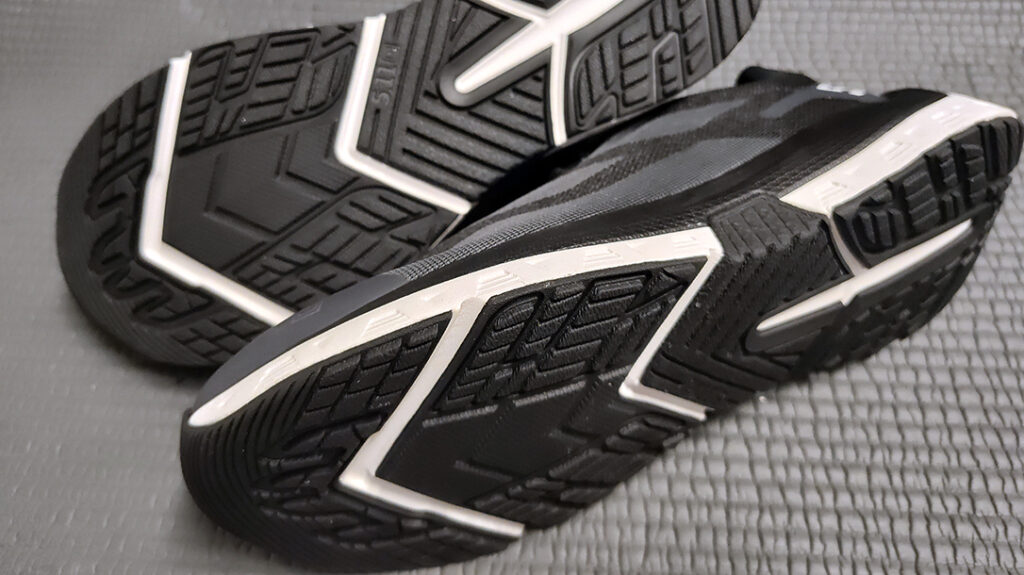
I find that you can never go wrong with wearing good sneakers at the gun range because these types of shoes are designed to be slip resistant, help support your feet and, more importantly, keep your feet fully covered. A sneaker I recommend from 5.11 Tactical is the PT-R Inure Runner. This shoe is extremely breathable to wear because it is engineered with mesh upper, which helps provide good blood circulation. Not to mention, this trainer shoe is also super comfortable to wear because the insole of the shoe is designed with INSITE Arch Relief that is made to help add extra support as you go about your day. There is also a TPU toe and heel overlay to aid in this sneaker’s durability.
These shoes have a CMEVA midsole, while the outsole of the shoe is made out of rubber, which ensures that these sneakers are slip resistant and can maintain a strong grip on different surfaces. You can choose this shoe in the colors Pacific Navy or Black/White. This trainer shoe also comes in sizes 4-15, and you have the option of choosing your width in either Regular-D or Wide-E.
Out of all the shoes I recommend, these sneakers were my favorite because they were easy to slip on and off and able to be worn for extended periods of time. While they are made for endurance training, these shoes will have no problem joining you on the range. I loved the colors, the sleek design and, more importantly, how they made me feel that I could accomplish anything when I had them on. The MSRP on the PT-R Inure Runner is $125.
5.11 A/T Women’s Ranger 2.0
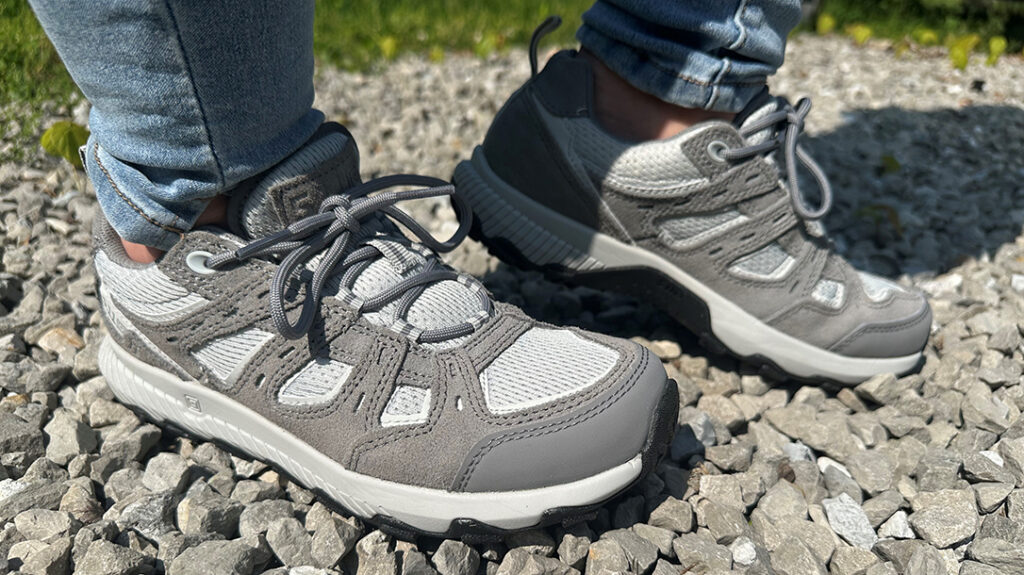
If you are looking for a sneaker that offers lots of support, I recommend the 5.11 A/T Women’s Ranger 2.0. This shoe comes equipped with anAll-Terrain Load Assistance System that is made to offer extra stability. They have a suede upper and a breathable mesh, which means these sneakers are great for people that are moving around a lot. For extra durability, these sneakers have a scratch rubber toe cap, and this feature makes these shoes a great option to wear to outdoor ranges.
The Ranger 2.0 has an Ortholite insole and Echo Lite high-rebound EVA midsole, which provides extra cushioning and support. As for the outsole, this sneaker has a multi-direction lug pattern. Lastly, for your convenience there is a removable support plate on the inside of the shoe. The Ranger 2.0 comes in sizes 6-10 and even includes half sizing. You can also choose your sneakers to be in the colors Volcanic or Pearl Grey.
I loved the design of the shoes, the support I gained when wearing them, and I loved that they kept my feet safe and protected at the range. The MSRP of the Ranger 2.0 is $110.
Women’s A.T.A.C. 2.06”
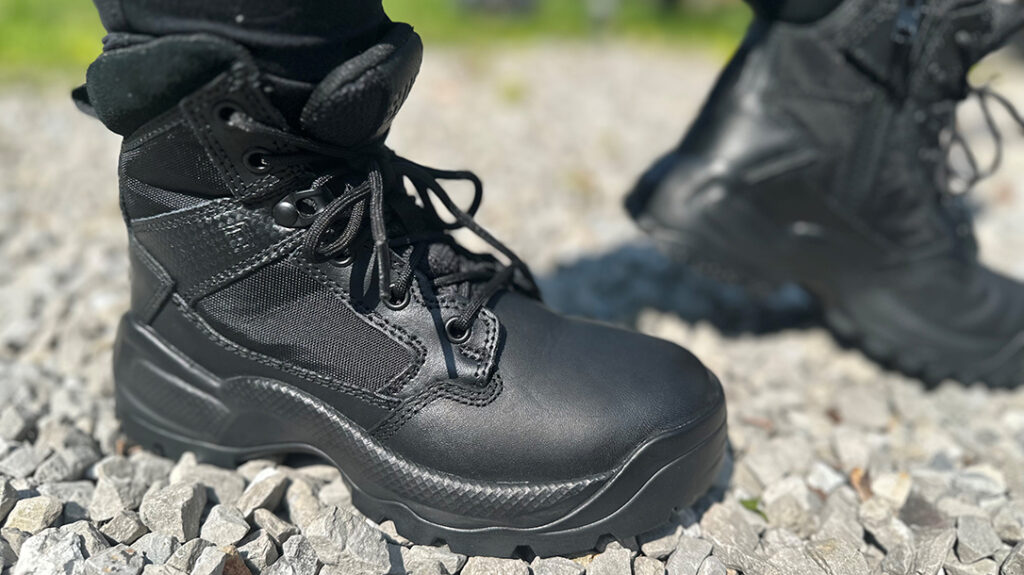
Now if sneakers are not a type of footwear you prefer to wear, boots are always a great option to look into, and the Women’s A.T.A.C. 2.06” are ones that I definitely recommend. These boots are made with an Ortholite footbed and a breathable tongue construction that ensures your feet stay cool and dry. They also have an Achilles heel flex that helps keep these shoes comfortable and flexible to wear. To add extra protection, these shoes have a Shock Mitigation System and are designed to last because they are made with a full grain leather toe. The upper on these boots are made out of 840D nylon, and the outsole on these boots are slip and oil resistant. As for sizing, they come in sizes 5-10 and unfortunately do not have half sizing.
Overall, these boots were breathable, easy to slip on and off and were extremely lightweight. These boots are great to wear outside, and I love that the black color can easily be paired with pretty much anything. The MSRP of the Women’s A.T.A.C. 2.06” is $110.
Closing Remarks
A good range shoe is one that does not make you choose between style and safety, but instead is one that allows fashion and function to coexist. Each shoe from 5.11 Tactical was comfortable to wear, made me feel confident wearing them, and allowed me to be range ready. I cannot recommend these shoes enough, and I cannot wait to wear them again. They are truly among the best women’s range shoes on the market. To check out the shoes I mentioned, please visit 511tactical.com.
The Second Amendment contained within the U.S. Bill of Rights states: “A well regulated Militia, being necessary to the security of a free State, the right of the people to keep and bear Arms, shall not be infringed.” Understanding the verbiage of the day, along with constitutional law and modern precedent, goes a long way in understanding your Second Amendment rights.
Understanding Your Second Amendment Rights
Poor comma placement aside, the simple text of this constitutional protection seems fairly straight forward. The term “right of the people” isn’t all that confusing, and the term “shall not be infringed” seems pretty unambiguous.
However, what constitutes “infringing” on this “right of the people to keep and bear Arms” has been roundly cussed and discussed for the past half century, and even before that. Before digging in a little deeper, let’s consider a few salient points.
A Well Regulated Militia …
The common argument (although not as common nowadays) that the term “well regulated Militia” means that this is a right reserved only for those serving in a state militia is a relatively new one, no matter what anti-gun advocates want you to believe. In U.S. v. Cruikshank (1876), Presser v. Illinois (1886), Miller v. Texas (1894) and U.S. v. Miller (1939), the U.S. Supreme Court recognized that the Second Amendment protects an individual right to arms, and the high court has never taken a different view.
The Kansas Supreme Court invented the idea that the amendment instead protected a “right” of a person to keep and bear arms only while serving in a state militia in the 1905 case Salina v. Blaksley. Later, in the 1942 case U.S. v. Tot, the U.S. Court of Appeals for the Third Circuit advanced the idea that the amendment protects the “right” of a state to have a militia.
Protecting an Individual Right to Arms
In 2008, however, the U.S. Supreme Court heard its first case centered specifically on whether the Second Amendment protects an individual right to arms. In that case, District of Columbia v. Heller, the court ruled that the amendment protects an individual right to keep arms and to bear arms “in case of confrontation,” without regard to a person’s relationship to a militia.
In another important Supreme Court case, McDonald v. Chicago in 2010, the court found that individual right as protected by the Second Amendment extends throughout the entire nation, regardless of where one might live. And in a more recent case, New York State Rifle & Pistol Association v. Bruen, which was decided in 2022, the court ruled that the individual right to arms applies to bearing arms outside the home.
While all those court cases might sound overwhelming, the gist is that the Second Amendment protects your right to purchase, own and carry firearms. And while different states might try to pass various laws making your practice of that right more difficult, if the laws violate that right they will eventually be found unconstitutional in the courtroom.
(Photo by Pixabay.com)
Fear Factor
One fear of some “seasoned” gun owners, many of whom have become understandably cynical because of the constant proposed infringements on gun owner rights over the past several decades, is that new gun owners won’t be interested in the Second Amendment and the freedoms it protects. Fortunately, that doesn’t seem to be the case based on recent research.
A 2022 survey from the National Opinion Research Center (NORC) at the University of Chicago not only found that new gun owners were largely young and educated, but their thoughts on the right to keep and bear arms aren’t much different than those of longtime gun owners.
“We found that their views align really well with other gun owners even though demographically they’re so different,” said NORC senior fellow John Roman.
Blowing Up the Anti-Gun Narrative
According to a report on that study by the National Shooting Sports Foundation (NSSF), the explanation for that could be quite simple—law-abiding Americans are not falling for anti-gun narrative anymore.
“The study showed almost every gun control talking point crumbled in the past two years, while gun owners increased,” the NSSF report stated. “The data suggests that this population of consumers, the first-time gun buyers, are vastly aware of the misleading rhetoric, as reflected in more of NORC’s findings. A clear majority of first-time gun buyers, nearly 70%, believe concealed carry should be expanded. This majority also wants to shorten unconstitutional waiting periods to legally buy a gun and also supports qualified teachers being able to carry a concealed firearm in order to protect their students.”
In the end, there is a much larger discussion that we could get into on the ins and outs of the Second Amendment. But one thing’s for certain: Unless you are a prohibited person because of a past felony, a current drug addiction or a few other disqualifiers, you can proudly practice yourright to keep and bear arms as protected by the Second Amendment!
In our next installment of Shooting 101, we’ll explore different kinds of guns and what roles they best fill for lawful gun owners.
To stay fit for rural or urban activities, it takes a workout, and one of the most important parts of your attire is your footwear for pain-free stability and traction. New to the market is the 5.11 Tactical PT-R Inure Runner Sneaker. This lightweight, high-performance sneaker was now in my hands, or more aptly, on my feet, to test its many innovative features and all-around fit and feel. So, how did it score after I put it through mile after mile of non-stop (well, some stopping) hardcore use?
5.11 Tactical PT-R Inure Runner
The sneakers were both sporty and streamlined, and they offered a lightweight feel in my hands. Lightweight often equals construction using cheap or inferior materials; definitely not the case with this pair. The stitching was crisp and tight, no loose mends, and firm when tugged. The transition area where fabric meets the rubber was also firmly in place without noticeable off-centering or stress stretching. Overall, the construction appeared solid. As for the design, it exuded simplicity. The sample sent to me was the black and white version (the other color being Pacific Navy) and it was aesthetically pleasing. The sneakers look at home both in the gym or paired with casual attire as you traverse your day.
Fit & Feel
One true step toward success is always the fit of the sneaker. Here, no matter how nice of a design or construction it is, if it doesn’t fit well and causes more discomfort than coziness for your feet, then it’s practically worthless for you. My foot is wide, yet the Inure handled it well, giving in at just the right points to allow a snug, yet form-fitting envelopment of my foot. The laces were easily tightened with the knot firmly staying in place (I can’t take when laces come undone constantly during a workout) during my initial testing. With both sneakers on, and a few brisk steps forward and around my house to break them in, I was ready to hit the gym.
In-Action
On the treadmill, the sneakers performed very well, gripping every step of the moving platform as I ran. Here is where I felt its lightweight design in a realistic scenario. There was no clunkiness to my steps, nor did I feel weighted down as I ran. Additionally, in the past, I experienced my feet actually shifting within the sneaker as heat and sweat built up during a long run, but I was pleasantly surprised that didn’t happen with the Inure. One of its features is a mesh upper that allows for circulation of sweat from an intense workout and that was precisely what I experienced on the treadmill. For all my other gym activities, this sneaker stepped up. It offered excellent grip on all surfaces, while not being to “sticky” or causing me to slightly trip as I moved about.
I have only good things to say about 5.11’s PR-R Inure Runner. It performed excellently throughout my time at the gym and while running my daily errands. It definitely can be used in many locations, from work, to the gym, to going out, and you won’t feel out of place. I foresee with its durability and overall construction that this pair will be with me for a while, and I highly recommend that the Inure should be part of your footwear collection, too.
For all those Americans who accidentally lost their bump stocks in boating accidents over the past few years, it’s time to head to the lake and try to fish them out again!
Supreme Court Strikes Down Bump Stock Ban 6-3!
Earlier today, the U.S. Supreme court in a 6-3 vote struck down the bump stock ban instituted by the Department of Justice under the Trump Administration. Under that Final Rule, bump stocks were redefined as “machine guns” for the purpose of the Gun Control Act and were to be regulated in the same manner as fully-automatic firearms.
The question before the court was whether a bump stock was actually a machine gun under federal law. And six justices—John Roberts, Clarence Thomas, Samuel Alito, Neil Gorsuch, Brett Kavanaugh and Amy Coney Barrett—concluded that the two were not the same.
In his opinion for the majority, Justice Clarence Thomas wrote what many gun owners have known all along.
“We hold that a semi-automatic rifle equipped with a bump stock is not a ‘machine gun’ because it cannot fire more than one shot ‘by a single function of the trigger,’” Justice Thomas wrote. “And, even if it could, it would not do so ‘automatically.’ ATF therefore exceeded its statutory authority by issuing a Rule that classifies bump stocks as machineguns.”
Thomas continued: “Semi-automatic firearms, which require shooters to reengage the trigger for every shot, are not machine guns. This case asks whether a bump stock—an accessory for a semi-automatic rifle that allows the shooter to rapidly reengage the trigger (and therefore achieve a high rate of fire)—converts the rifle into a ‘machine gun.’ We hold that it does not.”
ATF Argument “Logically Inconsistent”
In the majority opinion, Thomas explained how the ATF’s argument in justifying the ban actually didn’t make any sense when closely scrutinized.
“The position that ATF and the dissent endorse is logically inconsistent,” Thomas wrote. “They reason that a semi-automatic rifle equipped with a bump stock fires more than one shot by a single function of the trigger because a shooter ‘need only pull the trigger and maintain forward pressure’ to ‘activate continuous fire.’ If that is correct, however, then the same should be true for a semi-automatic rifle without a bump stock. After all, as the dissent and ATF themselves acknowledge, a shooter manually bump firing a semi-automatic rifle can achieve continuous fire by holding his trigger finger stationary and maintaining forward pressure with his non-trigger hand.
“Yet, they agree that a semi-automatic rifle without a bump stock ‘fires only one shot each time the shooter pulls the trigger.’ Their argument is thus at odds with itself.”
Then, possibly referring to shooting superstar Jerry Miculek and a few other fast shooters known to the public, Thomas drove the final nail in the bump stock ban coffin.
“A bump stock does not convert a semi-automatic rifle into a machine gun any more than a shooter with a lightning-fast trigger finger does,” he concluded.
Challenging DOJ & ATF Ban
The case, Garland v. Cargill, revolved around the bump stock ban instituted by the DOJ and ATF after a horrible mass murder in Las Vegas in 2017. While instituted by the Trump Administration, the Biden Administration has been defending the ban in court since the current president took office in January 2021.
In his concurring opinion, Justice Samuel Alito addressed the horrible shooting in Vegas.
“I join the opinion of the Court because there is simply no other way to read the statutory language,” Alito wrote. “The horrible shooting spree in Las Vegas in 2017 did not change the statutory text or its meaning. That event demonstrated that a semi-automatic rifle with a bump stock can have the same lethal effect as a machine gun, and it thus strengthened the case for amending §5845. But an event that highlights the need to amend a law does not itself change the law’s meaning.”
Writing for the liberal minority, Justice Sonia Sotomayor criticized the majority justices for a decision that she said would lead to “deadly consequences.”
Big WIN for 2A!
“Today, the Court puts bump stocks back in civilian hands,” Justice Sotomayor wrote. “To do so, it casts aside Congress’s definition of ‘machine gun’ and seizes upon one that is inconsistent with the ordinary meaning of the statutory text and unsupported by context or purpose.
“When I see a bird that walks like a duck, swims like a duck, and quacks like a duck, I call that bird a duck. A bump-stock-equipped semi-automatic rifle fires ‘automatically more than one shot, without manual reloading, by a single function of the trigger.’ Because I, like Congress, call that a machine gun, I respectfully dissent.”
Justice Sotomayor was joined on the minority by Justices Elena Kagan and Ketanji Brown Jackson.
On January 9, 2023, Tactical Life reported:
Following the unfortunate tragedy in Las Vegas in 2017, President Trump signed an executive order directing the Attorney General to regulate bump stocks. Following the EO, the ATF ordered that all owners destroy or turn in their bump stock within 90 days (story below). However, the U.S. Court of Appeals recently ruled that the ATF did not have that authority; only Congress does. As a result, the ban has been struck down.
Federal Court Strikes Down Bump Stock Ban
Since its inception, the bump stock ban has survived challenges at the Cincinnati-based 6th U.S. Circuit Court of Appeals, the Denver-based 10th Circuit, and the federal circuit court in Washington.
However, on September 13, 2022, the New Orleans-based U.S. 5th Circuit Court of Appeals heard the arguments. Following this most recent challenge, the court struck the ban down in a 13-3 decision. But the court did not find the ban unconstitutional on the grounds of Second Amendment infringements. Instead, the court ruled on the lack of authority for the ATF to change laws.
According to Fox News, “In a 13-3 decision, the 5th Circuit Court of Appeals in New Orleans held that the Bureau of Alcohol, Tobacco, Firearms and Explosives (ATF), acting under ‘tremendous’ public pressure, short-circuited the legislative process by approving a rule to define bump stocks as ‘machineguns,’ which are heavily restricted. The court said ATF did not have the authority from Congress to do so.”
Likewise, Rich Samp, attorney for the appellant, said in a statement posted to Fox News that “[t]his case is not about gun control. It is instead about who has the constitutional prerogative to change the criminal law if changes are warranted. The current statute, adopted in 1986, defines ‘machinegun’ in a manner that does not encompass non-mechanical bump stocks. It is unlawful for a prosecutorial entity like ATF to rewrite existing law without authorization from Congress. Any change in gun-control laws must emanate from Congress.”
Do Not Meet the Definition of Machinegun
The ban required the ATF to redefine bump stock-enabled firearms as “machineguns” under the National Firearms Act of 1934 and the Gun Control Act of 1968. This reverses a decades-old decision that bump stocks are not machine guns.
Breitbart News posted a copy of the DOJ’s summary of the ban at the time, which states:
“The Department of Justice is amending the regulations of the Bureau of Alcohol, Tobacco, Firearms, and Explosives (ATF) to clarify that bump-stock-type devices-meaning “bump fire” stocks, slide-fire devices, and devices with certain similar characteristics-are “machineguns” as defined by the National Firearms Act of 1934 and the Gun Control Act of 1968 because such devices allow a shooter of a semiautomatic firearm to initiate a continuous firing cycle with a single pull of the trigger.”
However, the appellant, Michael Cargill, successfully argued that bump stocks do not meet the definition of “machinegun” under federal law. His argument successfully illustrated that the trigger functions multiple times to fire the rifle. Federal law states that a machine gun operates with a “single function of the trigger.”
In the lead majority opinion, Judge Jennifer Walker Elrod states, “A plain reading of the statutory language, paired with close consideration of the mechanics of a semi-automatic firearm, reveals that a bump stock is excluded from the technical definition of “machinegun” set forth in the Gun Control Act and National Firearms Act.”
Gun Owners of America posted to Twitter that the ruling could set precedence for future gun rights battles as well:
Huge news!
The fight on bump stocks is CRITICAL to defending all semiautomatic weapons from an arbitrary ban AND against the Biden ATF’s latest attacks on gun owners AND will help defend Forced Reset Triggers. https://t.co/lBYFjMDtQl
But we’re not out of the woods yet, the Biden administration, which defended the law in court, may appeal to the U.S. Supreme Court.
On December 21, 2018, Tactical Life reported:
Bump Stock Owners: What You Need to Know After ATF Ruling
So the other shoe finally dropped. As you likely know by now, the Bureau of Alcohol, Tobacco, Firearms, and Explosives (ATF) recently announced its amended ruling on bump stock-type devices. Following President Trump’s demands, the ATF ruled that all bump stocks now fall within the definition of “machinegun” under federal law.
In short, following the Las Vegas shooting, Trump decided these devices needed to go, so he demanded ATF change its ruling. Meanwhile, the NRA, while publicly stating its disappointment in the ban, mostly maintained support of the president.
Conversely, the Firearms Policy Coalition (FPC), with Tim Harmsen of Military Arms Channel fame as plaintiff, filed suit. Lead counsel in this suit includes Joshua Prince and Adam Kraut, known civil rights attorneys. But only time will tell if FPC and its allies can successfully get the ruling overturned.
In the meantime, the ruling now requires all device owners to destroy their devices or abandon them at a local ATF office. If choosing to destroy the device, it is the owner’s responsibility to ensure the device is rendered incapable of being readily restored to its intended function, according to ATF.
For anyone wishing to abandon their device, you can visit Local ATF Offices to find a location near you. For those planning to destroy their device, see the list of destruction instruction links, by manufacturer, below:
ATF Bump Stock Destruction Information
All bump stock owners have 90 days from the date of publication to comply by either abandoning or destroying their device. Failure to do so would put owners in direct violation of federal law.
The ATF has compiled a lot of information regarding the new ruling; for more, visit atf.gov.
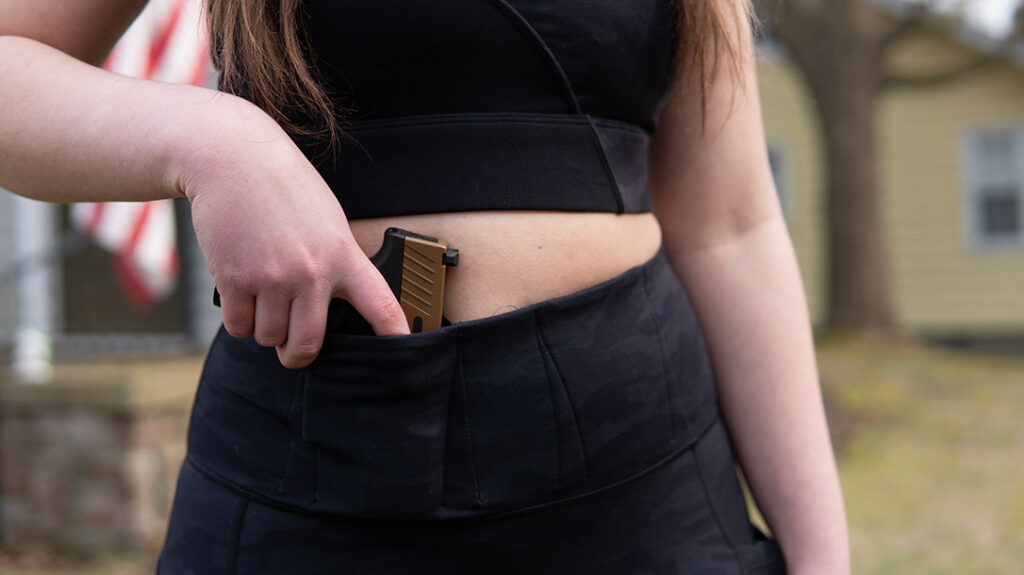
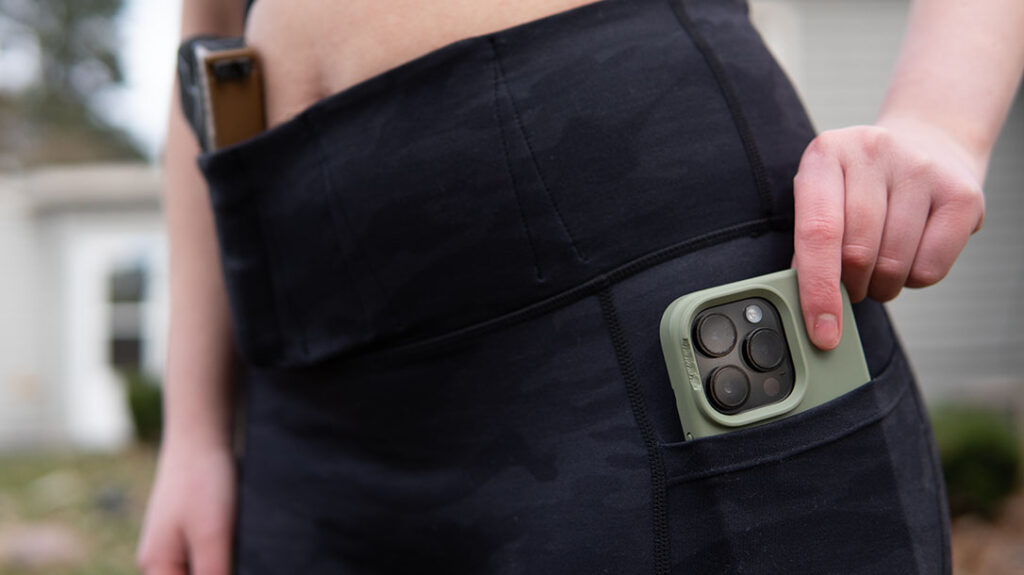
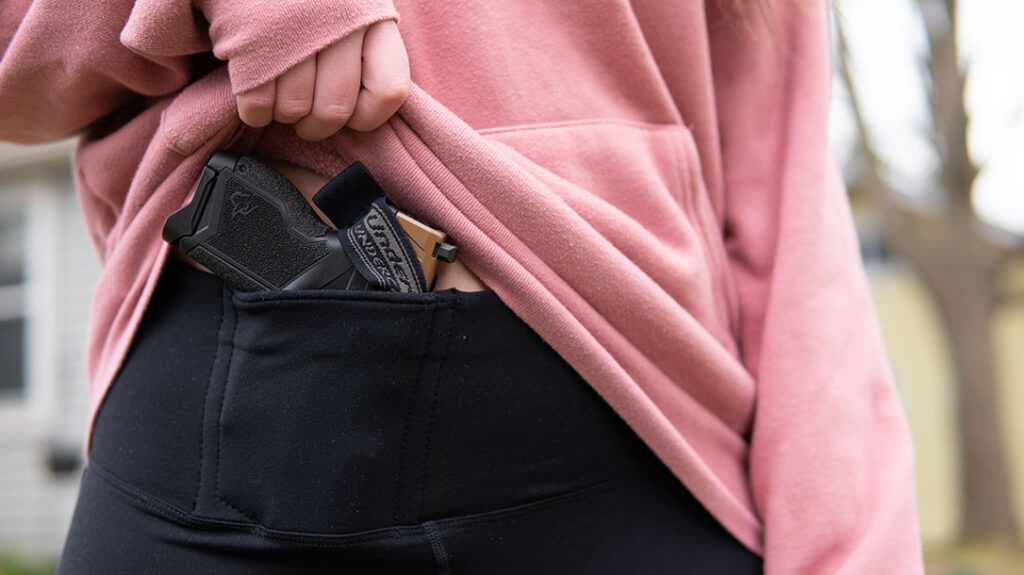
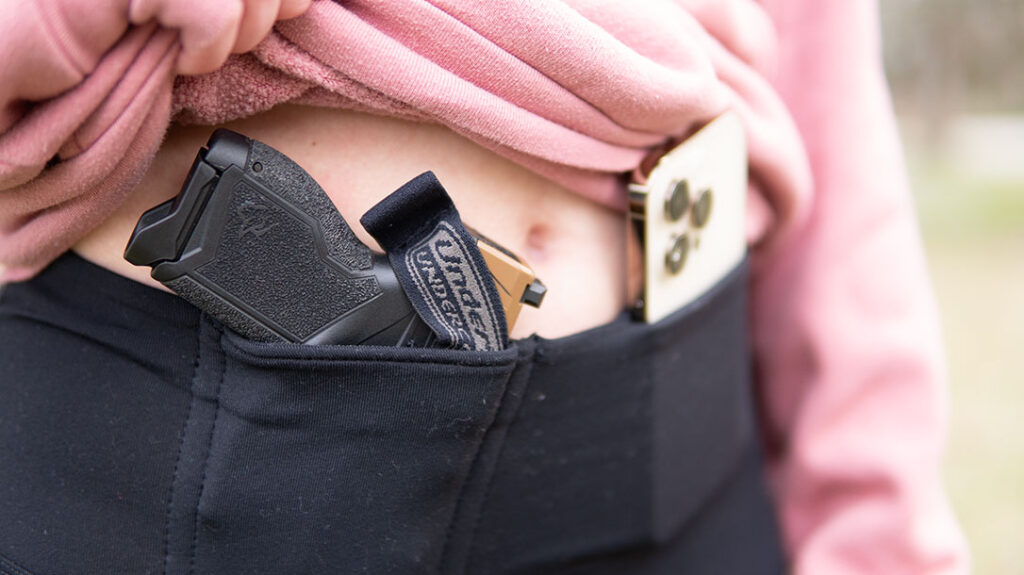
Concealed-carry leggings are activewear designed to help women safely and securely carry their firearms. Compared to regular leggings, this type of activewear allows fashion and function to coexist. Not to mention helping you look and feel your most confident self. So, if you are ready for a wardrobe update, here are three brands of concealed-carry leggings that I recommend.
3 Brands of Concealed-Carry Leggings
Alexo Athletica
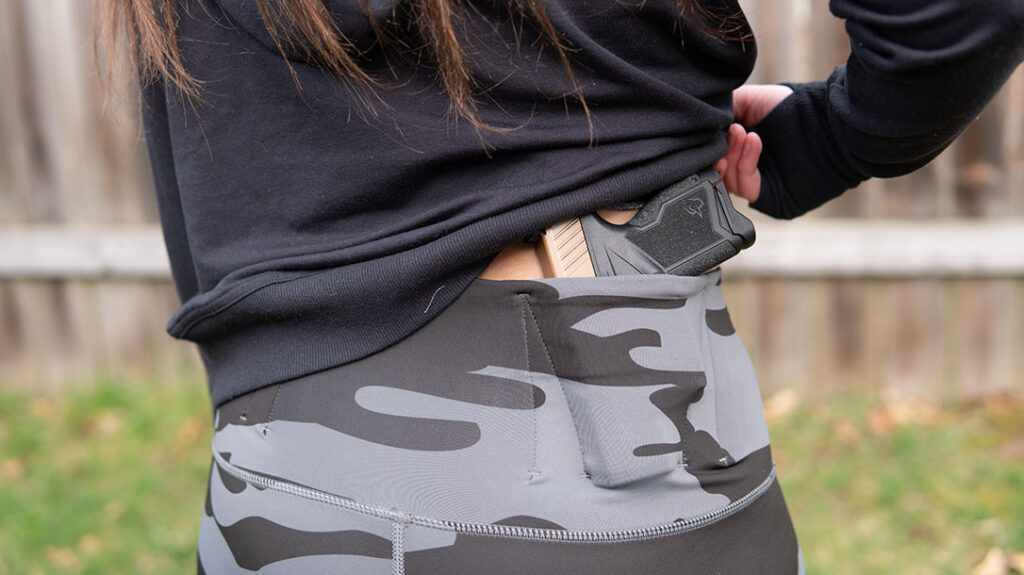
The first pair of leggings on the list is the ⅞ Camo Concealed Carry Legging by Alexo Athletica. These compression-fit leggings have eight pockets built into the waistband, which allow for appendix or kidney carry on either the left or right side.
It is important to note that these leggings do not have a built-in trigger guard. However, the pockets have enough space to wear proper trigger guard protection in them.
The waistband on these leggings is on the thicker side, which makes for a tighter fit. But personally, this feature did not bother me in the slightest, and I still found them comfortable to wear. To help you get a proper fit, I recommend you follow the size guide on the Alexo Athletica website.
These Camo Concealed Leggings come in sizes XS-XXL, in the colors Black Camo or Olive Camo. In addition, they are made from nylon, which makes them silky and smooth to the touch.
Furthermore, I am happy to report that these leggings did a fantastic job of keeping my firearm secure. More importantly, they allowed me to participate in my daily activities without any issues.
The next pair of leggings are the Concealed Carry Leggings with Pockets by CurvesNCombatBoots. Much like the ⅞ camo leggings, these activewear have an ambidextrous carry design with holster pockets on the front and back of the waistband.
Regarding the waistband, I immediately noticed that these leggings were not as tight or restrictive as the ⅞ camo leggings. I felt this made them much more comfortable to wear.
This activewear is 70% polyester and 30% spandex and comes in sizes XS-XXL. It can be purchased in Black, Black Camo, Green Camo, or Snow Camo.
More importantly, these leggings had pockets on both sides, which allowed me to easily store my phone and other small belongings, such as a credit card. Overall, these leggings were soft to wear and kept my firearm secure. In fact, I did not want to take them off once I put them on.
Now, if you do not prefer leggings with a tighter fit, I recommend the Women’s Concealed Carry Original Leggings Full Length from Undertech Undercover. Of all three leggings, these are the thinnest and did not feel restrictive at all.
Upon purchasing these leggings, you can pick what side the carry pockets are on, depending on if you are left or right-handed. Likewise, you have the option to either appendix or kidney carry.
A fun feature of these leggings is a retention strap in both pockets to help keep your firearm secure. I will admit that it took me a minute to get used to this feature. But once I did, I was happy to have the extra support.
When wearing these types of leggings, you never want to feel like your firearm is slipping around. So, something as simple as a retention strap ensures your firearm stays in place.
These leggings come in sizes XS-XXXL and are available in black or gray. They are made of 87% nylon and 13% elastane, and because of their stretchiness, I found them to be the comfiest of the three.
Regarding the length, these leggings have a 29-inch inseam. Although they were a bit too long for my liking, I would have no issues wearing them again. If you prefer a shorter length, Undertech Undercover also makes a crop-length version of these leggings.
Finally, these leggings were stretchy, extremely cozy to wear and were a pair that I cannot wait to wear again.
Concealed-Carry Leggings are Comfortable, Stylish, and Functional
A good pair of concealed-carry leggings is not only comfortable and stylish but also functional. You deserve to have clothes that help make carrying a concealed firearm easy.
I can say without a doubt that all three of these brands go above and beyond to make sure you look good and feel your best. But more importantly, they keep your firearm safe and secure.
A 62-year-old Oregon man was stranded in the woods overnight after his truck plunged into a ravine. He was later rescued after his dog ran 4 miles to their intended campsite, alerting friends and family that something was wrong.
Brandon Garrett, of Halfway, Oregon, was driving on a remote U.S. Forest Service Road with his four dogs on June 2 when he missed a curve, according to a press release from the Baker County Sheriff’s Office. His truck plummeted into a steep ravine in the Wallowa-Whitman National Forest, a 2.4-million-acre swath of federal land in northeast Oregon and western Idaho. Garrett was able to crawl about 100 yards from the vehicle, which had come to rest on its side in a creek at the bottom of the ravine. He spent the night there with three of his dogs. The fourth dog, a whippet named Blue, took off.
Later that night Blue showed up at the campsite to which Garrett had been headed to meet his family. They began searching for Garrett that night and were finally able to locate the crash site the following morning. Brandon’s brother, Tyree Garrett, spotted the truck only after searching specifically for spots that couldn’t be seen from the road. He saw his brother’s dogs near the truck, but got no response when he called Brandon’s name. “That just stopped my heart,” Tyree told the New York Times, noting that the weather overnight had featured pouring rain and cold temperatures. “I just, God darn, thought for sure my brother was gone.”
Brandon Garrett with his dog Blue. Baker County Sheriff’s
Unable to get to the truck because of the thick brush and steep slope, the family called 911. Baker County Sheriff’s Office, Baker County Search and Rescue, Pine Valley Rural Fire District, and Halfway Ambulance responded to the scene. Sheriff Travis Ash was searching for a way to reach the truck when he heard Brandon Garrett calling for help. While the sheriff rendered first aid, volunteer firefighters and U.S. Forest Service employees used chainsaws to clear a path for the search and rescue team, which rigged a highline rope system and a rescue basket to pull Garrett across the ravine. He was then transported by ambulance to a Life Flight Helicopter and airlifted to a hospital.
Garrett told NBC-TV affiliate KGW that he’s had Blue for about five years and is very grateful to the dog and all the human helpers who saved his life. Blue reportedly made his trek with glass embedded in his snout, another dog sustained a broken leg, and a third required surgery for a broken hip. Garrett was treated for multiple non-life-threatening injuries and released.
For all those Americans who accidentally lost their bump stocks in boating accidents over the past few years, it’s time to head to the lake and try to fish them out again!
Supreme Court Strikes Down Bump Stock Ban 6-3!
Earlier today, the U.S. Supreme court in a 6-3 vote struck down the bump stock ban instituted by the Department of Justice under the Trump Administration. Under that Final Rule, bump stocks were redefined as “machine guns” for the purpose of the Gun Control Act and were to be regulated in the same manner as fully-automatic firearms.
The question before the court was whether a bump stock was actually a machine gun under federal law. And six justices—John Roberts, Clarence Thomas, Samuel Alito, Neil Gorsuch, Brett Kavanaugh and Amy Coney Barrett—concluded that the two were not the same.
In his opinion for the majority, Justice Clarence Thomas wrote what many gun owners have known all along.
“We hold that a semi-automatic rifle equipped with a bump stock is not a ‘machine gun’ because it cannot fire more than one shot ‘by a single function of the trigger,’” Justice Thomas wrote. “And, even if it could, it would not do so ‘automatically.’ ATF therefore exceeded its statutory authority by issuing a Rule that classifies bump stocks as machineguns.”
Thomas continued: “Semi-automatic firearms, which require shooters to reengage the trigger for every shot, are not machine guns. This case asks whether a bump stock—an accessory for a semi-automatic rifle that allows the shooter to rapidly reengage the trigger (and therefore achieve a high rate of fire)—converts the rifle into a ‘machine gun.’ We hold that it does not.”
ATF Argument “Logically Inconsistent”
In the majority opinion, Thomas explained how the ATF’s argument in justifying the ban actually didn’t make any sense when closely scrutinized.
“The position that ATF and the dissent endorse is logically inconsistent,” Thomas wrote. “They reason that a semi-automatic rifle equipped with a bump stock fires more than one shot by a single function of the trigger because a shooter ‘need only pull the trigger and maintain forward pressure’ to ‘activate continuous fire.’ If that is correct, however, then the same should be true for a semi-automatic rifle without a bump stock. After all, as the dissent and ATF themselves acknowledge, a shooter manually bump firing a semi-automatic rifle can achieve continuous fire by holding his trigger finger stationary and maintaining forward pressure with his non-trigger hand.
“Yet, they agree that a semi-automatic rifle without a bump stock ‘fires only one shot each time the shooter pulls the trigger.’ Their argument is thus at odds with itself.”
Then, possibly referring to shooting superstar Jerry Miculek and a few other fast shooters known to the public, Thomas drove the final nail in the bump stock ban coffin.
“A bump stock does not convert a semi-automatic rifle into a machine gun any more than a shooter with a lightning-fast trigger finger does,” he concluded.
Challenging DOJ & ATF Ban
The case, Garland v. Cargill, revolved around the bump stock ban instituted by the DOJ and ATF after a horrible mass murder in Las Vegas in 2017. While instituted by the Trump Administration, the Biden Administration has been defending the ban in court since the current president took office in January 2021.
In his concurring opinion, Justice Samuel Alito addressed the horrible shooting in Vegas.
“I join the opinion of the Court because there is simply no other way to read the statutory language,” Alito wrote. “The horrible shooting spree in Las Vegas in 2017 did not change the statutory text or its meaning. That event demonstrated that a semi-automatic rifle with a bump stock can have the same lethal effect as a machine gun, and it thus strengthened the case for amending §5845. But an event that highlights the need to amend a law does not itself change the law’s meaning.”
Writing for the liberal minority, Justice Sonia Sotomayor criticized the majority justices for a decision that she said would lead to “deadly consequences.”
Big WIN for 2A!
“Today, the Court puts bump stocks back in civilian hands,” Justice Sotomayor wrote. “To do so, it casts aside Congress’s definition of ‘machine gun’ and seizes upon one that is inconsistent with the ordinary meaning of the statutory text and unsupported by context or purpose.
“When I see a bird that walks like a duck, swims like a duck, and quacks like a duck, I call that bird a duck. A bump-stock-equipped semi-automatic rifle fires ‘automatically more than one shot, without manual reloading, by a single function of the trigger.’ Because I, like Congress, call that a machine gun, I respectfully dissent.”
Justice Sotomayor was joined on the minority by Justices Elena Kagan and Ketanji Brown Jackson.
On January 9, 2023, Tactical Life reported:
Following the unfortunate tragedy in Las Vegas in 2017, President Trump signed an executive order directing the Attorney General to regulate bump stocks. Following the EO, the ATF ordered that all owners destroy or turn in their bump stock within 90 days (story below). However, the U.S. Court of Appeals recently ruled that the ATF did not have that authority; only Congress does. As a result, the ban has been struck down.
Federal Court Strikes Down Bump Stock Ban
Since its inception, the bump stock ban has survived challenges at the Cincinnati-based 6th U.S. Circuit Court of Appeals, the Denver-based 10th Circuit, and the federal circuit court in Washington.
However, on September 13, 2022, the New Orleans-based U.S. 5th Circuit Court of Appeals heard the arguments. Following this most recent challenge, the court struck the ban down in a 13-3 decision. But the court did not find the ban unconstitutional on the grounds of Second Amendment infringements. Instead, the court ruled on the lack of authority for the ATF to change laws.
According to Fox News, “In a 13-3 decision, the 5th Circuit Court of Appeals in New Orleans held that the Bureau of Alcohol, Tobacco, Firearms and Explosives (ATF), acting under ‘tremendous’ public pressure, short-circuited the legislative process by approving a rule to define bump stocks as ‘machineguns,’ which are heavily restricted. The court said ATF did not have the authority from Congress to do so.”
Likewise, Rich Samp, attorney for the appellant, said in a statement posted to Fox News that “[t]his case is not about gun control. It is instead about who has the constitutional prerogative to change the criminal law if changes are warranted. The current statute, adopted in 1986, defines ‘machinegun’ in a manner that does not encompass non-mechanical bump stocks. It is unlawful for a prosecutorial entity like ATF to rewrite existing law without authorization from Congress. Any change in gun-control laws must emanate from Congress.”
Do Not Meet the Definition of Machinegun
The ban required the ATF to redefine bump stock-enabled firearms as “machineguns” under the National Firearms Act of 1934 and the Gun Control Act of 1968. This reverses a decades-old decision that bump stocks are not machine guns.
Breitbart News posted a copy of the DOJ’s summary of the ban at the time, which states:
“The Department of Justice is amending the regulations of the Bureau of Alcohol, Tobacco, Firearms, and Explosives (ATF) to clarify that bump-stock-type devices-meaning “bump fire” stocks, slide-fire devices, and devices with certain similar characteristics-are “machineguns” as defined by the National Firearms Act of 1934 and the Gun Control Act of 1968 because such devices allow a shooter of a semiautomatic firearm to initiate a continuous firing cycle with a single pull of the trigger.”
However, the appellant, Michael Cargill, successfully argued that bump stocks do not meet the definition of “machinegun” under federal law. His argument successfully illustrated that the trigger functions multiple times to fire the rifle. Federal law states that a machine gun operates with a “single function of the trigger.”
In the lead majority opinion, Judge Jennifer Walker Elrod states, “A plain reading of the statutory language, paired with close consideration of the mechanics of a semi-automatic firearm, reveals that a bump stock is excluded from the technical definition of “machinegun” set forth in the Gun Control Act and National Firearms Act.”
Gun Owners of America posted to Twitter that the ruling could set precedence for future gun rights battles as well:
Huge news!
The fight on bump stocks is CRITICAL to defending all semiautomatic weapons from an arbitrary ban AND against the Biden ATF’s latest attacks on gun owners AND will help defend Forced Reset Triggers. https://t.co/lBYFjMDtQl
But we’re not out of the woods yet, the Biden administration, which defended the law in court, may appeal to the U.S. Supreme Court.
On December 21, 2018, Tactical Life reported:
Bump Stock Owners: What You Need to Know After ATF Ruling
So the other shoe finally dropped. As you likely know by now, the Bureau of Alcohol, Tobacco, Firearms, and Explosives (ATF) recently announced its amended ruling on bump stock-type devices. Following President Trump’s demands, the ATF ruled that all bump stocks now fall within the definition of “machinegun” under federal law.
In short, following the Las Vegas shooting, Trump decided these devices needed to go, so he demanded ATF change its ruling. Meanwhile, the NRA, while publicly stating its disappointment in the ban, mostly maintained support of the president.
Conversely, the Firearms Policy Coalition (FPC), with Tim Harmsen of Military Arms Channel fame as plaintiff, filed suit. Lead counsel in this suit includes Joshua Prince and Adam Kraut, known civil rights attorneys. But only time will tell if FPC and its allies can successfully get the ruling overturned.
In the meantime, the ruling now requires all device owners to destroy their devices or abandon them at a local ATF office. If choosing to destroy the device, it is the owner’s responsibility to ensure the device is rendered incapable of being readily restored to its intended function, according to ATF.
For anyone wishing to abandon their device, you can visit Local ATF Offices to find a location near you. For those planning to destroy their device, see the list of destruction instruction links, by manufacturer, below:
ATF Bump Stock Destruction Information
All bump stock owners have 90 days from the date of publication to comply by either abandoning or destroying their device. Failure to do so would put owners in direct violation of federal law.
The ATF has compiled a lot of information regarding the new ruling; for more, visit atf.gov.
When it comes to wilderness survival, the knowledge of utilizing natural resources for nutrition can be a game-changer. Pine bark cookies, a traditional survival food, have a rich history and have been used by various indigenous cultures and survivalists for centuries. These cookies provide sustenance in the wild and offer a unique taste and a deep connection to our natural world.
In this article, we will teach you how to make pine bark cookies and cover everything from harvesting to baking the cookies. I’ve also included some ingredients to transform this survival food into an absolute treat, adding a touch of modernity to this ancient tradition.
Cambium, the inner bark of a pine tree, is rich in vitamins and fiber. Jennifer Caudill
Why Pine Bark?
Pine bark, mainly the inner bark or cambium layer, is a treasure trove of nutrients. It is rich in vitamins A and C and fiber, making it a powerhouse of nutrition. This part of the tree is not only edible but can also be harvested without causing significant harm to the tree—if done correctly. Pine bark has a long history of use as a survival food, particularly during times of scarcity. I was fortunate to find a recently blown-down Pinus virginiana (Virginia, yellow pine) for this recipe. This tree—which was still alive, but soon to be dead—was a perfect choice to harvest as much of the cambium layer as I needed without harming a live tree.
Choosing the Right Pine Tree
When harvesting pine bark, it’s essential to choose the right tree to ensure it’s safe for consumption. Here are some commonly used species:
Eastern White Pine (Pinus strobus) is my favorite because it has more sucrose than other varieties, which makes for a sweeter cookie.
Virginia Pine (Pinus virginiana) is my second favorite because it is abundant in my area. Its bark contains considerable fiber.
Ponderosa Pine (Pinus ponderosa) are found in the northwest and far western United States.
Lodgepole Pine (Pinus contorta) are found in northern California and continuing into Canada in Western North America.
Scots Pine (Pinus sylvestris) are found in northern Europe, so I’m throwing this one in for our European foragers.
Harvesting Pine Bark: Step-by-Step Instructions
The author uses a makeshift draw knife to strip a recently down pine tree to strip some cambium. Jennifer Caudill
You will want a sharp knife or draw knife to make easy work of this part of the process. Get a good collection bag or bandana to gather materials and move them to where you will process the ingredients.
Identify a Healthy Tree: Choose a mature, healthy tree. Avoid trees that are diseased or damaged.
Locate the Cambium Layer: The cambium is the soft, moist layer between the outer bark and the wood. This is the edible part. You can use a draw knife on the thick park or just the sharpened spine on a knife on those with the thin layering of outer bark.
Harvest: Cut a vertical strip of the outer bark, being careful not to take too much from any tree. Harvesting from different trees is best to avoid significantly harming one tree. If you are fortunate, as I was, to find a tree that was recently blown down, take as much as you wish. It will soon be dead and falling off. Peel back the outer bark to reveal the cambium layer. Carefully slice off the cambium layer in thin strips.
Preparing the Bark: Step-by-Step Instructions
Once you have harvested the cambium, it’s time to prepare it for cooking. Pine bark can be tricky, so some preparation is required to make it more palatable.
You can grind the bark with a mortal and pestle—but using a food processor is a lot easier. Jennifer Caudill
Cleaning: Rinse the bark strips thoroughly to remove any dirt or debris.
Drying: Lay the strips out to dry in the sun for a few hours, or use a dehydrator if you have one. Drying the bark makes it easier to grind into a powder.
Grinding: Once dried, use a mortar, pestle, or food processor to grind the bark into a fine powder. This will be the base for your cookies. I was excited to get the cookies made, so I used a food processor for this one.
Ingredients for Pine Bark Cookies
You don’t need many ingredients to make a batch of pine bark cookies. Jennifer Caudill
To make pine bark cookies, you will need a few additional ingredients. These can vary depending on what you have available, but a basic recipe includes:
1 cup of pine bark flour (ground pine cambium)
1 cup of all-purpose flour (or more pine bark flour for a more rustic, gluten-free option)
1/2 cup of honey or maple syrup (for sweetness)
1/4 cup of melted butter or oil
1/2 teaspoon of baking soda
1/2 teaspoon of salt
One egg for binding (optional)
Water (as needed to achieve the right dough consistency)
Optional: nuts, dried berries, or chocolate chips for added flavor and texture (I used dried cranberries and pumpkin seeds for this recipe to add texture and bonus flavor.)
How to Bake Pine Bark Cookies
The author flips a batch of cookies that he baked on a flat stone. Jennifer Caudill
Find a smooth stone to cook on. Choose rocks from the environment, but avoid those found in creeks. Creek rocks hold moisture and, under heat, will burst and throw fire and rock debris around.
Build a fire with dense hardwoods on top of your rock. This will heat the rock during the process. Allow the coals to get ample amounts on all sides of the rock. For our purposes here, I chose a thin rock and stacked it on two pieces of firewood to get it off the ground. I then built a fire under and around the rock to get it hot.
Mix the dry ingredients: In a large bowl, combine the pine-bark flour, all-purpose flour, baking soda, and salt.
Add the wet ingredients: Mix in the honey or maple syrup, melted butter or oil, and the egg if you’re using one. Stir well to combine.
Form the dough: Gradually add water to form a firm but not too sticky dough. If adding nuts, berries, or chocolate chips, fold them into the dough at this stage.
Shape the cookies: Use your hands to form the dough into small balls, then flatten them into cookie shapes. Place them on the rock. Placing oil on the rock will also help prevent the cookies from sticking.
Cook on the rock with fire around it until the edges are brown. Keep an eye on them to avoid burning.
Scrape the cookies off with a spatula and let them cool on a rock or log that was not used in the fire.
Nutritional Benefits
Pine bark cookies are more than just a survival food; they are packed with nutrients that can be beneficial in a survival situation. The cambium layer is rich in fiber, which aids in digestion. Adding honey or maple syrup provides natural sugars for energy, and any added nuts or berries contribute essential fats, proteins, and vitamins.
Tips for Making the Best Pine Bark Cookies
Experiment with Flavors: Pine bark has a unique, slightly sweet taste. You can enhance the flavor by adding spices like cinnamon or nutmeg.
Texture Matters: If the bark flour is too coarse, it can make the cookies gritty. Ensure the bark is ground as finely as possible. I will use regular kitchen appliances to do this when it is available. A mortar and pestle is a great way to keep it natural, but it takes considerable time to complete.
Conservation: Remember to harvest bark sustainably. Take only a little from one tree, and always be mindful of the environment. This means you should only remove bark some of the way around one tree. This is called girdling and will kill the tree.
The author goes in for a bite. Jennifer Caudill
Final Thoughts on Pine Bark Cookies
Making pine bark cookies is a rewarding experience that connects you to traditional survival skills and the natural world. Whether preparing for a backcountry adventure or simply curious about alternative foods, these cookies offer a unique and nutritious option. By following the steps outlined in this guide, you can create a batch of pine bark cookies that are both delicious and packed with the sustenance needed for any wilderness journey.
So, next time you’re out in the woods, take a moment to appreciate the pine trees around you. They’re a beautiful part of the landscape and a valuable source of nutrition waiting to be discovered. Happy baking!
Seeing a bear in central Florida is a fairly rare occurrence. Seeing a bear fight off two alligators while crossing a river—and capturing the entire tussle on video—is, well, crazy really. And yet it happened, just this week.
While paddling the St. Johns River between the High Banks marina and the Wekiva River on June 4, Kayaker Tyler Futrell of DeBary, Florida, spotted something swimming across the river and started recording it with his cell phone from about 100 feet away.
Early in the nearly 2-minute video, Futrell says uncertainly, “Not really sure what this is. I think it’s a pig?”
He later told Orlando’s News 6, “I grew up around here, so I’m pretty used to seeing hogs and whatever, but a bear is a pretty rare sight, so it didn’t even cross my mind.”
As Futrell continues to record the animal’s progress, a large gator swims into the frame aiming straight for the bear. “Oh, man, alligator coming to say hi,” Futrell says. As the two predators collide head on, the bear rises out of the water briefly, appearing to swat at the lunging gator, before swimming on. The gator appears to give chase for a few seconds before disappearing, prompting Futrell to comment, “Man, that’s a big gator.”
A half-minute later, as the bear swims parallel to the river bank to skirt a large mat of vegetation, a second gator lunges out from under the green cover, churning up a big splash of water. The bear again ploughs through the attack and hauls itself out on the bank. “It’s a frickin’ bear!” exclaims Futrell. “I’ve never seen that before in my life!”
Futrell couldn’t say if the bear or gators were injured, but the bear appears unharmed while climbing out of the river and can be heard moving away through the woods. Futrell told News 6 the bruin “was just kind of annoyed and ready to get out of the water.”
Florida has an estimated 4,000 black bears (the only bear species in the state) according to Florida Fish and Wildlife Conservation Commission. June marks the beginning of their breeding season, which extends to August. Cubs are born in late January and early February. Although their numbers have been rising since the 1980s, FWC estimates that bears today occupy only about 49 percent of their historic range in the state.