Home Blog Page 10

Understanding Your Second Amendment Rights

0

The Second Amendment contained within the U.S. Bill of Rights states: “A well regulated Militia, being necessary to the security of a free State, the right of the people to keep and bear Arms, shall not be infringed.” Understanding the verbiage of the day, along with constitutional law and modern precedent, goes a long way in understanding your Second Amendment rights.

Understanding Your Second Amendment Rights

Poor comma placement aside, the simple text of this constitutional protection seems fairly straight forward. The term “right of the people” isn’t all that confusing, and the term “shall not be infringed” seems pretty unambiguous. 

However, what constitutes “infringing” on this “right of the people to keep and bear Arms” has been roundly cussed and discussed for the past half century, and even before that. Before digging in a little deeper, let’s consider a few salient points. 

A Well Regulated Militia …

The common argument (although not as common nowadays) that the term “well regulated Militia” means that this is a right reserved only for those serving in a state militia is a relatively new one, no matter what anti-gun advocates want you to believe. In U.S. v. Cruikshank (1876), Presser v. Illinois (1886), Miller v. Texas (1894) and U.S. v. Miller (1939), the U.S. Supreme Court recognized that the Second Amendment protects an individual right to arms, and the high court has never taken a different view.

The Kansas Supreme Court invented the idea that the amendment instead protected a “right” of a person to keep and bear arms only while serving in a state militia in the 1905 case Salina v. Blaksley. Later, in the 1942 case U.S. v. Tot, the U.S. Court of Appeals for the Third Circuit advanced the idea that the amendment protects the “right” of a state to have a militia.

Protecting an Individual Right to Arms

In 2008, however, the U.S. Supreme Court heard its first case centered specifically on whether the Second Amendment protects an individual right to arms. In that case, District of Columbia v. Heller, the court ruled that the amendment protects an individual right to keep arms and to bear arms “in case of confrontation,” without regard to a person’s relationship to a militia.

In another important Supreme Court case, McDonald v. Chicago in 2010, the court found that individual right as protected by the Second Amendment extends throughout the entire nation, regardless of where one might live. And in a more recent case, New York State Rifle & Pistol Association v. Bruen, which was decided in 2022, the court ruled that the individual right to arms applies to bearing arms outside the home.

While all those court cases might sound overwhelming, the gist is that the Second Amendment protects your right to purchase, own and carry firearms. And while different states might try to pass various laws making your practice of that right more difficult, if the laws violate that right they will eventually be found unconstitutional in the courtroom.

(Photo by Pixabay.com)

Fear Factor

One fear of some “seasoned” gun owners, many of whom have become understandably cynical because of the constant proposed infringements on gun owner rights over the past several decades, is that new gun owners won’t be interested in the Second Amendment and the freedoms it protects. Fortunately, that doesn’t seem to be the case based on recent research.

A 2022 survey from the National Opinion Research Center (NORC) at the University of Chicago not only found that new gun owners were largely young and educated, but their thoughts on the right to keep and bear arms aren’t much different than those of longtime gun owners.

“We found that their views align really well with other gun owners even though demographically they’re so different,” said NORC senior fellow John Roman.

Blowing Up the Anti-Gun Narrative

According to a report on that study by the National Shooting Sports Foundation (NSSF), the explanation for that could be quite simple—law-abiding Americans are not falling for anti-gun narrative anymore. 

“The study showed almost every gun control talking point crumbled in the past two years, while gun owners increased,” the NSSF report stated. “The data suggests that this population of consumers, the first-time gun buyers, are vastly aware of the misleading rhetoric, as reflected in more of NORC’s findings. A clear majority of first-time gun buyers, nearly 70%, believe concealed carry should be expanded. This majority also wants to shorten unconstitutional waiting periods to legally buy a gun and also supports qualified teachers being able to carry a concealed firearm in order to protect their students.”

Many players are exploring various gambling sites non-gamstop options to enjoy online gaming securely.

In the end, there is a much larger discussion that we could get into on the ins and outs of the Second Amendment. But one thing’s for certain: Unless you are a prohibited person because of a past felony, a current drug addiction or a few other disqualifiers, you can proudly practice your right to keep and bear arms as protected by the Second Amendment!

In our next installment of Shooting 101, we’ll explore different kinds of guns and what roles they best fill for lawful gun owners.

Didn’t find what you were looking for?

Mauled: A Fight to the Death with a Black Bear

0

A stick snapped, and I said to my friend Trevor, “I think I hear it.” I took three steps to the left, and then…all I remember is lying on a plush mattress, staring at the stars, just kind of floating. That was the shock, I guess, but when I snapped out of it, the bear’s face was a foot away from mine, and I had both of my hands around his muzzle as it came down in slow motion and latched on to the left side of my face. He knocked me down in the mud and had my jaw in his mouth. I was thinking, I don’t want him to rip my face off. I had a knife in my right hand and I stabbed him in the face. When he released my jaw, I tried to sit up in the muck in order to get some leverage to shove my left arm as far as I could down the bear’s throat.

I stabbed and stabbed and stabbed as hard and as fast as I could. All of a sudden, the bear was gone.

My headlamp had fallen behind my head and landed so it lit up the top of my boots and these three little saplings to my left. I lay there on my back for maybe five minutes. Stay quiet, I thought to myself. Don’t say nothing. Don’t say nothing. I kept repeating that. Then I saw the light beam around one of the little trees break with a shadow. I thought it was Trevor, but it was the bear again.

Learn how to upgrade your membership plan and get the new print magazine!

This time he came straight for my crotch. It was as if the bear knew that was the kill spot—all those blood veins. I locked my knees as he started biting at me, and that must have really pissed him off, because he came charging up to my chest again. He slammed my left arm away and opened his mouth so wide the black pupils rolled up into his head. I remember just his teeth and these white spots where his eyes were supposed to be, and I thought, This is it.

He was angrier this time. He was biting and biting and biting. Suddenly I heard a stick snap. I thought again that it might be Trevor, but it was the bone on the outside of my left arm. Then there was a second snap—another crushed bone.

A man in a hat with bandaged arms rests in a hospital bed next to a woman.
Brandon Johnson recovers in the hospital after the bear attack. Courtesy of Brandon Johnson

All the while, I kept stabbing and stabbing. It’s amazing that I even had the knife. It was Trevor’s—some $8 flea-market thing. He gave it to me when I moved ahead of him on the trail, about a minute before the bear attacked.

After the bear broke through my left arm, he had my left hand in his mouth, and when he spun around, he twisted my wrist and hand all the way around, inside the skin, and snapped my thumb and ripped all the ligaments to shreds.

The bear backed away and left me in the dark. I don’t know how long I was there, but I could feel everything leave my body: all the hope and the fight just draining out like water in a tub. At first I was worried the bear would come back, but then I grew terrified of dying out there, so I started yelling. I just wanted to hear a human voice.

Read Next: Black Bear vs Brown Bear

I heard noises behind me, then to my left. I saw the shadow in the light again, against those little trees, and the bear ran straight in and climbed on my chest. I had just enough time to use my right hand to drape my broken left arm over my face, before the bear opened his mouth again—like 10 inches wide, just unbelievable. At that moment, I knew: This is my chance. With all the strength I had left, I shoved the knife in as far and as hard down his throat as I could—so hard that I broke two fingers.

I pulled my hand back out and kept stabbing, but then started coughing and had trouble breathing. I was choking on blood. I was blind, too, because more blood covered my eyes. With so much blood loss, I knew I wasn’t going to survive. I wiped my right eye with my sleeve so I could see better, and that’s when I saw a 3/4-inch faucet of blood pumping out of the bear’s face. It wasn’t my blood. It was his. That’s when it hit me: I am going to kill this thing.

It seemed like the bear knew that the knife was what was causing him so much trouble. He grabbed my right arm in his mouth and chomped down twice, breaking my right arm. I could barely move by then. All I could do with the knife was wave it back and forth in a small arc in front of the bear. I just wanted to appear threatening. But when the bear saw it, he swatted my broken arms apart, smacked me in the chest, grabbed on to my right calf, turned me around, and slammed me into the ground like a chew toy.

After that, at last, he left for good.

Trevor said I wasn’t breathing when he and our friend Craig found me. They used ATV tie-down straps for tourniquets, and ratchet straps to strap my arms to my body. I walked out 700 yards, leaning on Craig and Trevor. God just helped me stand up. It took us two hours to cross a 5-foot-deep beaver slough and get back to the stand site before I saw the flashlights of the EMTs. They got me on a four-wheeler, which got me to an ambulance, and then to the helicopter. My first surgery was seven and a half hours long. When I woke up, I sat up and yelled: “Did they find the bear?”

That’s all I wanted to know. Did they find the bear? —As Told to T. Edward Nickens

Epilogue

Johnson has had six operations to address his injured arms and hands, with more to come. Nine months after the attack, he had not yet been able to return to his work as a general contractor, but he’s already been back to the bear woods to work on his treestand sites. He plans to hunt this season. “You have to face your demons,” he explains. Speaking of which: Yes, his friends found the bear. Bleeding profusely, it moved off about 45 yards, then turned around and laid its head on crossed paws.

This story originally ran in July 2015

Brown Bear That Attacked Five in Slovakia Shot Dead, Officials Say

0

The central European country of Slovakia has weathered a spate of bear attacks in recent weeks, including one that killed a 31-year-old woman and another that left five people injured in the middle of a populated urban area. In response to these incidents, Slovakia’s environmental minister wants to ease protections on the country’s brown bears—allowing hunters and response team members more leeway in shooting and killing bears deemed responsible for attacks on humans.

Learn how to upgrade your membership plan and get the new print magazine!

The most recent attack occurred on March 17. That’s when a brown bear entered the town Liptovský Mikuláš from the nearby Tatras Mountains, a post on the town’s Facebook page states. It attacked pedestrians—including a 10-year-old girl—along a four-lane road and then swam across a river before “security forces pushed [it] into the forest.”

The Tatras Mountains are part of the Carpathian Range. The region is home to a National Park that straddles the border of Slovakia and Poland. Two days before the in-town attack that injured five, a different brown bear approached a 29-year-old man and a 31-year-old woman in the Tetras Mountains. Both of those people were visiting Slovakia from nearby Belarus, officials said.

According to a press release issued by Slovakia’s Mountain Rescue Service, the bear chased the woman off a steep cliff. The rescue crew later spotted the bear near the woman at the bottom of the cliff before scaring it away with warning shots. They managed to located her companion, who was uninjured, but the woman was pronounced dead at the scene.

According to the BBC, brown bear populations in the Carpathian Mountains have rebounded significantly since 1989, when the fall of communism brought about stricter environmental controls across central and eastern Europe. Local researchers say that Slovakia’s is now home to more than 1,200 individual brown bears.

Read Next: Man Loses Lower Jaw During Grizzly Bear Attack While Tracking Deer in Southwest Montana

Last Wednesday, Slovakian Environmental Minister Tomas Taraba said the bear that attacked five in Liptovský Mikuláš has since been killed, but members of an opposing political party claim that Taraba’s environmental officials killed the wrong bear, the BBC reports. In response to the recent attacks, Taraba says he’ll petition the European Union to “allow hunters, conservationists, police officers and national park administrators to shoot any bear that comes within 500 meters of a residence, village or city.”

How to Start a Fire Without a Lighter

0

I am a professional survival instructor, and I teach how to start fire to groups of people ranging from elite military operators to school children. Fire building is a critical skill. It is one of two primary focuses (shelter being the other) in thermoregulation. The ability to start a fire in the wilderness can mean the difference between comfort and hardship or life and death.

While many of us rely on lighters (like the best camping lighters, for instance), they can fail, run out of fuel, or get lost. I have firsthand knowledge of how crucial it is to have alternative methods in your skillset for knowing how to start a fire without a lighter. This knowledge boosts your confidence in the outdoors and deepens your connection with the natural world and our ancestors’ ways. Having numerous ways to start a fire offers a backup to the backup of thermoregulation security. This article will explore five ways on how to start a fire without a lighter.

Knowing how to start a fire is an indispensable survival skill. Jennifer Caudill

Method 1: Matches

Matches are the most straightforward alternative to a lighter. They are lightweight, portable, and easy to use. However, they can become useless if wet, so storing them in a waterproof container is vital. To start a fire with matches, first prepare your fire area. Gather tinder (small, easily ignitable materials like dry grass, dried inner bark, or small twigs), kindling (slightly larger sticks), and fuel wood (more significant pieces of wood).

How to Start a Fire Without a Lighter Using Matches

  1. Prepare the Fire Site: Clear a space on the ground, protecting it from overhanging branches containing rain or snow. Remove all of the ignitable material from around the fire area. Put dried sticks down on the ground to create a fire. Create a small pile of fuel in the center.
  2. Light the Match: Strike the match away from your body, ensuring it’s fully ignited.
  3. Ignite the Tinder: Hold the match to the tinder until it catches fire. Shield the flame from the wind with your hand or body.
  4. Build the Fire: Once the fuel is lit, gently add kindling, careful not to smother the flames. As the kindling catches, gradually add larger pieces of wood.
  5. Maintain the Fire: Keep adding wood as needed, ensuring the fire gets enough air to breathe.

Remember, safety is paramount. Always have water or dirt nearby to extinguish the fire if necessary.

Method 2: Fire Steel and Striker

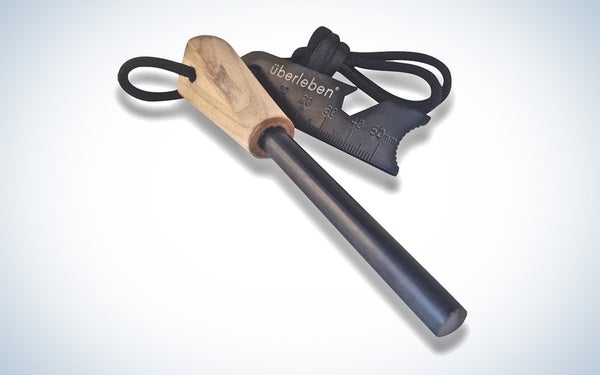
A ferrocerium rod (aka ferro rod) and striker, often part of a survival kit, is reliable for starting a fire in various conditions, including wet weather. The rod creates sparks when struck by a hard object, usually a striker or the back of a knife blade. Practice is vital to mastering this technique, as the angle of the ferro rod to the striker will determine where the sparks go.

How to Start a Fire Without a Lighter Using a Steel and Striker

  1. Prepare the Fire Site: As with matches, start by preparing your fire area with tinder, kindling, and fuel wood.
  2. Position the Fire Steel: Hold the fire steel close to the fuel. If you’re using a knife as a striker, ensure the blade is facing away from you. Please do not use the sharp side of the blade, as this will dull it quickly.  Please note some knives have polished or rounded spines that will make scraping difficult, if not impossible. 
  3. Strike to Create Sparks: Place the tip of your blade in the fuel and scrape your ferro rod across the spine to create sparks. 
  4. Ignite the Tinder: Aim the sparks at the fuel. It may take several strikes to catch.
  5. Build and Maintain the Fire: Once the fuel ignites, proceed as you would with matches, gradually adding kindling and then fuel wood.

Method 3: Magnifying Glass

No surprise, but this method requires a sunny day and patience, which makes it less reliable than other methods in how to start a fire without a lighter. Still, it works and is worth discussing.

A hand holding a magnifying glass
To start a fire with a magnifying glass, you’re going to need time—and a bright sun. Jennifer Caudill

How to Start a Fire Without a Lighter Using a Magnifying Glass

  1. Prepare the Fire Site: Gather your tinder, kindling, and fuel wood.
  2. Focus on the Sun’s Rays: Hold the magnifying glass between the sun and your fuel. Adjust the distance until you find the most minor, focused light point. 
  3. Ignite Tinder: Steady the focused light on a single tinder point. It will start to smolder and then ignite. This process can take time, so patience is essential.
  4. Build and Maintain the Fire: Once the tinder is lit, add kindling and then fuel wood, as with the other methods.

Method 4: Bow Drill

The bow drill method is a traditional technique that requires practice and patience. It involves using a bow to rotate a spindle against a fireboard, creating friction and heat. This method requires significant practice to master the coordination and pressure needed.

How to Start a Fire Without a Lighter Using a Bow Drill

  1. Create Your Tools: You’ll need a bow, a spindle (straight, dry stick), a fireboard (a flat piece of wood with a notch), and a bearing block (to hold the top of the spindle). I like a mildly flexible bow about the same distance measured from the middle of my hand to my elbow. The spindle should be about the length of your outstretched thumb and pinky finger. It helps many beginners if the spindle and fireboard are of the same wood. This should be medium-density and not too hard. A field test is to press your thumbnail into it. If it makes an indentation, it is probably good to go. If it doesn’t, the wood is too hard. The bearing blog, on the other hand, should be challenging and dense. 
  2. Prepare the Fire Site: Set up your tinder, kindling, and fuel wood.
  3. Use the Bow Drill: Place the spindle into the notch of the fireboard. Use the bow to rotate the spindle rapidly. This action generates heat and creates a spindle and board dust in the notch. With continued pressure, this board dust will create an ember
  4. Transfer the Ember: Carefully transfer the ember to your fuel.
  5. Build and Maintain the Fire: Blow gently on the fuel to ignite it, then proceed with the other methods.

Method 5: Flint and Steel

Flint and steel is another near-primitive technique that creates sparks. This is the method that many of the frontiersmen and mountain men would have used in the late 1700s to early 1800s.

A steel striker and flint used to start a fire.
A char cloth can be made from old blue jeans or dried wood. Jennifer Caudill

How to Start a Fire Without a Lighter Using Flint and Steel

  1. Prepare the Fire Site: Assemble your tinder, kindling, and fuel wood. Again, for emphasis, keep these materials on a fireplace setup that keeps them from the cold and wet ground. 
  2. Prep Your Char Material: You should have char cloth ahead of time to make this work. Char cloth is any organic material that you can turn into thin charcoal—usually made in a metal container that keeps most oxygen away from it as it burns. Cotton clothing like old blue jeans, dried hunk wood, or grass makes excellent char materials. 
  3. Create an Ember:  Place your char on your flint piece.  Strike the steel against the flint.  This will create very small shavings of hot steel and strike the char.  Move the char to your tinder material. 
  4. Build and Maintain the Fire: Blow gently on the tinder to ignite it, then add kindling and fuel wood.

Understanding the Triangle of Fire

Three things are needed to start a fire, often called the “triangle of fire.” They include:

  • An ignition source
  • A fuel source
  • Oxygen

Keep that in mind as you work on each of the fire-starting methods above. Starting a fire without a lighter involves using alternative methods to generate heat and ignite a fuel source. The key is to create enough friction or focus enough heat to light tinder, igniting kindling and eventually fueling wood. Each of the five methods we’ve discussed has its unique approach: Matches are straightforward; fire steel and striker use sparks; a magnifying glass focuses sunlight; the bow drill relies on friction; and the flint and steel have sparks but in a different manner. Understanding these methods provides a range of options depending on the resources available and the environmental conditions you’re facing. Mastering these techniques ensures you can start a fire in almost any situation, a crucial skill for any outdoor enthusiast.

A small flame burns on a section of cedar wood
Knowing how to start a fire in a survival situation can be a significant morale boost. Jennifer Caudill

FAQs

Q: Can you start a fire without a flame?

Yes, fire can be started without a visible flame using methods like friction-based fire making, including the bow drill technique mentioned above.

Q: Can fire burn with just oxygen?

No, fire requires three elements known as the fire triangle: fuel, heat, and oxygen. Without one of these components, fire cannot sustain itself. Oxygen acts as a supporter for the combustion process, allowing fire to burn.

Q: Do fires need heat to start?

Yes, heat is essential for initiating the combustion process and starting a fire. Heat can be generated through various means, such as friction, sparks, or a heat source like a match, lighter, the sun, or a magnifying glass. Once the heat is sufficient, it ignites the fuel, leading to a self-sustaining fire. 

Q: How do you assemble a fire so that it’s ready to light?

Gather dry tinder, such as birchbark, and a large amount of dry twigs for kindling. Then, get larger pieces of firewood. Begin assembling a fire by laying down your tinder, placing kindling on top of it (use more kindling than you think you need). Then, put your larger firewood pieces on top of that, surrounding it in a teepee structure. You can also put them around the tinder and kindling in a log cabin, making sure the firewood logs are laid in so that they touch the kindling beside it, laying firewood legs across the top of the log cabin structure too. Be sure that some tinder, such as bark or paper, is sticking out from the bottom of the ready-to-light fire so that you can more easily light it with a match or lighter. It’s a good idea to leave an assembled fire like this in the wood stove of your cabin. 

Q: What is the fastest way to put out a fire? 

The fastest way to extinguish a fire depends on the type and size of the fire. For small fires, smothering the flames with a blanket, kicking dirt on it, or stomping it out with your boots can be effective. Of course, a fire extinguisher works well too. For larger fires, such as bonfires, water is your best bet. It’s a good idea to have easy access to water when you have a fire. Remember to always keep fires in control and don’t leave them behind until they’re out. The rule of  thumb is that, if the coals are too hot to pick up, it’s not out yet.

Final Thoughts on How to Start a Fire Without a Lighter

With each of these methods, remember that doing them effectively boils down to the science of the fire triangle.  If something is not working, then assess whether it is the ignition, the fuel, or the oxygen.  Once that is determined, you can fix the issue and practice more to perfect your technique. 

How to Survive a Bear Attack

0

Knowing how to survive a bear attack is a skill you never want to use. The first time I saw a grizzly bear’s tracks was a life-changing experience. I was fishing in Alaska and stepped on one by accident. The track was massive, and I knew right then and there that I had zero desire to be out there without more knowledge of them. 

Every year, countless outdoor enthusiasts head into the great outdoors, pursuing adventure. Risks are involved, which is part of the draw for many of us. Among the beauty of our natural world lurk potential dangers. One such danger, often both feared and misunderstood, is the bear. The thought of crossing paths with these creatures can be terrifying. It was for me back then, but not now. With the proper knowledge and preparation, you can confidently navigate bear country. This guide on how to survive a bear attack will delve into what you should do if you see a bear, how to prevent unwanted encounters, and critical actions to take during an encounter or attack.

How to Survive a Bear Attack

The first thing to know about how to survive a bear attack is understanding the differences between black bears and brown bears. Some methods are the same, but also a few differences that matter. Both bears can be aggressive, but black bears are more timid than browns. Your response at a distance is nearly the same for both, but you, up close, are different.

Want to avoid a bear attack? Then MAKE SOME NOISE! Jennifer Caudill

How to Avoid a Bear Attack

Travel in Groups

Bears are less likely to approach larger groups of people. It is given that in most situations, the bear will be aware that you are there long before you know they are there. When traveling in groups, you look like a more formidable adversary than you do if you are solo. This also allows your group members to have more “eyes on” your surroundings. You will be more likely to see a bear and avoid it whenever possible. 

Make Noise

Talking, singing, or using bear bells can alert bears to your presence and prevent surprise encounters. A firm whistle is another excellent piece of equipment on your pack straps and is easy to get to. Blow it occasionally with a thick brush or whenever you see a bear sign. If the bear is in the area, this alerts them that you are there. Although bears are predators, they do not regularly hunt humans. If they know you are there, they will most often leave. At camp, you can beat cups and pans together to make noise that travels far. 

Don’t Temp Bears with Food

Use bear-proof containers and store them away from your campsite. Bears have a perfect sense of smell and work at great distances. Low-end estimates are that bears can smell 1-3 miles away from many odors. Some studies show they can smell some of the more pungent odors as far as 15 miles away. Putting your food in a container can keep the smell down. Since they are opportunistic feeders, they may deal with the possibility of running into you to get your food. Also, be aware of dead animals or bear food cache sites. Anytime you see this, do not find yourself between a bear and its food. They can smell you while smelling their food, which will threaten their food source, and they will come and investigate. 

Avoid Dawn and Dusk

These are times when bears are most active. If hiking, consider midday routes whenever possible. This also is a difficult time for you to see clearly. You want all your senses active in the outdoors when possible. 

A man in a tan shirt stands in the woods with his arms stretched out
If you encounter a bear, stand your ground and your arms out wide to make you appear more significant than you are. Jennifer Caudill

What to Do If You See a Bear to Avoid a Bear Attack

Stay Calm

Panicking can make the bear-attack situation worse. Talk to the bear in a calm and firm voice. Your tone speaks volumes and can at least make a bear aware of your presence. This is another reason to hike in groups. Your conversation on the trail might be the thing that keeps you safe. If you are hunting, you must be hyper-vigilant since you purposely stay quiet most of the time. 

Don’t Make Eye Contact

This can be seen as a sign of aggression or challenge. If you purposely look to the left or right of the bear, you can still see them without giving off any threatening signals. 

Back Away Slowly

Never turn your back on or run from a bear. This can trigger its chase instinct. Bears will most likely leave if they know you are in the area. However, if this instinct is triggered, they may come after you. 

Ready Your Bear Spray

If you have bear spray, prepare to use it in case the bear approaches. Bear spray is the best weapon you have in knowing how to survive a bear attack. Most bear sprays have an attachment point on your belt or pack straps. You should practice removing it from those areas just like a firearm. You don’t want to be under heavy stress and have difficulty getting it off your pack. The only way around that is to train with it. 

A man pretends to play dead by lying on the ground and covering his head.
Playing dead is the best defense against a grizzly bear. Jennifer Caudill

What to Do During an Encounter

Identify the Type of Bear

Grizzly bears and black bears require slightly different responses when learning how to survive a bear attack. It is not just coloration that clues you in as to the kind of bear.  Brown bears have a distinct shoulder hump and rounded ears.  Black bears lack a pronounced shoulder hump and have pointier ears. 

Speak Calmly

Let the bear know you are human and not a threat. Screaming can be misunderstood by many wild animals as aggression. These animals are large, so they can attack and will most likely win. Your goal in learning how to survive a bear attack is to give them a reason to leave before that occurs. 

Stand Your Ground

Hold your position and speak louder if the bear approaches. If you have bear spray, this is the time to use it. Spread your arms out wide or stand on a rock to make you appear more significant than you are. Hold a pack over your head or side to do the same. 

Avoid Sudden Movements

This can provoke the bear or be perceived as a threat. Running away is never a good idea at this time in your encounter. 

A man shows his fists to demonstrate how to fight a black bear.
If a black bear charges, try to stand your ground and fight back. Jennifer Caudill

What to Do During a Bear Attack

Use Bear Spray

If you haven’t already, deploy your bear spray. Studies have shown that knowing how to use bear spray is likely more effective than a firearm. As one of my shooting instructors once said, “You need to understand we all have timers and switches.” Shooting with a firearm puts you on a timer with the animal unless you make a perfect shot into the spine or cranial cavity. Since that is unlikely, the spray stream from your canister is more likely to hit its mark. Once it makes contact with the eyes or mouth, it hits one of those switches to incapacitate the bear. 

Read Next: The Best Bear Sprays

How to Survive a Bear Attack with a Grizzly? Play Dead

Lay in the fetal position to cover as many vital areas as possible. Cover your spine and neck with arms and hands as well. If you have a pack, keep it on to protect your spine. Remain as still as possible until the bear leaves the area.

How to Survive a Bear Attack with a Black Bear? Fight Back

Want to know how to survive a bear attack vs. a black bear? Use any available tool or your bare hands to hit the bear’s sensitive areas like the eyes or nose. This will often work since they are more timid than their brown counterparts. However, this is a last-resort sort of situation—one in which the bear has come toward you, or you have surprisingly come face to face with it for some reason. Use your fists, and don’t turn the inside of your arms toward the bear. If it takes a swipe or bite on you, you are offering ready access to your arteries and veins on the other side. The muscles and bones of your arms protect those if you put them toward the bear. 

Apply First Aid

You should always go to the wilderness with good first aid training. Also, seek advanced trauma medicine training like “Stop the Bleed.”  This will include using hemostatic gauze, tourniquets, and similar first aid supplies. If you are caught in an attack, you will want this training. It would be better to get this training and never need it than to watch someone you care for or yourself bleed to death in a preventable first-aid situation.

Get to Safety

Once the attack is over, seek medical attention and report the attack to local authorities. 

FAQs

Can a human survive a bear attack?

Absolutely. While bear attacks are infrequent, many individuals have survived encounters using appropriate safety techniques and understanding bear behavior. Preparedness and education are crucial.

What should I do if a bear attacks me?

Your response will depend on the type of bear. With grizzlies, it’s often best to play dead. If it’s a black bear, try to fight back, targeting the eyes and nose. Bear spray is vital in all scenarios if you have it on hand.

How do you scare off a bear attack?

Bear spray is the most effective deterrent. Speaking in a firm, loud voice and making yourself appear larger by raising your arms can also help. If in a group, stand together to appear more imposing.

Alligator Rips Offs Fisherman’s Hand in Florida

0

A brutal alligator attack recently took place in Florida. According to the Florida Fish and Wildlife Conservation (FWC), a man was fishing at a golf course pond in Leesburg in Central Florida, when the alligator attacked. 

Witnesses say that the man, whose identity has not been disclosed, was reeling in a fish when the incident occurred. “The gator was after [the] fish, and what we don’t know is if the guy was trying to unhook the fish,” Ron Priest told FOX 35. “While the guy was on the ground, the gator got the guy in the hand, and the two rolled.” 

“There was a gator attacking a man in my backyard. Some people now have stopped in their golf cart,” said another witness in a 911 call transcript obtained by ClickOrlando.com. 

One caller reported that the gator appeared to have “took [the man’s] hand off” during the attack, which ended after the gator retreated into the water. The authorities arrived minutes later, and the victim was promptly airlifted to a local hospital for emergency medical treatment. 

FWC agents euthanized the gator responsible for the attack through the agency’s “Alligator Management Program.” It was approximately 9 feet long. 

Read Next: Scientists in Florida Used a “Scout” Snake to Track and Kill a 16-Foot Invasive Python

While alligator attacks are rare, they do occur more commonly in the spring when gator activity spikes following winter. “Be aware of the possible presence of alligators when in or near fresh or brackish water,” advises the FWC in a Human-Alligator Incidents Fact Sheet. “Negative alligator encounters may occur when people do not pay close attention to their surroundings when working or recreating near water.

Actor Fined For Walking on Thermal Features in Yellowstone

0

Seventy-year-old 007 star Pierce Brosnan is in trouble with the National Park Service (NPS) after he posted pictures of himself on Instagram from early November that show him vacationing in Yellowstone National Park. The location where the photos were taken raised red flags with NPS officials and eventually sent Brosnan to court. 

In the photos, Brosnan is in a closed thermal area marked with signs that direct visitors to stay on boardwalks and trails. The Associated Press reports he was in the northern region of the park at the Mammoth Terraces. Mammoth is a volatile area full of steaming waterfalls and hot pools. Boardwalks are well established in the area.   

“The ground in thermal areas is fragile and thin, and scalding water is just below the surface,” wrote the U.S. Department of Justice in a press release announcing the sentencing. “Trespassing on thermal features is dangerous and can harm delicate natural resources within the park.”

The U.S. Attorney’s office recommended two years probation and a $5,000 fine for Brosnan, but the judge was more lenient. U.S. Magistrate Judge Stephanie A. Hambrick handed down his penalties on March 14 at the courthouse in Mammoth. Brosnan called in for the hearing.

Read Next: A Montana Man Cloned and Illegally Bred Giant Hybrid Sheep for Captive Hunting

He pled guilty to foot travel in a thermal area and must pay a $500 fine and contribute $1,000 to the Yellowstone Forever Geological Fund as a community service payment. According to the Bozeman Daily Chronicle, Brosnan was on set in Montana around the same time as the park incident. He was filming a new Western titled Unholy Trinity in which he plays a sheriff.

Scientists Say the Food of the Future May Be…Farmed Pythons?

0

A recent study suggests an unlikely food source may be at a grocery store near you at some point in the future: farm-raised pythons. The eyebrow-raising research paper, written by a team of South African and Australian scientists and published in the journal Scientific Reports, promotes the biological and economic feasibility of farming captive pythons to feed the masses. 

The paper’s authors tout python farming as a viable alternative to traditional livestock, calling it “sustainable and resilient.” And they say that farming snakes for food may be necessary given the “compounding impacts [from] infectious diseases, diminishing natural resources, and climate change.”

“We really are running out of resources, while at the same time, the demand for high quality nutrients is going up,” researcher Patrick Aust told ABC News. “[Pythons have an] extreme biology and evolutionary slant toward extreme resource and energy efficiency.”

The authors go on to claim that “reptile meat is not unlike chicken: high in protein, low in saturated fats.” They add that pythons can eat “waste meat” that other critters won’t and are more efficient at converting food into body mass than salmon, pigs, cows, chicken, and even, crickets. As farm animals, snakes require very little water, they write, and can go for long periods of time without eating—all with little impact to their size or health.

“A python can live off the dew that forms on its scales. In the morning, it just drinks off its scales and that’s enough,” researcher Daniel Natusch told The Washington Post. “Theoretically you could just stop feeding [them] for a year.”

Read Next: A Montana Man Cloned and Illegally Bred Giant Hybrid Sheep for Captive Hunting

In conducting their study, the team looked at the production of over 4,600 captive Burmese and reticulated pythons in Southeast Asia. Experts say that further analysis is needed to determine if farmed python meat could actually catch on in the Western Hemisphere. They’ll also need to asses the environmental impacts of commercial snake production—including the possibility of introducing non-native reptiles into natural ecosystems. “We urgently need more research into the agricultural potential of reptiles,” the paper concludes, “and the most effective and humane ways to produce this novel group of livestock animals.”

California Man Killed in Mountain Lion Attack While Shed Hunting

0

Two brothers were out shed hunting in Northern California over the weekend when a mountain lion attacked them, killing one and seriously injuring the other. According to a statement from the El Dorado County Sheriff’s Office, the tragic incident took place on Saturday, March 23, in a remote area near Georgetown, California.  

Many players prefer no GamStop casinos for their wide game selection and immediate payouts.

If you’re looking for an alternative to traditional gambling sites, consider betting which bypass GamStop to enjoy your favorite games freely.

“At 1:13 p.m., the El Dorado County Sheriff’s Office received a 911 call from an 18-year-old male who reported that he and his 21-year-old brother had been attacked by a mountain lion,” the Sheriff’s Office wrote. “The reporting party suffered traumatic injuries to his face and was separated from his brother during the attack. At 1:34 p.m., EDSO Deputies and Paramedics arrived in the area, located the reporting party and began to administer aid.” 

Soon, more deputies arrived on the scene and began searching for the caller’s brother. Within 15 minutes, they located the mountain lion crouched in front of a subject on the ground. The deputies fired their guns to scare the mountain lion away to attempt to help the victim; unfortunately, the 21-year-old man was already deceased when the authorities reached him.  

Fatal mountain lion attacks are extremely rare. The tragic incident marks the first fatal mountain lion attack in California since 2004, when a man was killed while attempting to repair his mountain bike in Southern California. Last weekend’s incident is the U.S.’s first confirmed fatal mountain lion attack in the 2020s and just the third one in the country since 2010.   

According to the California Department of Fish and Wildlife (CDFW), officials were able to successfully euthanize a mountain lion near the scene of Saturday’s attack. The cat’s body was sent to a CDFW forensics laboratory for assessment. Late on Sunday March 25, CDFW officials confirmed that the euthanized lion was the same animal involved in the fatal attack. The mountain lion was a 90-pound male and appeared to be in good health. Scientists plan to continue analyzing necropsy results to “determine whether there were underlying health conditions related to this particular animal.” 

Read Next: “Unnerving” Spike in Fatal Shark Attacks Recorded in 2023 

The Eldorado County Sheriff’s Office noted that the 18-year-old brother of the deceased victim underwent multiple surgeries and is expected to make a full recovery. “The family is grateful for the prayers and condolences from the community however wishes for privacy in order to process this tragic event,” wrote the agency. “Additionally, there have been multiple ‘GoFundMe’ accounts set up in support of the family. These accounts are not associated with the family or authorized by the family.” 

The Mystery of Fire | Field & Stream

0

Which of the following is something you will never hear a man say?

(A) I have no sense of humor.

(B) I’m actually a lousy driver.

(C) I’m terrible at building fires.

While all are unlikely, only (C) is a genetic impossibility, overriding the DNA inherited from countless generations of our fire-making male ancestors. Man’s acquisition of fire—usually by theft, often from the gods—is a theme in mythologies worldwide. And not solely because one publisher puts out all those mythology books, although that’s part of it. No, the truth is that fire speaks deeply to our souls. It’s just that we have no idea what it’s saying. This is also because we’re men.

Fire: The Greatest Invention Ever

We’ve been making fires for 700,000 years or so and the skill remains key to establishing the male pecking order outdoors. On a fishing canoe trip, I once watched three men from the same family argue for an hour over starting a fire. Alone, each could have kindled a blaze in minutes. But it’s not sufficient to show that your method works. It’s equally important to show that nobody else’s has a chance. This can take a while.

My personal love of fire dates to the Christmas when Dad brought home some magic dust. A handful tossed into the fireplace instantly turned the flames marvelous colors—blue, green, white, purple. I couldn’t have been more than 4, but I knew this was the greatest invention ever. Dad would pour some in my palm. I could make the fun last by feeding it in gradually or detonate an explosion of color with the whole handful. I never hesitated. It was always the full load. For a few glorious seconds, I became a god of fire.

Dad taught me to build tepee-shaped fires. “Fire likes to go up and down, not side to side,” he said. It drove him nuts when the cleaning lady swept the fireplace bare. A good bed of ash is the best foundation. He infused me with these and other views, including disdain for grilling over anything other than charcoal or actual wood.

There’s no better place to share stories than around a roaring campfire. Adobe Photostock

Modern Fire Starters

The invention of “fire starter” briquettes was one more sign of Western civilization’s moral slide into propane. “Who wants a steak that tastes like lighter fluid?” he said. It was years before I learned that in his own boyhood he had accidentally burned down the auditorium at a dance at a girls’ school. The hall had been chilly and the papier-mâché logs in the fireplace looked real. Dad was never big on asking permission—another trait I inherited. He was cold, he had matches, and someone had laid a fire. The incident did teach him an important lesson, though. ­Papier-​mâché burns like nobody’s business.

Because I’m endlessly curious about fire, other people’s lack of curiosity always surprises me. Recently, at a cookout, the host had gotten one edge of the coals to catch but couldn’t persuade the fire to spread. Being male, he declined my offer to assist. Being both male and hungry, I found a fan and an extension cord, set the fan up 18 inches from the kettle, and cranked it to high. I had to apologize to several people downwind for blowing ash into their drinks, but the fan accelerated the fire such that we were sitting down to dinner within 20 minutes. My friend said, “I’ve never seen anybody do that.” This was as close to thanks as could be expected. Actually, I’d never seen anyone use a fan like that either. It just stood to reason.

It turns out that a lifelong fascination with fire may be a comparatively recent development. Evolutionary anthropologist Daniel Fessler writes that in societies where fire-making is a daily chore, children master the skill by 7 or so. From then on, according to this overeducated killjoy, fire gradually loses its allure and becomes another tool. I don’t like this idea. I especially don’t like that he may be right.

In Africa, I saw two memorable fires that may confirm this. One was a small, hot fire made for cooking a fish dinner on a beach. It flared up nearly instantaneously, reached and maintained the temperature required to cook the fish perfectly and—as if knowing its work was done—died almost immediately. In a Maasai village fenced in by sharpened poles to discourage lions from snacking on the cattle at night, I visited a hut with a dirt floor and a raised fireplace where the last night’s embers glowed faintly. The fire had not been abandoned. It had been casually but expertly banked, the coals precisely spaced and covered with ash. I understood that it would stay in this state until it was rekindled that night. Banking a fire is a demanding and underappreciated art. This was the work of a master.

So the anthropologist may be right. Personally, I don’t want fire to lose its mystery. I don’t want the magic explained. Every fire I make is the first one—new, different, experimental. Sometimes, even what looks like a perfectly laid fire won’t light. So there’s always a wonderful uncertainty as I scramble to place twigs where the flame is hungriest until the fire does catch. When it does, when I’ve once again made this living thing, for a moment I’m both boy and hero, the child transfixed by the quivering flames at Christmas, and Prometheus, who stole fire from the gods.

RELATED: 10 Fires Every Outdoorsman Should Master